
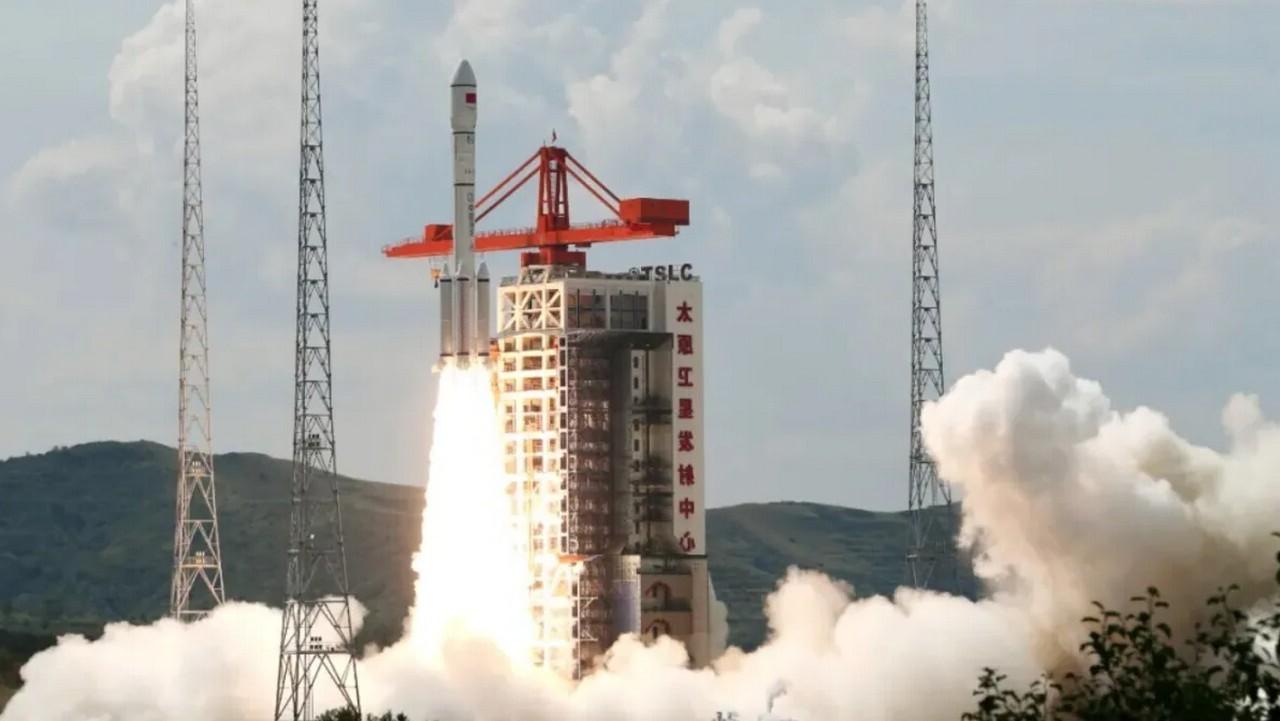

In early August, China launched the first 18 satellites of its constellation called Qianfan (thousand sails) which aims to provide high-speed Internet access and possibly military applications.
But while Qianfan could ultimately have more than 14,000 satellites in low Earth orbit, astronomers are sounding the alarm.
Excessive brightness at the zenith
In a study published on the arXiv server, a group of astronomers, some of whom are attached to the Center for the Protection of Dark and Quiet Skies from Satellite Constellation Interference of the International Astronomical Union, warn of the excessive brightness of the first Qianfan satellites which presents a significant risk for astronomical research and observation of the night sky.
By studying the change in brightness of the satellites as a function of their elevation, the group of experts concluded that the variation ranges from magnitude 8 when the satellites are low on the horizon to magnitude 4 when they are near the zenith. .
The Qianfan constellation will be deployed in an orbit between 500 and 300 km altitude
However, they explain, this magnitude of 4 is brighter than the limit of magnitude 6 from which celestial objects are visible to the naked eye. Therefore, these satellites could be visible in the night sky and disrupt astronomical observations.
According to the study, this first series of satellites is placed in polar orbits inclined 89 degrees relative to the Earth's equator, at an altitude close to 800 km. But it is planned that most of the Qianfan constellation will be deployed in lower orbits, between 500 and 300 km altitude, which raises fears of an increase in their brightness.
Establish a dialogue between operators and astronomers
Astronomers anticipate an even more negative impact with saturation of telescope images which would no longer correctly perceive less luminous celestial objects. They call for communication between satellite constellation operators and the astronomical community in order to find solutions to minimize the impact of these satellites on sky observation.
From the observations made and in the absence of technical information on the configuration of these satellites, astronomers have deduced that they have a single solar panel, an orientation with the base towards the Earth (communication antennas pointing towards the low) and an absence of reflective surfaces to minimize light pollution.
The previous Starlink
This problem is not new. For years, astronomers have been pointing out the inconvenience caused by SpaceX's Starlink satellites. However, Elon Musk's company would have taken into account feedback from astronomers and made technical modifications which tend to alleviate the problems of excessive brightness.
“ SpaceX changed the design of its Starlink satellites because early observations showed their Generation 1 spacecraft would impact astronomy. This is what motivates us to present the first results for Qianfan », We can read in the study.
It remains to be seen whether Shanghai Spacecom Satellite Technology, the designer of the Qianfan satellites, will take these remarks into account.

With an unwavering passion for local news, Christopher leads our editorial team with integrity and dedication. With over 20 years’ experience, he is the backbone of Wouldsayso, ensuring that we stay true to our mission to inform.


