

[Un article de The Conversation écrit par Mathieu Beraneck – Directeur de Recherche CNRS en Neurosciences, Centre national de la recherche scientifique (CNRS), Université Paris Cité, George Washington University]
What happens in our brain when we vacillate for no apparent reason, and even standing seems so difficult? Behind these sensations hides a system as precise as unknown: the vestibular system, and the organs of balance nestled in the inner ear. The brain, constantly on alert, uses these vestibular sensations with vision and proprioception – these sensations of the body from muscles, tendons, skin – to maintain balance and orient us in space, even in extreme situations: darkness, transport, weightlessness.
How does the sense of balance work, and especially what happens when you are dizzy?
Balance, from the inner ear to the brain
Appeared very early in the evolution, even before the cochlea, the vestibular system is very preserved in vertebrates. In humans, its organs are ten: five in each ear!
Three semi-circular channels detect the rotations of the head, while two Otolithic organs detect linear accelerations and, a little like a lead wire, orientation in relation to gravity. When we move our heads, the movement stimulates ciliated cells which, like seaweed in the sea, move jointly by activating the vestibular nerve (VIII nerve, vestibulo-cochlear), thus transforming a movement into a nervous influx.

This information joins the brain at the cerebral trunk (which brings together many essential functions for survival, such as the regulation of breathing, heart rate, sleep). Information from the inner ear is important for balance, but also for other reflex functions such as stabilization of the gaze and posture, and more cognitive functions such as the orientation and perception of its body in space, or even navigation, and in general for the ability to live in your body and to be in a physical, but also social environment.
The cerebral trunk vestibular neurons merge vestibular information with other visual and proprioceptive sensory information. The sense of balance is therefore in fact a “multi-sensory” function: it is much more difficult to stand with your eyes closed, or bare feet on a foam carpet. Other information from the cortex, the cerebellum, the spinal cord also comes to modulate the activity of vestibular neurons and therefore participate in creating the feeling of balance.
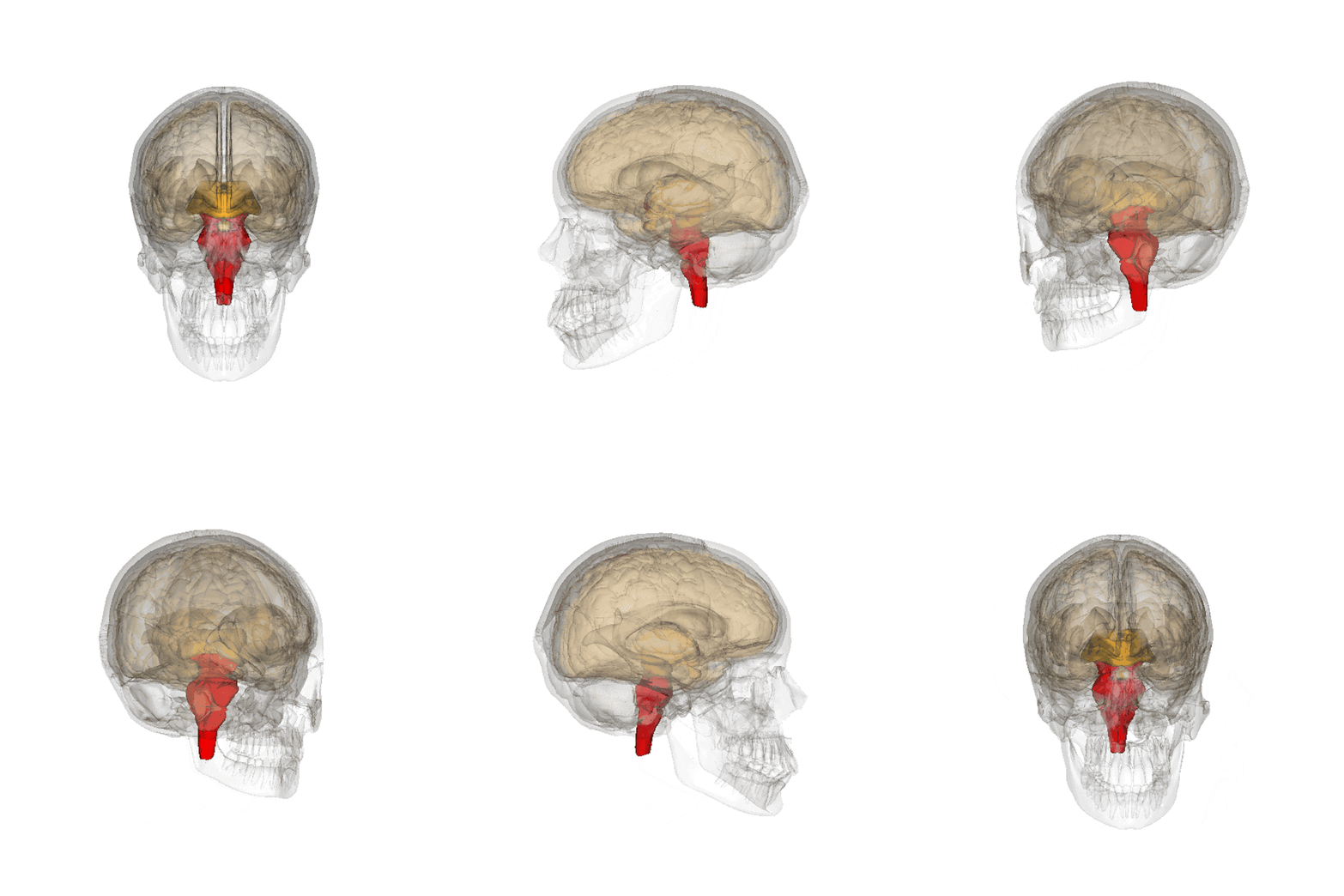
It is also interesting to note that balance is a “hidden” meaning. Indeed, the inner ear does not create a conscious sensation: one is aware of seeing, hearing, feeling, but one does not feel in balance. Balance is such an essential function that the brain milks it in a background task, in a reflex manner, in order to allow us to go about our occupations without having to constantly think about standing. It is only in unstable situations that we become aware of the precariousness of our bipedia: we actually have an unconscious meaning of the balance that becomes – if necessary – a conscious perception of the imbalance!
How do dizziness occur?
The dizziness appears when the brain receives discordant information, and can no longer properly determine if the body is stable, in motion, or if it is the environment that moves.
At rest, the two vestibules are constantly sending the cerebral trunk of the balanced signals. During movements in one direction, one side sees its activity increased, and the other diminished. The brain deduces the rotation of this differential activation. When, due to a pathology, dizziness occurs, the signals of the two vestibular complexes become asymmetrical even at rest: this erroneous neural signal therefore leads to an illusion of movement, and to postural reflexes generated to counterbalance these dizzying sensations.
Depending on the pathologies, vertiginous sensations can be very variable. However, they always reflect the fact that there is an imbalance which, coming from the inner ear or from another part of the central nervous system, now prevents the brain from correctly referenced the position and movements of the body in space.
With age, all of the systems involved in balance lose precision: visual and proprioceptive acuities decrease, as well as muscle strength, and often activity decreases. From this globally less precise information, it becomes more difficult for the brain to control the position of the body in space. The risks of falling, with their potentially dramatic consequences, increase.
For dizziness patients, whatever their age, the loss of control is scary: standing or walking becomes a dangerous and exhausting task.
A silent epidemic and persistent obstacles for management
The causes of vertigo and balance disorders are varied: neurological pathologies (trauma, stroke, multiple sclerosis), affected by the inner ear (Benin positional vertigo, Menière, Labyrinthitis disease), vestibular nerve (neuritis, neuroma), or cortex (vestibular migraine). The diagnosis is based on clinical examination and interrogation, but the diversity of causes complicates management.
The vestibular rehabilitation led by specialized physiotherapists helps the brain to compensate for erroneous signals by relying on visual and proprioceptive sensory information (we speak of sensory substitution), and on voluntary engine control, restaurants thus confidence in movement.
Indeed, research carried out in recent years has shown that during voluntary movements, the brain can predict, to anticipate the consequences of movement and in so that making the vestibular coding make: to continue to move and solicit your body and its brain is therefore essential to help resolve dizziness.
Although there are a few specialized ENTs and physiotherapists vestibular for this type of rehabilitation, caregivers are generally insufficiently trained with vertigo, and the functional exploration and specialized care centers are too few, and geographically poorly distributed. This situation often leads to long diagnostic wandering: several months, even years, can separate the first symptoms and the patient's effective management.
Another difficulty, the vestibule is difficult to observe: small vestibular organs are housed in the temporal bone and little accessible to the examination. Medical imagery is progressing but it remains the prerogative of the rare specialized centers. Hence an urgent need to better inform, train, structure the care path, and invest in innovative research and treatments.
A need for basic research and promising research avenues
The CNRS “vertigo” research group has brought together ENT for ten years, neurologists, radiologists, physiotherapists and researchers to improve understanding of pathologies and thus the care of patients. This improvement will go through a better description of the pathophysiological mechanisms: in the majority of cases, the initial causes of the disease remain unknown.
Researchers are working to develop models such as organoids, cultivation cells reproducing certain aspects of an organ (here the inner ear organs) for pharmacological tests. They also develop animal models which make it possible to understand the cellular and multisensory mechanisms of vestibular compensation, or to reproduce genetic diseases at the origin of congenital deafness and balance disorders in children, in order to develop new therapeutic options such as gene therapy.
Initiatives are also underway to perpetuate this research via regional groups, such as in Île-de-France the “Vestibular Paris” pole, and the upcoming implementation at the national level of a research institute on balance and vertigo that will pursue the dynamics created within the community of caregivers, researchers and teacher-researchers in vestibular otonology.

With an unwavering passion for local news, Christopher leads our editorial team with integrity and dedication. With over 20 years’ experience, he is the backbone of Wouldsayso, ensuring that we stay true to our mission to inform.


