

[Un article de The Conversation écrit par
Joshua Pate – Senior Lecturer in Physiotherapy,
University of Technology Sydney – Dale J. Langford
– Associate Professor of Pain Management Research in
Anesthesiology, Weill Cornell Medical College, Cornell University
& Tory Madden – Associate Professor and Pain
Researcher, University of Cape Town]
As she hugged her arm in the emergency room, my daughter said to me, “It really hurts.” » — “On a scale of zero to ten, how much do you rate your pain?” », asked the nurse. My daughter's tear-stained face then expressed intense confusion. — “What does that mean, ten?” ”, she asked. — “Ten is the worst pain you can imagine. » She looked even more disconcerted.
I am his father and as such but also a pain specialist, I was able to see on this occasion to what extent the pain assessment systems that we have, although designed with good intentions and apparently easy to use, sometimes prove to be very insufficient.
Pain scales
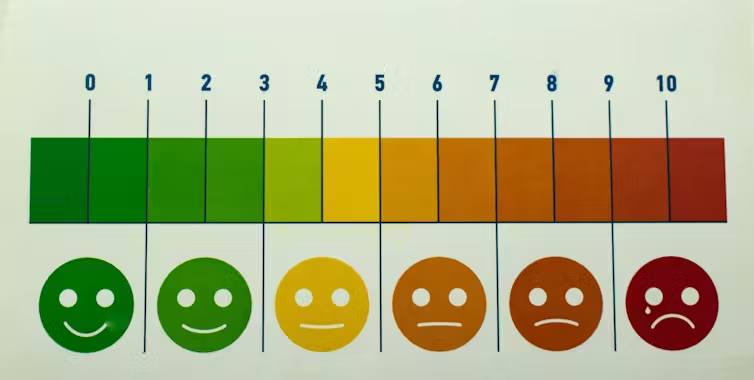
The scale most commonly used by caregivers to assess pain has been around for around fifty years. Its use requires asking patients to rate their pain by assigning a number from 0 (“no pain”) to 10 (usually “the worst pain imaginable”).
This assessment method focuses on a single aspect of pain – its intensity – to try to understand as quickly as possible what the patient is feeling: how much does it hurt? Is the pain getting worse? Does the treatment alleviate it?
Such rating scales may be useful for monitoring changes in pain intensity. If the pain goes from 8 to 4 over time, that means the patient is probably feeling better – although the intensity 4 felt by one individual may not be exactly the same as that felt by another person.
Research suggests that a two-point reduction (30%) in the severity of chronic pain generally corresponds to a change that results in a significant difference in the daily lives of sufferers.
But it is the upper limit of these scales – “the worst pain imaginable” – that poses a problem.

A tool too limited to account for the complexity of pain
Back to my daughter's dilemma. How does anyone imagine the worst possible pain? Does everyone imagine the same thing? Research suggests no. Even children have a very personal interpretation of the word “pain”.
Individuals have a tendency – understandably – to anchor their evaluation of pain in experiences they have had in the past. This creates considerable variation from one person to another. Thus, a patient who has never suffered a serious injury may be more likely to give high ratings than someone who has previously suffered severe burns.
The “no pain” statement can also be problematic. A patient whose pain has reduced but who remains uncomfortable may feel paralyzed when faced with this type of scale, because it does not include a number from 0 to 10 which accurately reflects their physical feelings.
More and more pain specialists are recognizing that a simple number cannot account for an experience as complex, multidimensional and eminently personal as pain.
Our identity influences our pain
Various factors influence how we evaluate pain: the extent to which it disrupts our activities, the degree of anxiety it causes, our mood, our fatigue, or even how said pain compares to what we are used to feeling.
Other parameters also come into play, including the patient's age, gender, level of literacy and numeracy, and cultural and linguistic context. If the caregiver and the patient do not speak the same language, communication around pain and its management will prove even more difficult…
Another difficulty: some neurodivergent people may interpret language more literally than average, or process sensory information differently than others. Understanding what people express about their pain then requires a more individualized approach.
“Impossible” quotes
However, we must make do with the tools we have. Research has shown that when patients use the scale of 0 to 10, they attempt to communicate much more than just the “intensity” of their pain.
So, when an individual says “my pain is 11 out of 10,” this “impossible” rating probably goes beyond a simple assessment of the severity of their suffering. This person may be wondering, “Does this caregiver believe me?” What number will allow me to get help? » In this single number is condensed a large quantity of information. It is very likely that the number stated actually means: “The situation is serious. Help me, please. »
In everyday life, we use a multitude of different communication strategies. To express our feelings, we can moan, change the way we move, use vocabulary rich in nuances, use metaphors… When it comes to assessing a level of pain, collecting and evaluating such complex and subjective information is not always possible, because it is difficult to standardize it.
As a result, many researchers working on pain continue to rely heavily on rating scales. Indeed, they have the strengths of being simple, quick to present, and having proven to be valid and reliable in relatively controlled contexts.
Clinicians, on the other hand, can use this other, more subjective information to form a more complete picture of the person's pain.
How to better communicate about pain?
To mitigate the effects that differences in language or culture can have on the way of expressing pain, different strategies exist.
The use of visual scales is one. The “Faces Pain Scale–Revised (FPS-R)” asks patients to choose one of several facial expressions on a document to communicate their pain. It can be particularly useful when it comes to assessing the pain of children, or that of people who are uncomfortable with numbers and reading (either in general, or because they do not master the language used in the healthcare system that takes care of them).
The vertical “visual analogue scale” requires one to indicate one's pain on a vertical line, a bit as if one were imagining that it was gradually “filled” by pain).
(In France, the scales considered valid for measuring pain have been listed by the High Authority of Health (HAS), NdT)
Who can improve things, and how?
Healthcare professionals
Take the time to correctly explain to patients the principle of the chosen pain rating scale, keeping in mind that the formulation of the limits (0 to 10) is important.
Pay attention to the story the number the person gives is telling, because a single number can mean very different things from one person to another.
Use the quote as a starting point for a more personalized exchange. Take cultural and individual differences into account. Ask patients to use descriptive vocabulary, and check with them that your interpretation is correct, to be sure you are talking about the same thing.
Patients
To better describe your pain, use the numerical scale provided to you, but add context. Try to describe your pain (is it a burn? A throbbing? Does it feel like a stab?), and compare it to past experiences.
Explain the impact pain has on you – not only emotionally, but also on your daily activities.
Parents
Ask caregivers to use a child-friendly pain scale. There are specific tools, for different ages, such as the “face scale”.
In pediatric services, caregivers are trained to use vocabulary adapted to each stage of the child's development, because the understanding of numbers and pain does not evolve in the same way in everyone.
Ladders, a simple starting point
Pain rating scales will never perfectly measure pain. They should be seen as conversation starters, intended to help people communicate a deeply intimate experience to another.
That's what my daughter did. She found her own words to describe her pain: “It's like when I fell off the monkey bars, but into my arm instead of my knee, and it doesn't lessen when I stay still.” »
From this starting point, we were able to begin to move towards a treatment allowing effective management of his pain. Sometimes words work better than numbers.

With an unwavering passion for local news, Christopher leads our editorial team with integrity and dedication. With over 20 years’ experience, he is the backbone of Wouldsayso, ensuring that we stay true to our mission to inform.


