

[Un article de The Conversation écrit par
Marie-Hélène Moncel – Archéologue, Muséum national d’histoire
naturelle (MNHN)]
Working on the first settlements of Europe, I have focused my work with my colleagues for several years on the roots of Neanderthal behavior. The ANR NEANDROOTS project, which started at the end of 2019, made it possible to approach in a multidisciplinary manner a major period in human history dating back more than 400,000 years.
Go back 450,000 years
Genetic and anatomical data on fossil human remains show that Neanderthal traits emerged little by little between 600 and 450,000 years ago through the isolation of human groups occupying Europe and grouped under the termHomo heidelbergensis. Neanderthal is therefore a European. This man presents anatomical characteristics which distinguish him very clearly from Homo sapiens. For example, it is more robust and its skull does not have a forehead or chin.
Around 450,000 years ago, a long temperate or interglacial period began. It followed a long and severe ice age which reduced habitable areas and depopulated the north-western part of Europe.
Before this long interglacial, traces of human occupation exist, even if they are sporadic, but do not really allow regional entities to be distinguished. From this long interglacial period, prehistoric sites, providing tools and animal bones, became more numerous. They record behavioral changes with technical innovations in tool manufacturing methods. They also offer the possibility of describing modes of subsistence using the skeletal remains of consumed animals which show that hunting is developing at the expense of scavenging on animals that died naturally or were killed by carnivores. Traces of outbreaks are increasing, attesting that the fire is under control and reproducible. The reasons underlying these major changes, and this is the objective of this project, remain to be identified.
Has the long temperate climatic stability (25,000 years whereas usually 10,000 years) allowed the development of these innovations, and therefore an environmental adaptation to changes in climatic cycles? The habitable zones then cover a large part of Europe, both the south and the northwest. An interglacial period of such duration after a severe glaciation could have favored the vegetation and occupation of Europe. Vegetation is one of the key elements, which determines the availability of biomass for large herbivores and affects the mobility of human groups and perhaps their demographic expansion, and therefore the diffusion of innovations.
Was this behavioral evolution rooted in previous traditions having persisted despite the long ice age and developing thanks to this long climatic phase, in parallel with the development of Neanderthal anatomical traits?
As part of this interdisciplinary project, we attempt to answer these questions. A vast database has already been created to review all the occupations of the period. The objective is to characterize innovations using a common methodology, fill gaps in chronological and environmental data and develop methodological approaches to identify possible regional strategies and models for the diffusion of innovations. And, among other things, test the impact of climate change on human adaptation using the iLOVECLIM climate model and eco-cultural niche modeling (ECNModelling).
The many Neanderthal tools
The comparison of tools through cladistics (study of the relationships of living beings and the reconstruction of kinship relationships between them), usually used in biology, allowed us to quantify innovations and identify them spatially and chronologically in various points in Europe. For example, we were able to demonstrate that the emblematic “Levallois” debitage, which makes it possible to predict in advance the shape of the tools, a true technical revolution, seems to appear in several distant points at the end of the long glacial period around 450,000 years ago and to spread little by little, favored by the extension of habitable territories. The men prepare a block by cutting it in an organized manner and this preparation, which we call “Levallois” (first described in France, in the Paris region), makes it possible to predict the shape of future removals from the block and therefore the tools.

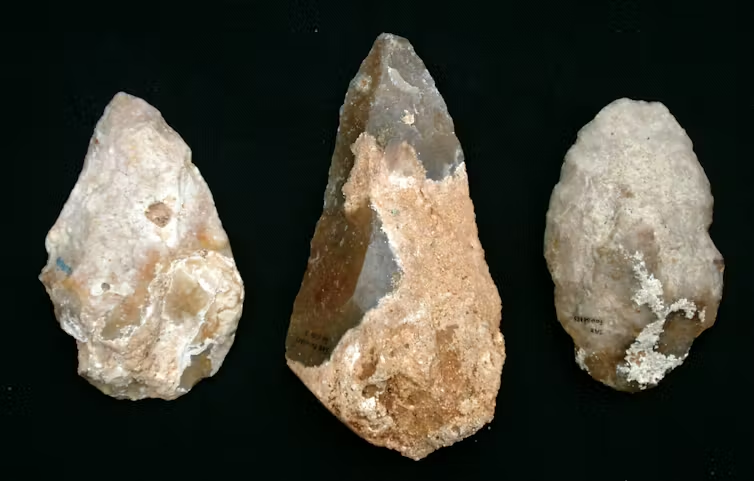
In other studies, we show that certain technical innovations are rooted in previous periods and have therefore persisted, but through modification, such as the way of making bifaces (large pointed tool with an arrangement on both sides) which becomes more elaborate or gives summary residual tools.
Comparing sites on a regional scale allows us to spatially identify networks of sites which certainly favored the circulation of human groups and innovations. We are facing the oldest evidence of regionalization in Europe, namely the establishment of regional traditions where men produce similar types of tools or use the same methods of producing these tools.
Some of these regional entities show originality through the proven use, for example, of bone to make tools, as in the Ceprano basin, near Rome in Italy. With Italian colleagues, we identified bone fragments of large herbivores, such as those of elephants, which were recovered to be retouched and obtain various tools, in association with stone tools. Bone is rarely used in general in these periods and its more systematic use in this case could be a marker of these human groups occupying these volcanic basins.
Concerning climatic data, the analysis of an ocean core off the coast of Spain and pollens having been trapped in marine sediments made it possible to clarify the modalities of the climatic transition between the glacial phase and the beginning of the long interglacial. The transition is rapid, abrupt, and climatic conditions quickly become temperate in Western Europe, a factor undoubtedly favorable to the populations. Thus, through “Eco-Niche modeling”, comparing the distribution of technical traditions and sites with the maps of territorial extension during this long interglacial and detailed climatic data allows us to test models of diffusion of innovations/inventions in relation to environmental data and the size and demographic structure.
Understanding this period in detail is not only a way to understand what characterizes Neanderthal compared to other hominins who lived before him and to modern humans, but also a way to construct models of human responses to varied (and new) environments depending on the latitudes.
Europe is a vast laboratory with climatic variations between North and South and the cyclical extension of glaciers shaped the landscapes and the extension of habitable zones during the Quaternary. These models are based on the disappearance and acquisition of tools and expertise retained for successful adaptation, on understanding the mechanisms of cultural transmission over time and the processes by which innovations or inventions spread, are maintained or evolve.
In fact, we are working on the resilience of populations to environmental changes, a current topic. Neanderthals and their ancestors persisted and adapted to varied environments. Our results indicate that they were able to find varied technical and behavioral solutions, amplified during a long temperate period. The reasons for their disappearance will perhaps one day be found in their past. These reasons are certainly multifactorial, combining the strong climatic instability recorded during a short period between 40,000 and 30,000 years ago not allowing them to find adaptive solutions and/or the probable small size of human groups as indicated by recent analyzes of fossil DNA.

With an unwavering passion for local news, Christopher leads our editorial team with integrity and dedication. With over 20 years’ experience, he is the backbone of Wouldsayso, ensuring that we stay true to our mission to inform.


