
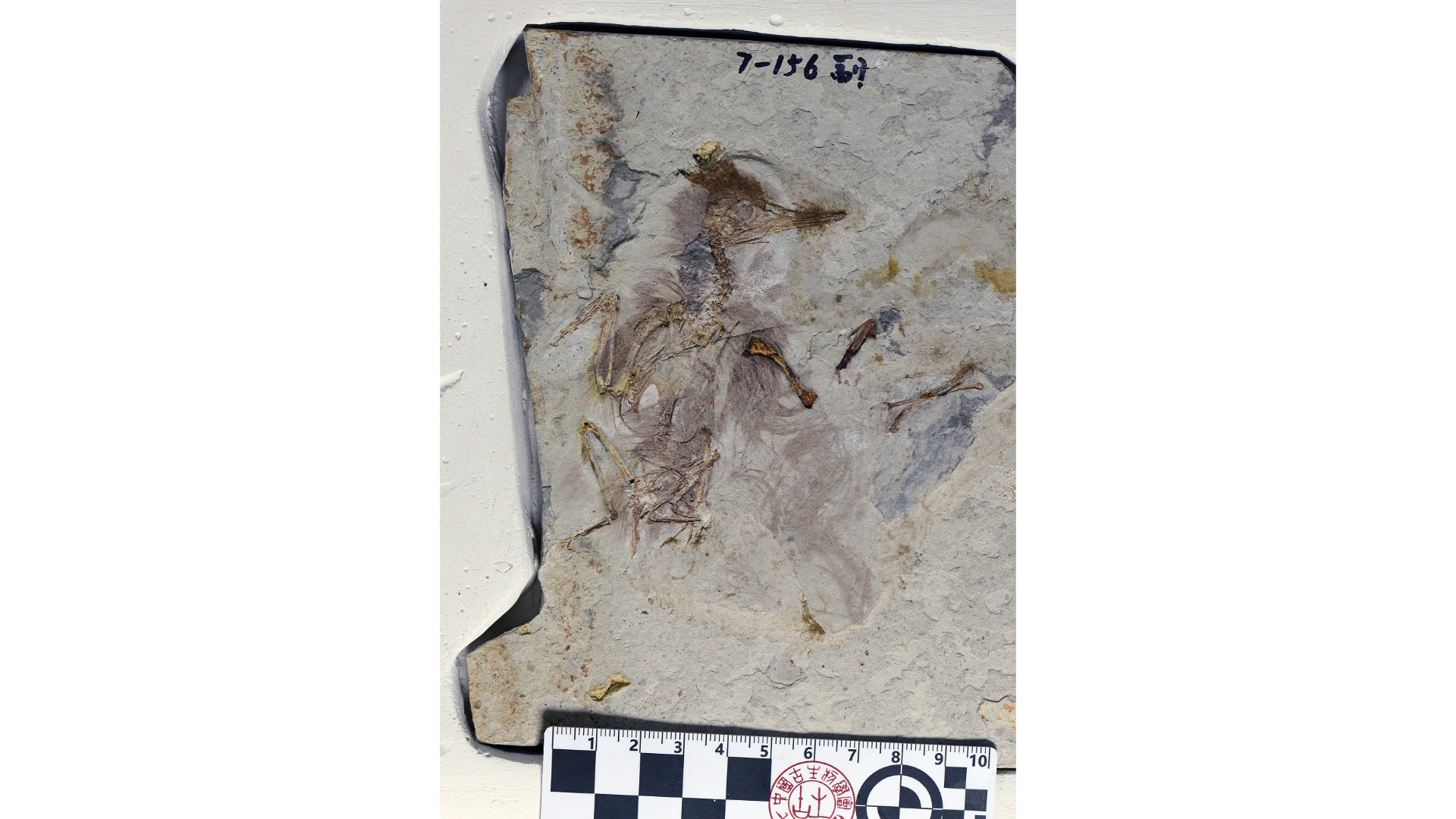
Among the countless vestiges of the past buried beneath the sediments, certain fossils resist oblivion by telling more than just the story of an extinct species. They capture a moment, a gesture, sometimes even a cause of death. This is the case of this bird fossil discovered in a Chinese museum, whose posture and internal content overturn certainties about the behavior of Cretaceous species.
An unusual find in the heart of a Chinese museum
While wandering the aisles of a museum in Shandong, China, paleontologist Jingmai O'Connor stopped short in front of a rock fragment the size of a sparrow. Stuck in the windows of the Tianyu Museum of Nature, the specimen, seemingly ordinary, nevertheless displayed unusual characteristics. Small sharp teeth at the end of the beak recalled another extinct species,
Longipteryx, but the rest of the skeleton told a completely different story.
The fossil, named Chromeornis funkyi in homage to the electro-funk group Chromeo, did not only surprise with its appearance. By examining it under a microscope, the team from the Field Museum in Chicago spotted a compact, dark mass lodged in the esophagus. A striking image, as if frozen in his last breath.
By analyzing the position and chemical composition of these elements, the researchers quickly concluded that they were not natural deposits. There are more than 800 small stones that the animal had indeed ingested during its lifetime. This discovery, reported by Gizmodo, represents an unprecedented case in collections of bird fossils from this era.

What the bird fossil says about the limits of adaptation
The phenomenon of gastrolithia, that is to say the voluntary ingestion of stones to facilitate digestion in the gizzard, is well known in modern birds. Species like chickens or ostriches use it to grind food. But Chromeornis clearly did not fit into this pattern. The comparative study carried out by Jingmai O'Connor's team showed that the quantity, distribution and texture of the stones did not match any of the criteria observed in other gastrolith fossils.
Some of these small masses weren't even real rocks. Their density, close to that of clay, suggests that they would have had no mechanical use in the animal's digestive system. Above all, their massive presence, concentrated in the esophagus, makes the hypothesis of natural storage highly improbable. This bird fossil thus testifies to aberrant behavior, perhaps triggered by a pathological condition.
Modern birds with digestive or neurological disorders can also swallow objects compulsively. The hypothesis of excessive ingestion followed by an unsuccessful regurgitation attempt emerges. Too large a mass would have ended up obstructing the airways. A scenario as rare as it is tragic in the fossil record.
When paleontology sheds light on the risks of current biodiversity
Chromeornis belongs to a now extinct group called the enantiornithines. These Late Cretaceous birds dominated the air before the fall of an asteroid 66 million years ago caused the extinction of the vast majority of species, including non-avian dinosaurs. Only the ancestors of modern birds went through this crisis.
Understanding why certain lineages survived while others foundered remains one of the big questions in paleontology. In this quest, the case of Chromeornis
plays an unexpected role. It reveals not only the behavioral diversity within prehistoric birds, but also their vulnerability to internal disturbances.
This bird fossil frozen in stone reminds us that evolution does not only select the most adapted, but also the luckiest. Unusual behavior, physiological fragility, environmental disturbance, so many factors which, combined, can tip a species over the edge. What if the story of this little Cretaceous bird made it possible, ultimately, to better understand the issues surrounding the conservation of living things in our own era of upheaval?

With an unwavering passion for local news, Christopher leads our editorial team with integrity and dedication. With over 20 years’ experience, he is the backbone of Wouldsayso, ensuring that we stay true to our mission to inform.


