
[Un article de The Conversation écrit par Rémi Durieux – Coordinateur de la recherche dans les territoires, Ademe (Agence de la transition écologique) & Leo Gelis – Chargé de mission Tourisme Durable, Ademe (Agence de la transition écologique)]
Also, faced with the challenges of the ecological transition, tourism practiced in the region today will not be able to remain the same tomorrow. ADEME has therefore financed a study, conducted by the Blue and GEOGRAPHR plan, which shows different possible paths (or scenarios) for the sector by 2050. They are partly applicable to other regions.
The objective: to make aware of the implications of these societal and technical choices.
An urgent adaptation issue
The economic issues are colossal. At the regional level, the tourism sector alone represents 153,000 jobs. The only tourism consumption drains 16.8 million euros and therefore constitutes a major economic windfall in the territory.
But tourism cannot continue to contribute to climate change indefinitely, because it is itself affected by the rise in temperatures and its consequences. This is likely to weigh on its economic benefits: weakening of the resource in groundwater and surface, elevation of sea level, rise in temperatures, erosion of biodiversity … These are some of the threats that climate change weigh on tourist areas.
The transport of international tourists
At the national level, the tourism sector represents 11 % of global greenhouse gas emissions from the territory, 77 % of which are linked to transport. Of these 77 %, 40 % come from air trips. In addition to these emissions related to mobility, 7 % of emissions are linked to accommodation and 6 % to catering.
Whatever the territory, the question of the transition of tourism is therefore inseparable from that of transport: the characteristics of mobility in the territory define the type of tourism that is deployed there.
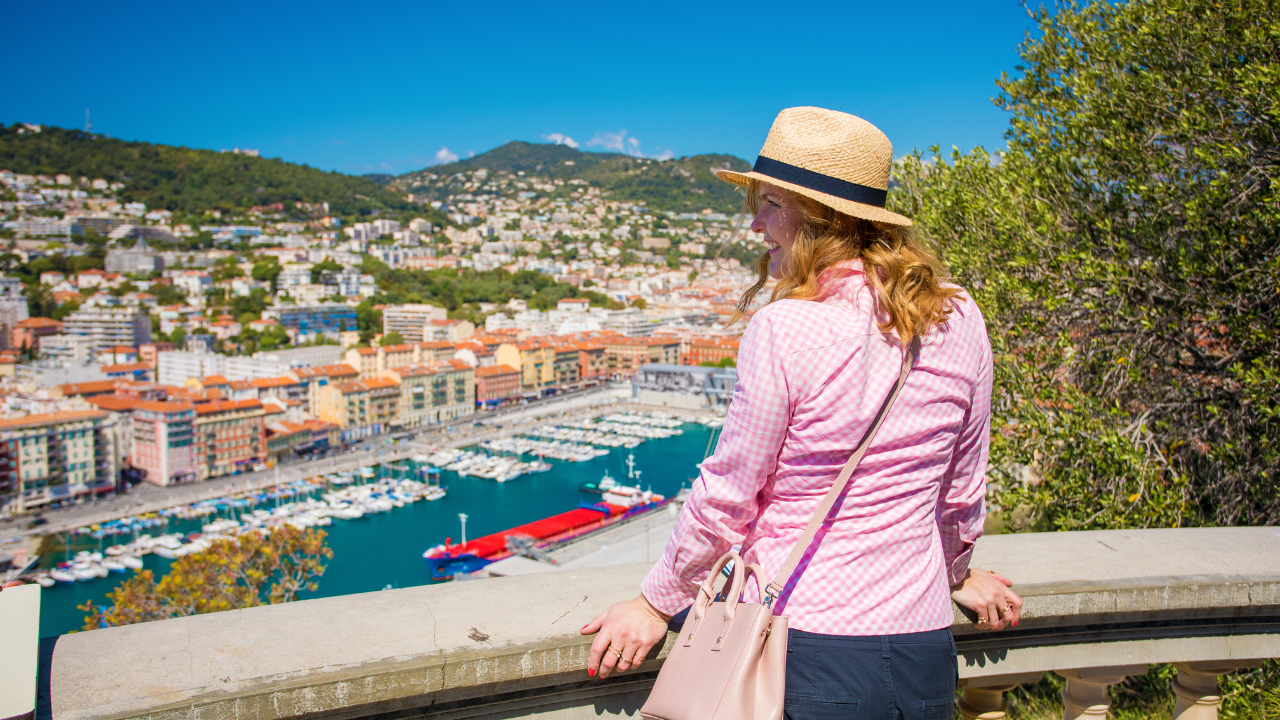
Thus, with a rail network of more than 1,300 km with 200 stations, a road network and highway of 50,000 km, three major ports (Marseille, Nice and Toulon) … But especially seven airports, including two (Nice and Marseille) of international dimension, the PACA region attracts a notable part of foreign customers.
In 2023, international tourists represented 29 % of stays and 13 % of economic benefits. Regarding hotel attendance, tourists from the United Kingdom come first, with 14 %of international customers, followed by Americans (13 %) and then Italians (10 %) and Germans (10 %).
A clientele difficult to neglect, given the economic weight it constitutes for the territorial dynamics.
What scenarios for the future for tourism?
To deal with these issues, several options are possible. It all depends which on the four scenarios developed by ADEME to reach carbon neutrality by 2050 is envisaged.
- The first, called “frugal generation”, implies deep transformations in the ways of moving, heating, and consumption methods in general. The “imposed sobriety” is the main lever of action, with coercive measures to restrict the use of the plane and thermal engines (in sea and on earth) as much as possible. And thus discourage the arrival by the tunes and the sea of distant passengers, and encourage local tourism by land and the use of soft mobility.
- The second, “territorial cooperation”, sees a transformation of society as part of shared governance and territorial cooperation. In this one, the evolution of the values of the company allows massive investments in the solutions of efficiency and renewable energies.
- The third, “green technologies”, is based on a deployment of energy efficiency thanks to technologies and digital, without the ways of living, moving or working to change a lot. However, these gain sober.
- Finally, the fourth, “restorative bet”, sees ecological issues against counterparties of economic and technological progress. He undertakes to better manage, even repair ecological social systems to maintain a livable world, based mainly on technologies. A bet, insofar as some of them are not yet mature.
Reinvent mobility
To facilitate soft mobility, the most sober scenarios are betting on the development of intermodality, free public transport and the deployment of vélotourism. Tourist sectors are only open to pedestrians, active mobility and delivery vehicles.
Furthermore, incitement to vélotourisme requires a policy in favor of continuous and secure routes and suitable reception places.
A call for projects from ADEME “Developing Vélotourisme” thus proposes to finance in part of the equipment dedicated to bicycle tourists (racks, charging stations, etc.) for various structures (tourist offices, accommodation, etc.), service areas for communities or the creation of feasibility studies for new cycling paths or intermoduality solutions to facilitate routes by velo, example.
Conversely, more technophile scenarios, which do not call into question the progression of air traffic, bet on the decarbonation of the plane thanks to biofuels and the mobilization of technologies of capture and storage of carbon.
Rethink tourism
Beyond transport as such, it is a question of rethinking the nature of tourism promoted to the territory, its volume and its distribution during the year.
While tourism in PACA is concentrated today on the summer period, reducing the pressure would involve spreading the influx of tourists more over the year, via communication strategies targeting interseas in priority. A method that has already started to set up the Regional Tourism Committee (CRT) vis-à-vis the American customers, a distant customers which depends on air transport to come and which particularly takes the PACA region.
This requires working with tourism professionals (accommodation, catering, leisure), so that they remain open in periods when they are usually on vacation – in the long term, this question more broadly questions the potential need for a redevelopment of school holidays.
It is also a question of encouraging the “slow tourism”, namely the idea of promoting another, slower, of traveling, such as market tourism and the development of activities more focused on environmental education, biodiversity, hiking, to the detriment of more carbon and impactful activities, which are plethora on the coast.
The ADEME, for example, financed, via a call for projects, the creation of an interpretation journey within an eco-owner in Peyrolles-en-Provence aimed at approaching subjects such as the use of water, summer comfort and the interests of a permacole garden.
Adapt the infrastructure
To transform tourism, communication and valuation will not be enough. This also involves in depth adapting infrastructure, from accommodation to catering through leisure structures.
In terms of accommodation, several tracks are envisaged. In a very sober scenario, it may be a question of reducing the number of tourist establishments on the coast, with the aim of limiting pressure on ecosystems and encouraging, in return, promotion by the public authorities of apartments.
The limitation of the number of second homes, a subject of size in PACA, can also be a tool to lower tourist pressure in the region. Finally, many tourist establishments will have to be renovated energetically to be adapted to new temperatures – the issue is particularly strong on holiday centers.
For this, the ADEME sustainable tourism fund offers a financing system for hosts and restaurateurs with a catalog of detailed actions: energy renovation, water or energy saving, etc.
In any case, it is imperative to act very quickly by making choices. Policies and measures, means to be implemented, conditions of policies and governance to carry out these transformations remain an open question. Whatever the way envisaged towards carbon neutrality, we must ensure the overall coherence of the choices made, thanks to planning orchestrated changes, associating state, territories, economic actors and citizens.

With an unwavering passion for local news, Christopher leads our editorial team with integrity and dedication. With over 20 years’ experience, he is the backbone of Wouldsayso, ensuring that we stay true to our mission to inform.


