
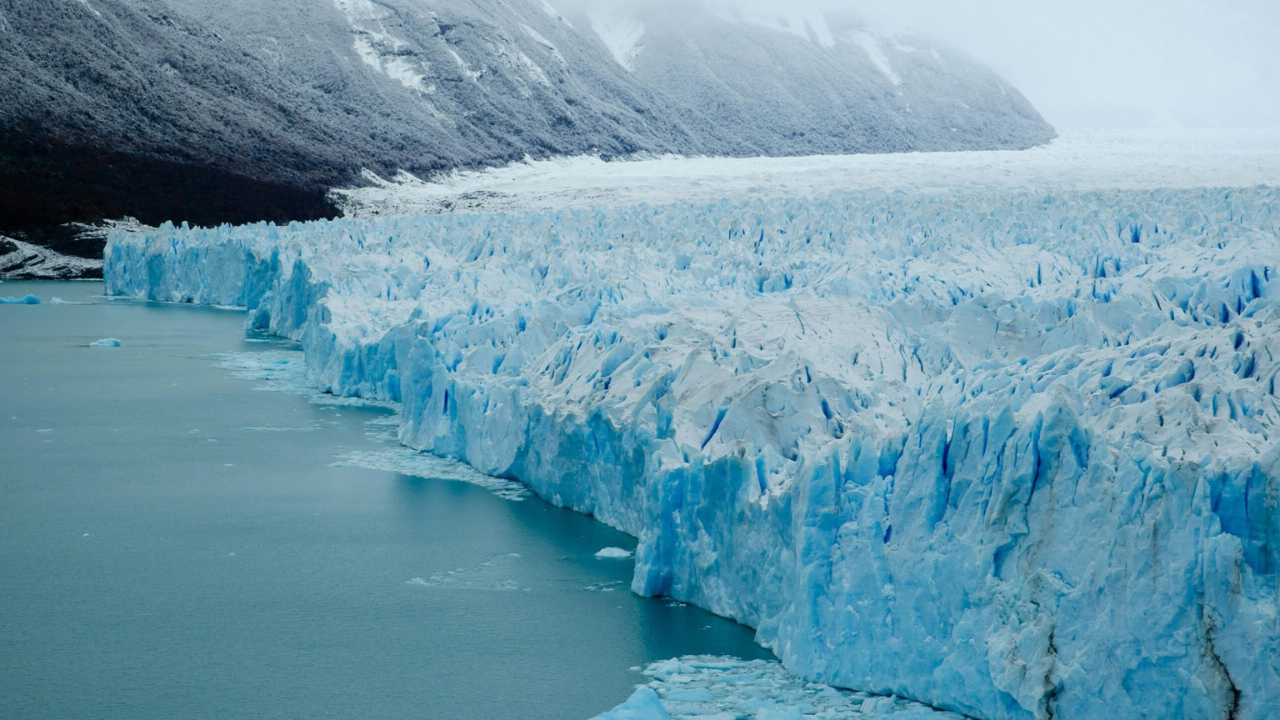
All over the planet, mountain glaciers are losing ground. They give in to increasingly constant heat, hollowing out landscapes and upsetting the ecosystems that they have shaped for millennia. However, certain places seemed to escape this trend, embodying a form of reassuring stability. The Perito Moreno, an emblematic glacier of Argentine Patagonia, was long perceived as one of them. But this image is beginning to crumble.
This apparent calm could be explained by a play of subtle balances. Fed by heavy snowfall at altitude, Perito Moreno flowed slowly to the lake, in shallow waters that allowed it to anchor itself against the opposite shore. This particular configuration favored the regular formation of a natural ice dam, causing spectacular ruptures which attracted hundreds of thousands of tourists each year.
But this balance is based on sensitive factors, including temperature and precipitation. The depth of the lake and the shape of the subglacial relief also play a crucial role. However, a simple variation is sometimes enough to disrupt this fragile stability. And in fact, this shift already seems to have begun.

What makes the giant waver today
In recent years, researchers have observed a series of worrying signals. Campaigns carried out by a German-Argentinian team made it possible to precisely reconstruct the topography of the glacier bed using a helicopter-borne radar and mapping of the lake bottom. These data, analyzed in a study published in Communications Earth & Environmentreveal a clear shift in the dynamics of Perito Moreno.
Between 2019 and 2024, the glacier surface fell at a rate of up to 5.5 meters per year locally, around ten times faster than in the previous two decades. At the same time, the ice began to flow more quickly, a sign of a weakening of the internal structure. As the glacier retreats, it sinks into deeper and deeper water. However, the deeper a glacier ends in a basin, the more unstable it becomes. The pressure exerted by the water promotes massive detachments of ice, and initiates a vicious circle: melting, retreat, floating, collapse.
The Perito Moreno is thus entering a phase of accelerated and lasting decline. Researchers believe it is likely that it will no longer be able to block the southern arm of the lake. His forehead might even soon float permanently, a sign of a near breakup.
The expected shock wave in the Andes… and elsewhere
The planned disappearance of Perito Moreno is not limited to a loss of landscape. It constitutes a strong signal on the state of mountain glaciers in the world. Since the year 2000, these ice reservoirs have already lost more than 6,500 billion tonnes, or around 5% of their mass. The Conversation recalls that in Iceland, a funeral ceremony was organized to mark the end of a glacier, which has become a symbolic act on a global scale.
The consequences are numerous and primarily concern water resources. Indeed, glaciers act as natural buffers. They hold water in the form of snow, then slowly release it throughout the year. Without this regulator, intake becomes more irregular, sometimes brutal. This directly disrupts access to water, both for cities and agricultural areas. Agriculture, consumption and hygiene, however, depend on this fragile balance.
Then, natural risks increase. Glacial retreats can cause sudden breakups, when lakes trapped behind natural dams suddenly empty. Fifteen million people around the world would be threatened by these glacial floods. The partial collapse of the Birch glacier in Switzerland in May 2025 tragically illustrated this risk. An entire section of mountain collapsed onto the ice, triggering an avalanche that destroyed the village of Blatten.
Finally, the level of the oceans remains in the background. If all mountain glaciers melted, global sea levels would rise by 32 centimeters. We're still a long way off, but every glacier that disappears brings this waterline closer.
Perito Moreno, once a bastion of resistance, is no longer the exception. Today he joins the procession of fallen giants, and his silent retreat resonates like a warning.


