
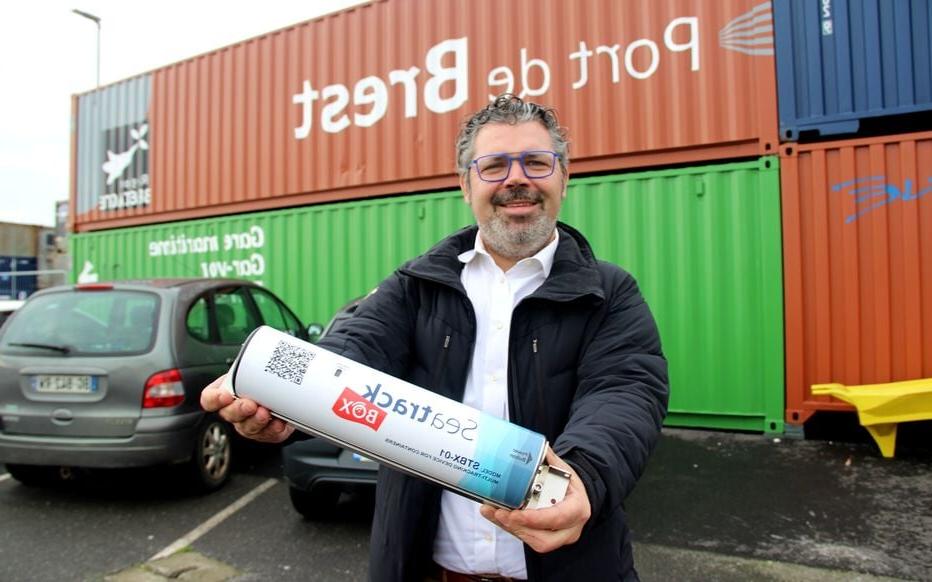
Each day, thousands of containers pass between ports around the world, loaded with sometimes sensitive, sometimes polluting goods. When an incident occurs at sea, these metal giants can disappear without leaving any trace, transforming the oceans into floating cemeteries. In this context, a technology developed in Brittany draws attention. Called Seatrackbox, it promises to locate the cargoes that have fallen to the water in real time, providing an unprecedented response to a logistical problem as discreet as it is ample.
According to TF1 Info, these incidents are so frequent that it was so far impossible to ensure traceability. For sea professionals, the observation is alarming. Pollution linked to lost cargoes represents up to 90% of floating waste on certain coastlines. Added to this is a major financial issue. A single container can contain up to 100,000 euros in goods. Between environment and logistics, the consequences are multiple.
Seatrackbox, the French solution to locate the fallen cargoes
Faced with this challenge, three Breton entrepreneurs have developed Seatrackbox, a connected tag capable of reporting in real time the fall of a sea container. 48 centimeters long, this innovative technology is directly likely on the containers and separates in two in the event of immersion. A part floats, the other remains attached to loading by a 25 -meter thread. The whole emits data via satellite, with an autonomy of up to three years.
This solution, tested by Vitalac in the Côtes-d'Armor, is already used for animal nutrition cargoes leaving for Taiwan. In the event of a fall, the tag passes red and automatically triggers an alert. Thanks to an accelerometer, an altimeter, a GPS and a water detector, it sends signals allowing the maritime authorities to precisely locate the object and organize their recovery.
This innovation, entering the test phase in early 2025, required six years of research and development, according to the new factory. It targets dangerous goods first, but its potential extends far beyond. Supported by public actors such as Vigipol, the Atlantic Maritime Prefecture or the Maritime Gendarmerie, Seatrackbox may well become a standard of port logistics in the coming years.

A new era for ports and industrialists
Seatrackbox is already transforming the practices of Breton companies, many to import and export goods by sea. For Vitalac, this is as much a responsible approach as a regulatory anticipation. Its CSR director, Lucie Knappek, recalls having seen the consequences of these losses, such as plastic microbeads stranded in Ouessant, in his eyes. Even if her cargoes are less polluting, she believes that it is their duty to limit risks at sea.
From January 1, 2026, all carriers will be required to declare the loss of their containers, according to a decision by the international maritime organization. As Thibaut Morin, Seatrackbox commercial director said, the case will facilitate this approach by making the process automatic. For shipowners as well as insurers, gain is obvious: reducing losses, reacting faster, limiting litigation.
The company aims to deploy in France from 2026, then internationally in 2027. Its ambition is clear. Make the tag an essential logistics tool, while generating around fifty jobs by 2028. From Ploufragan to Brest, Brittany thus becomes a nerve center of maritime innovation, with an impact that is both economical, environmental and strategic.


