
[Article déjà publié le 1er octobre 2024]
They are not aggressive animals
If they scare young and also sometimes adults, you have to understand something. The snake wants to meet you as much as you. In other words, it will do everything to avoid you. However, if he feels cornered or in danger in your presence, he will have to defend himself and often it goes through the bite, whether poisonous or not.
But that doesn't appeal to the snake either. Indeed, as explained by the biologist of the University of Georgia (USA) John Maerz in the media Southern Living“The goal of the venom is not to defend yourself, but to inject it into its prey. Venom production requires a lot of energy from the snake.”In other words, if it uses this method, it is that it has no other choice to defend itself.
Now that this is said, we do not necessarily do expressly entering the territory of a snake. Thus, we also do not ask to be bitten when we go on a hike. It is therefore important to know which snake you might have to meet when you go out to walk.
Three of the most poisonous snakes in Europe
It is not a question of making an exhaustive list of all the poisonous snakes of the old continent, but of those who could assert a stay in the hospital, even an unfortunately more radical outcome.
The Ammodyte viper ( Vipera Ammodytes ))
 © Adrian Eugen Ciobaniuc – Shutterstock
According to the National Museum of Natural History, the Ammodyte viper is an extremely poisonous snake. Living in particular in south-eastern Europe, it is also found in the Balkans. According to the cultural institution, its venom would be 10 to 12 times more powerful than that of Aspics vipers.
She is very easily recognizable thanks to her horn on his nose, which also earned her the nickname “Cornu viper”. Although they are rare, the cases of death in the event of bites by ammodyte vipers have been identified. These snakes can measure up to 85 centimeters and live at least 20 years.
The Aspic viper ( Vipera aspis ))
 © Pedro Luna – Shutterstock
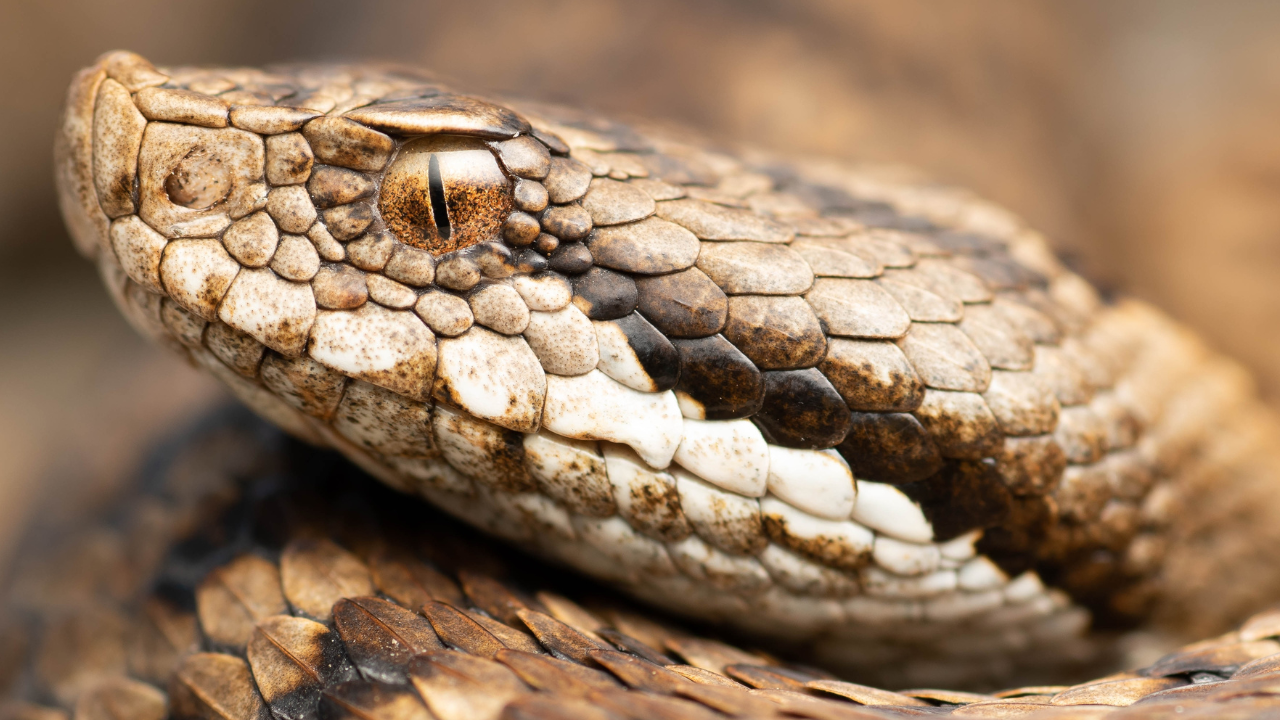
In France, it is the most dangerous snake on which one can fall in the wild. According to the portal of national parks in France, it is mainly found in the south of France, except in the Mediterranean periphery and in Corsica.
However, she likes to live at altitude. Indeed, observations highlight its presence at more than 3000 meters above sea level. Can measure 70 cm and live for thirty years, its bite can be fatal. It is also found in several countries in central Europe.
The viper of cyclades ( Macrovipera Schweizeri ))
 © Mike Manonas – Shutterstock
Endemic to the archipelago of cyclades off Greece, it is mainly found on the island of Milos. Only representative of the genre vipera Who lays eggs, the Cyclades viper likes proximity to the aquatic environments where rocks are present in number. The species is classified as being “in danger” by the International Union for the Conservation of Nature (IUCN).
In summer, in the middle of the day, it will be difficult to cross it, because the animal changes its behavior to become nocturnal during the summer period. Very poisonous, his bite can be fatal for humans if it is not taken care of quickly. Finally, concerning her hunting style, she likes to climb to the top of the trees to kill birds which she attracts by waving the tip of her tail.
The precautions to be taken during your hikes
Crossing the path of a snake is not something to take lightly, especially if the latter is able to kill an adult man. However, to protect yourself from it, there are very simple gestures to avoid any bad encounter with snakes during your summer hikes.
Thus, as the list the health insurance site (Ameli):
- Don't go alone
- Do not leave without a means of communication
- Put up rising shoes and pants to protect your skin from a potential attack
- Take a stick to keep a snake distant
- Walk with a heavy step, the vibrations caused by your steps could be used to scare snakes
- Watch where you put your hands and feet
These simple gestures are sometimes common sense. But common sense can save your life in certain situations. So don't take these snake species lightly lightly as well as all the others. These are wild animals that have a territory to defend against anyone who will enter it. All small gestures are good to avoid being bitten by one or more snakes.
Source: Southern Living / Animalia / National Museum of Natural History

With an unwavering passion for local news, Christopher leads our editorial team with integrity and dedication. With over 20 years’ experience, he is the backbone of Wouldsayso, ensuring that we stay true to our mission to inform.


