
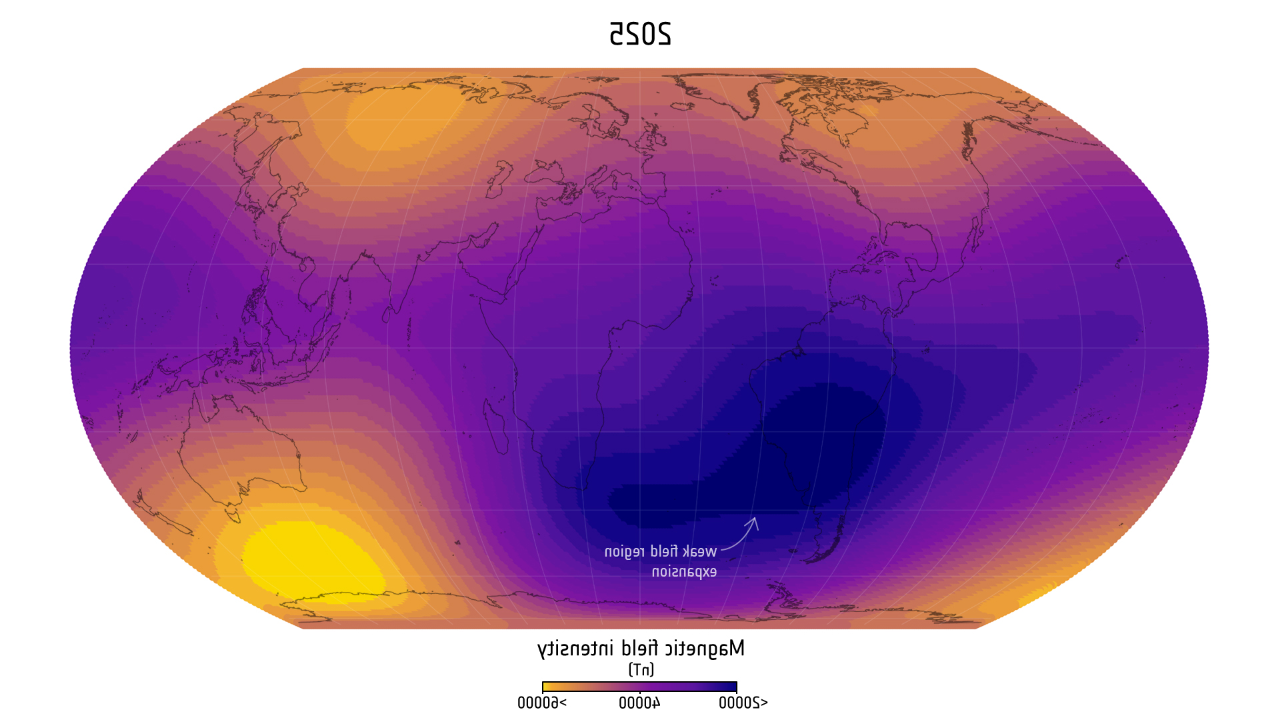
The Earth's magnetic field acts as an invisible shield, deflecting solar particles that constantly bombard our planet. Without it, radiation would seriously endanger electronic systems, satellites, and especially living organisms. However, this field presents an area of increasing weakness above the South Atlantic, called the South Atlantic Anomaly. Monitored for more than a decade, this anomaly is expanding and intensifying, increasingly exposing satellites and astronauts to critical doses of radiation.
Using data from the Swarm mission, operated by the European Space Agency (ESA), a team led by Chris Finlay, professor of geomagnetism at the Technical University of Denmark (DTU Space), published a study in October 2025 in Physics of the Earth and Planetary Interiors. It draws up a precise inventory of this worrying phenomenon, linked to the deep movements of the earth's core.
A magnetic anomaly of increasing dimensions
ESA's Swarm constellation includes three satellites launched in 2013 to measure components of the magnetic field. Its data thus made it possible to map the area of weakness with unprecedented resolution. Between 2014 and 2025, the anomaly expanded by approximately 1% of the Earth's surface. That's almost 5 million square kilometers, the equivalent of half the surface of Europe.
In this region, the magnetic field intensity reaches values significantly lower than the global average. The lowest point recorded reached 22,094 nanoteslas, compared to an average of 40,000 to 60,000 nanoteslas in other areas. This drop of 336 nanoteslas since 2014 indicates a constant degradation. This is not the first time that such an anomaly has been detected. Geological studies show that this region has had unstable magnetic activity for around 11 million years. But the scale and speed of current change are unprecedented on a human scale.
 © ESA/AOES Medialab
According to Chris Finlay, professor at the Technical University of Denmark, cited in the ESA press release, the variations observed “are not uniform”. The area is weakening more quickly in its eastern part, southwest of Africa, than in the west towards South America. This reveals more complex internal dynamics than simple linear attenuation. The phenomenon has accelerated since 2020. In addition, models predict that it could continue to expand if the internal conditions of the Earth's core persist.
Concrete impacts on satellites and space security
The main consequence of the South Atlantic Anomaly remains its impact on satellites and space infrastructures operating in low orbit. Generally between 400 and 1000 kilometers in altitude. In this weakened region, the protective magnetic barrier is less effective against energetic solar particles. Result: satellites crossing this zone experience an increase in exposure to cosmic radiation. Which can cause electronic malfunctions, data loss, or even irreversible hardware failures.
On-board instruments, particularly sensitive electronic circuits, become more vulnerable to SED (Single Event Disruption) events, caused by energetic particles passing through the components. Anomalies of this type have already been observed several times on communications and Earth observation satellites. Because the latter regularly pass over this region. Finlay indicates that “Low orbit satellites are more highly exposed in the SAA than in any other part of the globe “.
 © ESA (Data source: Finlay, CC et al., 2025)
The problem is not limited to machines. Astronauts staying on the International Space Station (ISS), which regularly passes through the area, are also concerned. Even if their presence in orbit remains temporary (a few months), their repeated exposure to this radiation could lead to cellular damage or increased risks of cancer. As several medical studies have shown on the effects of ionizing radiation.
To limit the effects, manufacturers of satellites and space equipment must “harden” their systems. That is, design them so that they are more resistant to high radiation environments. But this solution has a technological and economic cost. The wider the area, the more missions these constraints concern. This highlights the need for continuous monitoring and adjustment of flight plans according to variations in the anomaly.
What the anomaly reveals about the depths of the Earth
The expansion of the South Atlantic Anomaly constitutes above all the surface manifestation of deep processes occurring in the Earth's core. The magnetic field is generated by the movements of liquid iron in the outer core, located about 3000 km below our feet. This complex movement produces a natural dynamo, inducing electric currents and, therefore, an overall magnetic field.
In the anomaly zone, researchers identified a particularly atypical phenomenon: patches of reversed flow. These are areas where the magnetic field no longer leaves the core, but returns to it. This configuration disrupts the usual structure of the field, locally causing its weakening. Using Swarm's high-resolution data, scientists can observe these anomalies in motion. One of these patches, according to Finlay, “ moves slowly westward, under southern Africa, and contributes to accentuating the magnetic trough “.
This observation is consistent with broader geophysical models suggesting instability in the transition between the liquid core and the solid mantle. These deep structures, invisible to the naked eye, strongly influence the behavior of the magnetic field at the surface. Their dynamics, however, remain poorly understood due to lack of direct access.
Note that, despite this regional weakening, the researchers did not detect any sign of global magnetic reversal. Pole reversal — a natural phenomenon in which magnetic north and south swap sides — has occurred hundreds of times in Earth's history. But current data does not suggest such an event in the short term. Researchers speak of a fluctuation on the scale of several decades to a century, inherent to the chaotic behavior of the Earth's core.
An asymmetrical and changing magnetic field
As we will have understood, the earth's magnetic field does not form a homogeneous field nor is it perfectly centered on the globe. Unlike the simplified image of a bar magnet, the field structure is complex and asymmetric, with areas of high intensity and others of lower intensity, distributed unevenly across the globe. The Swarm mission made it possible to map these variations with unequaled precision.
In the southern hemisphere, only one area of strong magnetic field is identified. While in the north, two main regions concentrate forces: one over Canada, the other over Siberia. However, these two zones do not evolve in the same way. Since 2014, the field has weakened by 801 nanoteslas in Canada, with an area reduced by 0.65% (almost the size of India). Conversely, the field strengthened over Siberia, gaining 260 nanoteslas and an area equivalent to that of Greenland.
These developments partly explain the rapid drift of the magnetic north pole towards Siberia, observed since the mid-19th century. This migration, accelerated since the 2000s, poses a technical challenge to navigation systems based on magnetic north, particularly in aviation, military applications and GPS.
This transformation of the magnetic field, described as a global redistribution of intensity zones, is intended to reveal the turbulent movements of the earth's core. According to the most recent models, these changes are linked to changes in convection within the outer core. ESA plans to extend the Swarm mission beyond 2030. This period will coincide with a solar minimum, allowing a better distinction between solar variations and internal signals.
Source: CC Finlay et al., “Core field changes from eleven years of Swarm satellite observations“Physics of the Earth and Planetary Interiors. Volume 368, November 2025, 107447

With an unwavering passion for local news, Christopher leads our editorial team with integrity and dedication. With over 20 years’ experience, he is the backbone of Wouldsayso, ensuring that we stay true to our mission to inform.


