
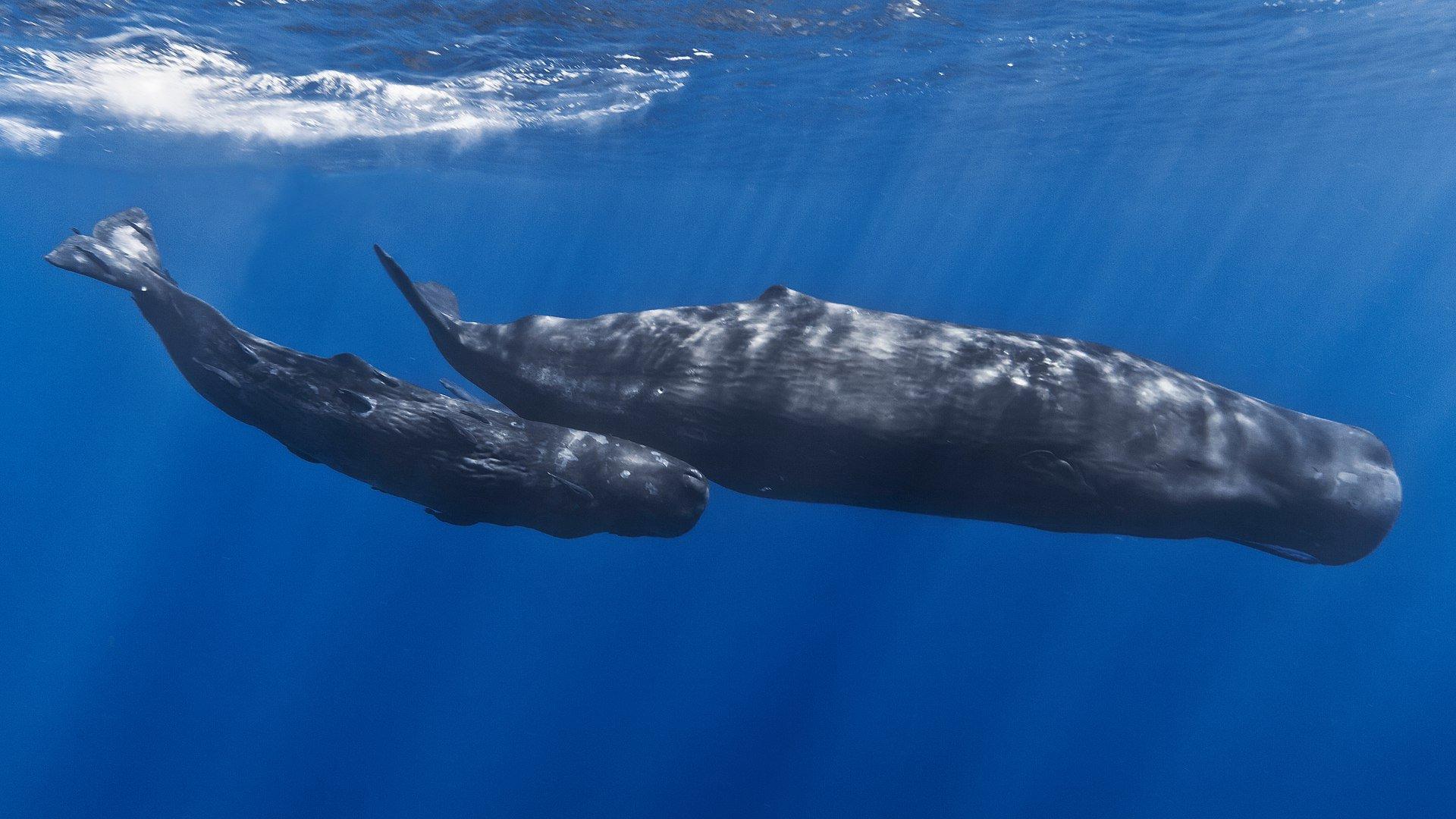
Cetaceans have fascinated for centuries with their intelligence, their sociability and their enigmatic way of interacting underwater. Among them, the sperm whale is particularly intriguing with its sound emissions based on sharp clicks, long interpreted as simple recognition or echolocation signals. But recent research reveals a completely different reality. Behind this apparent simplicity lies a vocal architecture of unsuspected richness. Sperm whales' communication could well be based on mechanisms surprisingly close to those of human language.
What sperm whale clicks hide
For a long time, researchers considered sperm whale communication as a binary system, based solely on the number and rhythm of clicks. These signals, called codas, were used to identify clans, signal a presence or communicate at short distances. But an international team has just revealed a much greater level of complexity in these acoustic exchanges.
Thanks to a database of more than 1,200 codas recorded off the coast of Dominica between 2005 and 2018, scientists have identified spectral variations which cannot be explained by depth, nor by the movement of animals, nor by the effect of the equipment used. These variations follow discrete structures, similar to our vowels “a” and “i,” and appear with striking regularity from one individual to the next.
The study published in Open Mind demonstrates that these sounds have frequency peaks, or formants, similar to those that structure human speech. To do this, researchers use the source-filter model, well known in phonetics, to compare the vibrations of the phonic lips of sperm whales to those of our vocal cords, and their air sac distal to our vocal tract.

When the communication of sperm whales is close to that of humans
A team of linguists and bioacousticians affiliated with the CETI (Cetacean Translation Initiative) project managed to transcribe these complex clicks using human letters. By slowing down the signals and eliminating the perceptual biases specific to our species, they isolated two main types of “vowel-coda” (designated as a-coda and i-coda) as well as combined forms, equivalent to our diphthongs.
These codas are not produced randomly. Each is uniformly type a or i, indicating active control by the animal. Researcher Gašper Beguš, lead author of the study, believes that this stability and this ability to chain different codas within the same exchange suggest a form of phonetic coding hitherto unsuspected in a non-human.
To verify this hypothesis, the scientists trained a neural network (fiwGAN) on this raw data. The model also identified regularities in the formants of the clicks, which made it possible to target the relevant sequences more precisely. This work shows that certain properties of human language could emerge independently in other species, in response to comparable socialization needs.
Towards a rewriting of the origins of vocal language
The fact that sperm whales produce vowels without vocal cords, solely by modulating a flow of air in their nasal system, then implies that the foundations of language are not strictly human. This observation invites us to review our conception of articulated vocalization as exclusive to Homo sapiens.
The CETI project, of which the biologist David Gruber is at the origin, works to reconstruct the bases of an inter-species dialogue. The identification of these vocal patterns, their consistency in dialogues between individuals, and their distribution within the same clan, as shown by IFLScience, support the idea that sperm whales have a rudimentary syntax based on the combination of elementary sounds.
We even observe codified exchanges where the codas respond to each other in mirror images, as if they followed a dialogic protocol. The ability to vary vowels between responses suggests a fine perception of sound nuances, and perhaps even an intention for semantic differentiation.
If these vowels do not yet have an established referential meaning, their structured existence could correspond to a social, identity or emotional function. Humans, too, use different vowels to mark their belonging to a group or region. Sperm whales, through the richness and precision of their clicking system, could well be the custodians of a parallel language, shaped by water, sound and evolution.

With an unwavering passion for local news, Christopher leads our editorial team with integrity and dedication. With over 20 years’ experience, he is the backbone of Wouldsayso, ensuring that we stay true to our mission to inform.


