
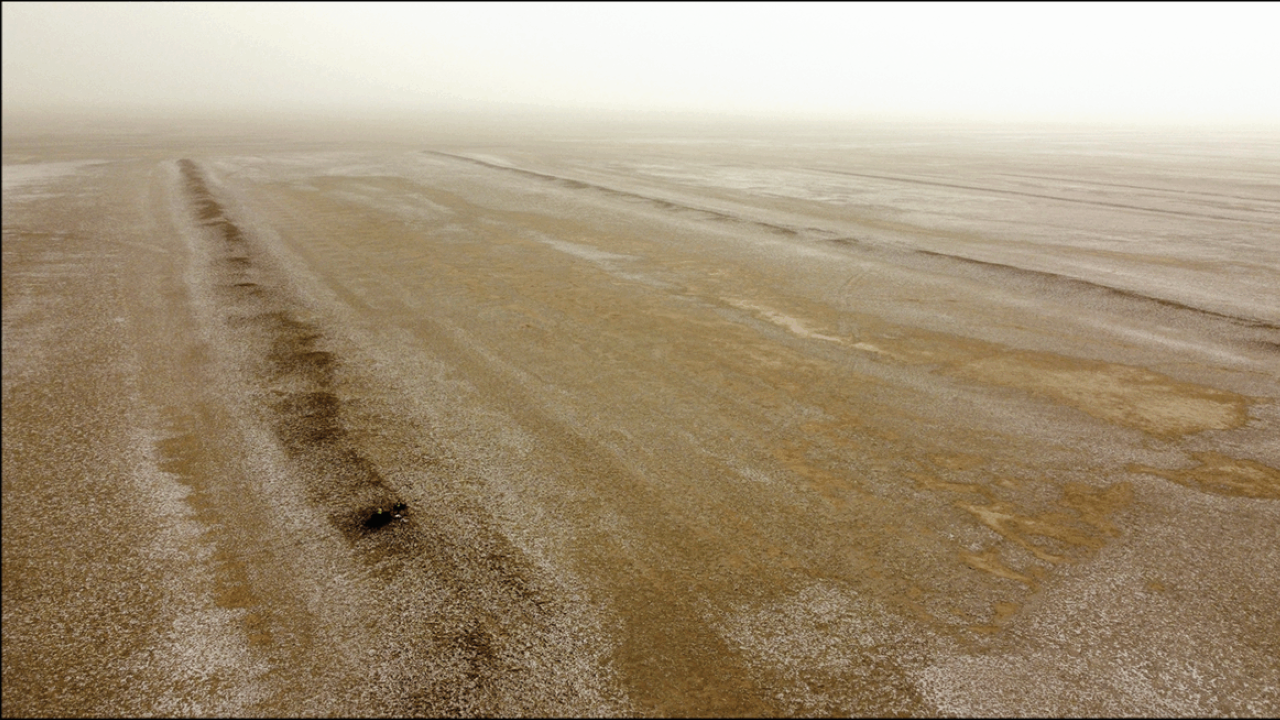
Near Basra, in southern Iraq, archaeologists have uncovered a huge network of dikes and canals covering more than 800 km². These remains are not simple hydraulic infrastructure. They testify to a medieval agricultural system built by the servile workforce in the brutal context of the Zanj revolt in the ninth century. This insurrection, led by African slaves against Abbassid power, was long reduced to an episode of violence.
A monumental discovery in the sediments of the al-Arab Shatt in Iraq
Located in the alluvial plain of the Shatt al-Arab, the unearthed network presents impressive density and regularity. The structures consist of rectilinear dikes 20 to 50 meters wide, several hundred meters long, separated by perpendicular channels. The whole draws an extended geometric framework, structured around the tide irrigation, taking advantage of the variations in the level of the estuary. This space organization is readable from modern satellites and already visible on Corona photographs of the late 1960s. It revealed a very advanced agricultural planning for the time.
The researchers targeted several points in the system to take samples. The optical stimulated luminescence analysis (OSL) has made it possible to date the latest sediment contributions exposed to light. Carbon 14 has been applied to fragments of shells found in the embankments. These crossed methods make it possible to bypass the frequent absence of organic remains in the clay soils of southern Iraqi.
 © © © Photo/Jaafar JOTHERI
An aerial photo of the site, Saturday January 29, 2022.
The accuracy of dates indicates that the crests studied have not been erected in a single phase. Some have gradually formed, over several decades, even centuries, by accumulation of sediments extracted during the regular maintenance of the canals. This rhythm of maintenance involves constant human mobilization. This suggests a lasting, organized system, and deeply dependent on hierarchical supervision. It is part of an economy based on constraint. The maintenance of the agricultural landscape was then inseparable from relations of domination inscribed in the soil itself.
The Zanj: forgotten builders' slaves
The word “zanj” appears in medieval Arab sources to designate black slaves. In fact, they were mainly used in agricultural work and the maintenance of saline marshes in the south of Iraq. The historiographical tradition generally links them to the Swahilia coast. But the term itself was used in an imprecise way. He included various African origins, sometimes also poor or locally marginalized peasants. The historian Gwyn Campbell stresses that the majority of Zanj could actually come from West Africa or the center of the continent, via the trans-Saharan milking networks which converged on the Arab-Persian Gulf, and not exclusively ports of the Indian Ocean.
The Zanj was enforced in the bass savory lands of the Basra region, a difficult and unhealthy environment. As mentioned earlier, they were assigned to drainage tasks, channel maintenance, and clearing of the land made infertile by salt. In 869, under the direction of Ali Ibn Muhammad, thousands of them revolted. They grabbed several localities and stood up to the Abbasid authority for more than a decade. They established their capital, Al-Muḫtāra, in an area which they had helped to shape, at the very heart of the agricultural system.
But their uprising was crushed in 883, but the material traces of their presence, such as the ridges and canals analyzed today, show that the exploitation of these lands continued well after. Far from being erased, their imprint remains engraved in the soils, ignored by official, but very real stories.
Agricultural engineering adapted to the tides
The agricultural infrastructure discovered south of Iraq is based on a fine control of local hydraulic dynamics. Located in the tide area of Shatt al-Arab, it exploits the periodic rise in fresh waters pushed by the tides of the Persian Gulf. This natural phenomenon, still active today, made it possible to irrigate low land without using mechanical devices. The canals, arranged at regular intervals, guided these flows inland, irrigating the plots located between the dikes.
The network formed a rigid grid, composed of parallel dikes spaced 100 to 250 meters. Between them, water circulated via secondary channels. These blocks formed real culture units. The arrangement of structures shows a rationalization of agricultural space, designed to optimize both the drainage of excess water and the homogeneous distribution of irrigation. The earth moved during the cleaning of the canals was rejected on the dikes, contributing to their gradual elevation. This process explains the high salinity measured in the ridges. Indeed, the salts accumulated by evaporation were regularly deposited, making these areas not very fertile, but reinforcing the dikes.
This type of agriculture required a very structured work organization, with a constant maintenance of the channels to prevent siltation. It is a sustainable technical system, well suited to a binding environment. But it was based on an abundant and permanently available workforce, in this case workers reduced to slavery.
Recognize the invisible, a memory engraved in Iraq's land
Today, the remains of the Zanj agricultural system are on the outskirts of the urban and industrial areas of Basra in Iraq. They are exposed to direct threats. The extension of the oil fields, military infrastructure and rapid urbanization gradually erod what remains of this landscape shaped by human exploitation. The lack of legal or heritage protection aggravates the risk of silent disappearance of this site. The importance greatly exceeds the purely archaeological interest. It is a material witness to slave practices in the medieval Islamic world. This area is still little explored, both historically and memorial.
The scarcity of archaeological studies on the question does not be due to a lack of clues, but to a long silence around these servile populations and their role in the economy. The fact that the Zanj not only helped to shape the agricultural landscape, but also to maintain its functioning over several centuries after their insurrection, forces to reconsider their place in history. They were not simple temporary victims of an oppressive system. These were actors forced by a territorialized economy, the traces of which still structure the Iraqi soil.
This land is therefore not neutral. It carries the memory of a long invised group, reduced to a footnote in classic stories. To preserve these structures is to recognize a history hitherto marginalized, and to inscribe in the collective memory the essential part of slaves in the construction of the medieval Islamic world. Because we must read this soil, loaded with forgotten efforts, as much as the texts which neglected those who worked it.
Source: Brown, PJ, Jotheri, J., Rayne, L., Abdalwahab, NS, & Andrieux, E. (2025). “The Landscape of the Zanj Rebellion? Dating the remains of A Large-Scale Agricultural System in Southern Iraq”. Antiquity, 1–17. DOI: 10.15184/AQY.2025.72

With an unwavering passion for local news, Christopher leads our editorial team with integrity and dedication. With over 20 years’ experience, he is the backbone of Wouldsayso, ensuring that we stay true to our mission to inform.


