

Deep in the ancient swamps of eastern China, a vanished city continues to reveal its secrets. Far from the splendor expected of a refined civilization, archaeologists have unearthed meticulously carved human fragments, abandoned as simple refuse. Behind this disturbing discovery lies a little-known part of the Neolithic culture of Liangzhu, a society where emerging urbanization seems to have disrupted the relationship with the body and death.
Masks and cups carved from the flesh of the past
The archaeological scene of Liangzhu has recently been revealed, nestled between canals and ancient ditches. It belongs to one of the oldest cities in East Asia. More than 180 human fragments were discovered there in bulk, with no trace of burials. Among them, 52 bones showed clear signs of human intervention. Indeed, some had clear cuts, others had perforations, cut edges or even polished surfaces.
The detail of the shapes is intriguing. Four skulls had been cut horizontally to create “skull cups”, caps probably serving as containers. Others had been split vertically to become stylized facial masks, with no known equivalent in the Chinese Neolithic world. Some mandibles were filed at the base, while long bones had worked ends, reminiscent of scraping tools.
What is striking is the proportion of unfinished objects. Around 80% of the worked bones were not finished, as if their shaping had been abandoned along the way. A detail that contrasts with the careful finishing of animal artifacts, such as points and ornaments, found nearby.
In their study published in Scientific Reports, researchers led by Junmei Sawada put forward the idea that these fragments were not sacred objects, but rather rejects, thrown into ditches like ordinary waste.
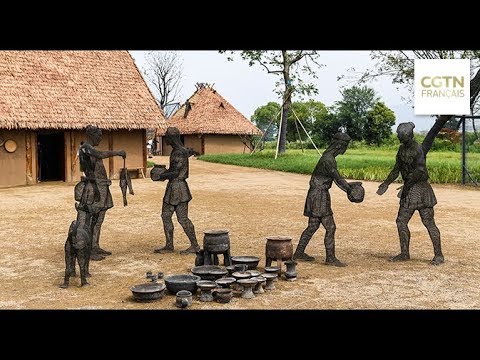
The Neolithic culture of Liangzhu and the emergence of an urban society
The uniqueness of this practice takes on its full meaning when placed in the context of the Neolithic culture of Liangzhu, which appeared around 5,300 BCE. This civilization built one of the first urban centers in Eastern Asia, with dams, canals, temples and a well-established social hierarchy. Listed as a UNESCO World Heritage Site since 2019, the city offers a rare testimony to the upheavals linked to early urbanization.
In previous agricultural communities, each deceased person was a loved one, a family memory. But in Liangzhu, the population density has introduced a new social figure: the unknown. The multiplication of contacts with individuals outside one's circle has transformed the perception of the dead body. Archaeologists from the University of Niigata, who made the discovery, speak of a desecration of the corpse, made anonymous by urban complexity.
The contrast is striking. On one side, elites buried with precious objects in sophisticated tombs; on the other, human bones cut and then thrown away, without ceremony. The coexistence of these two treatments suggests a deeply hierarchical society, where all bodies are no longer equal.
Legacies and enigmas of a shaped humanity
The exact nature of the artifacts remains difficult to determine. Some, like skull cups, were perhaps used in rituals, as proposed by researchers relayed by LiveScience, with reference to other examples found in the luxurious tombs of Fuquanshan or Jiangzhuang. Other artifacts, however, defy classification. Split masks, polished mandibles or unfinished long bones have no known equivalent, neither in China nor elsewhere. No parallel could be established with stone or animal bone tools, which makes any interpretation uncertain.
It is possible that some pieces had an artistic or demonstrative purpose, but their rejection in the canals suggests that they were neither sacred nor valuable. They perhaps reflect, above all, a loss of collective meaning around death.
This practice only lasted for a short time. Radiocarbon dates indicate a period of approximately two centuries, between 4800 and 4600 BCE. Then, without a clear explanation, the shaping of human bones disappeared from the cultural landscape. This withdrawal coincides with a decline in Liangzhu's water infrastructure, perhaps caused by climate change. As if the city, shaken to its foundations, had reconnected with a more human vision of its dead.
Thus, through the channels, Liangzhu has revealed the traces of a radical shift. A society where the body was no longer always a subject of memory, but sometimes a simple material, an object of use, or even waste. And in these polished or split fragments, it is perhaps less violence than social distance that is expressed. An early form of dehumanization, born in the anonymity of the city.

With an unwavering passion for local news, Christopher leads our editorial team with integrity and dedication. With over 20 years’ experience, he is the backbone of Wouldsayso, ensuring that we stay true to our mission to inform.


