
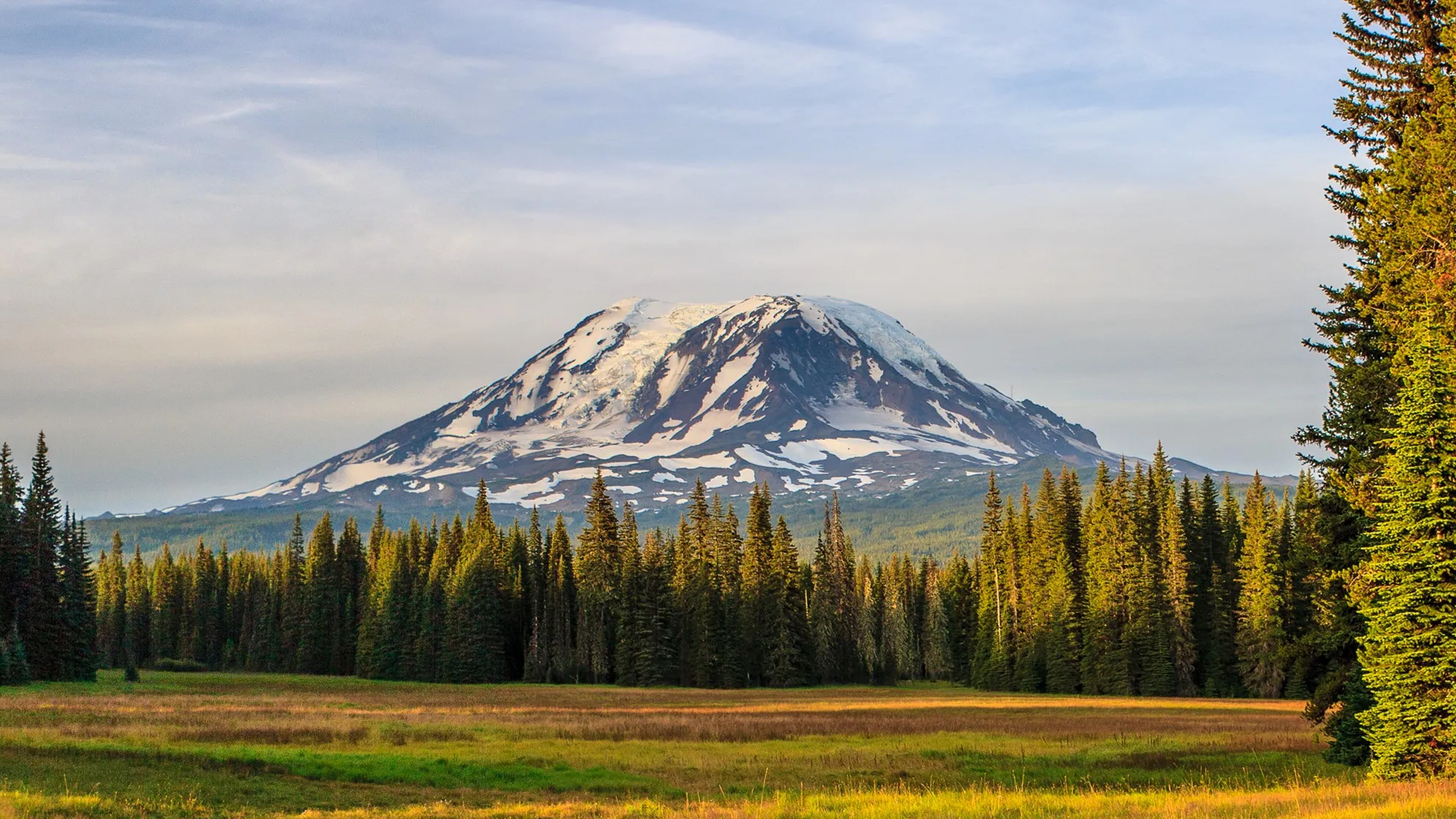
Mount Adams, located in Washington state, is the largest active volcano in the region. Classified as “high risk” by the US Geological Survey (USGS), this volcano has nevertheless remained dormant for several millennia. However, an unexpected increase in seismic activity was detected in September, with six earthquakes recorded in one month, while the normal is one earthquake every two to three years.
This situation worries scientists at the Cascades Volcano Observatory (CVO) and the Pacific Northwest Seismic Network (PNSN), attached to the USGS. Despite the absence of immediate signs of eruption, such as degassing or ground deformation, these researchers are trying to understand the causes of this abnormal seismicity. The issue is crucial because Mount Adams, although generally calm, could cause destructive lahars even in the absence of an eruption.
An unprecedented seismicity record
Mount Adams, usually considered a relatively quiet volcano, saw unprecedented seismic activity in September. This marks a turning point in the observation of this region. Historical data generally shows only one earthquake every two to three years.
However, the fact that six earthquakes were recorded in just one month constitutes an exceptional event. The tremors, although minor, with magnitudes varying between 0.9 and 2, attracted the attention of scientists. In fact, they are the first of such magnitude since records began in 1982. This renewed activity raises questions about the internal dynamics of the volcano and the geological processes currently underway.

Aerial view of Mount Adams and its glaciers. © George Rose/Getty images
Despite this record activity, researchers are not seeing any of the classic signs associated with an imminent eruption. Namely degassing or deformation of the ground. These indicators are generally used to predict major volcanic events. All this leads experts to assess this situation with caution. Jon Major, of the Cascades Volcano Observatory, emphasizes that the absence of these visible signals and the low intensity of the earthquakes do not allow us to conclude that there is an immediate danger. However, this unusual seismicity encourages scientists to redouble their efforts to better understand the underlying mechanisms.
Increased surveillance to elucidate the causes
Faced with the abnormal increase in seismic activity at Mount Adams, researchers quickly reacted to strengthen monitoring of the volcano. Until now, only a permanent seismic station, located about 11 kilometers from the summit, made it possible to detect earthquakes in the region. However, this single station does not provide sufficiently precise information to accurately locate the source of earthquakes or to determine their depth.
This gap in the monitoring network is particularly concerning. Indeed, it limits the ability of scientists to understand the evolution of volcanic activity. To compensate for this shortfall, the Cascades Volcano Observatory (CVO) obtained authorization to install additional temporary seismic stations around the volcano.

Earthquake survey for September 2024 for Mount Adams. © USGS
These new seismic stations will provide more extensive coverage. They will make it possible to capture data in real time, essential data for improving the precision of seismic surveys. The CVO, in collaboration with the Pacific Northwest Seismic Network (PNSN), will be responsible for analyzing this information. The objective is to identify the smallest earthquakes.
They are often considered indicative of deeper underlying processes. As noted by the US Geological Survey (USGS), these temporary installations will make it possible to locate tremors with more certainty and determine whether additional measures will be necessary to ensure the safety of populations living nearby.

A USGS Cascades Volcano Observatory scientist sets up a temporary seismic station at Mount Adams, October 2, 2024. © USGS/OPB
A volcanic giant with a discreet threat
Mount Adams, although relatively silent for millennia, remains a volcano closely monitored by authorities due to its destructive potential. Culminating at 3,742 meters, it is located in the Cascade Range, approximately 110km from Portland. It is 18 kilometers in diameter, formed approximately 520,000 years ago. Its main cone developed during three distinct eruptive episodes, 500,000, 400,000, and then between 50,000 and 30,000 years ago. The volcano is surrounded by several small chimneys. Its last eruption, according to the USGS, was between 3,800 and 7,600 years ago. It has since been considered dormant.
However, this apparent inactivity should not mask the fact that there remains a latent threat. Unlike explosive volcanoes like Mount Saint Helens, whose eruptions can throw ash for miles, Mount Adams produces effusive eruptions, with slow lava flows. These eruptions, less spectacular, can still cause significant damage to the natural and agricultural environment.
The main risk for populations living near Mount Adams nevertheless lies elsewhere. Indeed, it is the phenomenon of lahars. These are debris flows made up of rocks, volcanic ash and ice. These mud flows can occur even without an eruption, following landslides caused by rock instability.
The summit of the volcano, covered in glaciers, hides large quantities of rocks weakened by hydrothermal activity. This makes Mount Adams particularly vulnerable to these events. A lahar could hurtle down the slopes of the volcano at high speed, sweeping away everything in its path, including homes and infrastructure downstream.
Source: USGS

With an unwavering passion for local news, Christopher leads our editorial team with integrity and dedication. With over 20 years’ experience, he is the backbone of Wouldsayso, ensuring that we stay true to our mission to inform.


