
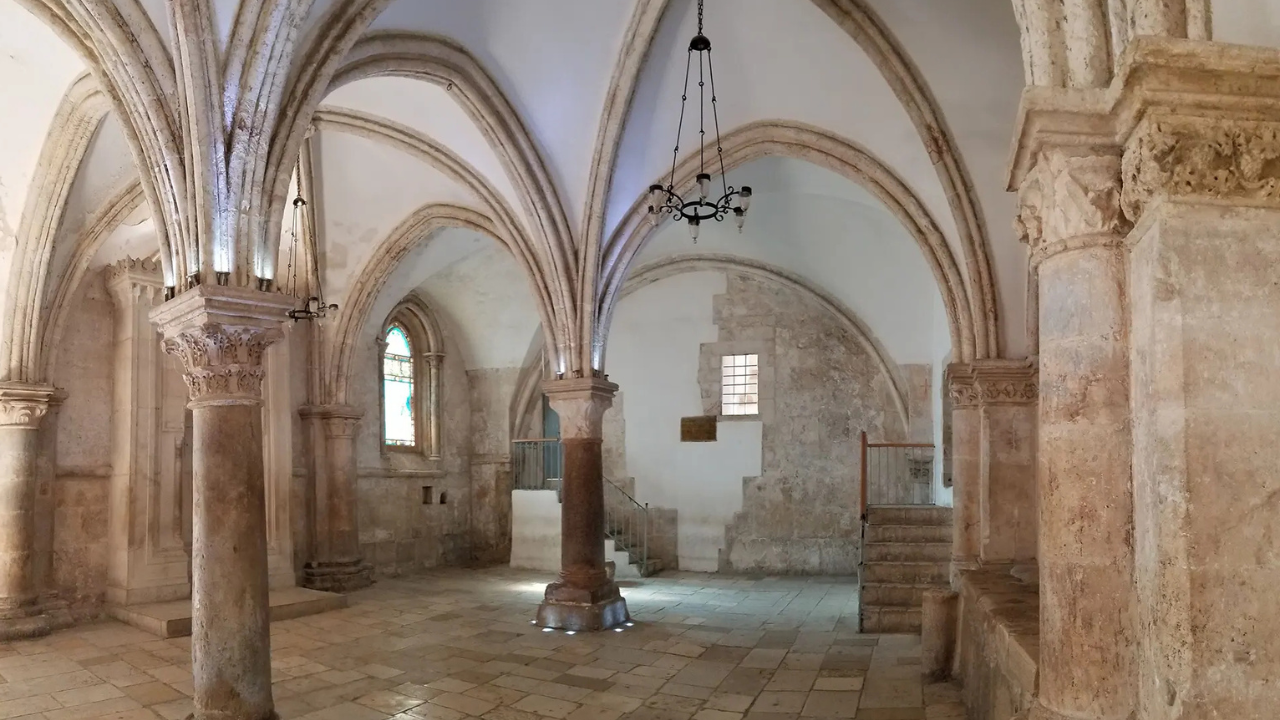

The largest group of graffiti has been left by Arabic -speaking Christians in the East according to the press release, but pilgrims from Armenia, Syria, and even Serbia and Czechies left their “dedication” within the cenacle.
Today, this place is known as “cenacle”. It was built by the crusaders in the 13th century. It measures 15 by 12 meters, and has no decorative elements, apart from architectural elements mixing several styles. It attracts many pilgrims from around the world to meditate in this room.
Pilgrims and pilgrims
It is in a detailed article of the prestigious Liber Annuus, the directory of the Studium Biblicum Franciscanum of Jerusalem that an international research team including historians from the Austrian Academy of Sciences (OEAW) and the Israeli Antiquities Authority (IAA) detailed inscriptions on the walls of the Cenacle, thanks to digital methods.
In the majority of cases, these inscriptions date from the end of the Middle Ages. Scientists have notably discovered a fragment of Arab registration “… ya al-ḥalabīya ”. However, for scientists, it is a graffiti representing a pilgrim from the Syrian city of Aleppo (deduction made following the observation of the female suffix “Ya”). This is therefore a very rare material trace of a female pilgrimage!
An overview of the geographic origin of pilgrims
Scientists were also able to identify the signing of some historical personalities, including Johannes Poloner de Rastibonne, who had written the story of his pilgrimage to Jerusalem between 1421 and 1422. But what is the most striking in studying these graffiti is to see how the pilgrims came from the four corners of the world to come and collect themselves within the cenacle.
“” “All of these inscriptions offer a unique overview of the geographic origin of pilgrims. This was much more diverse than the current research perspectives, dominated by the West ”suggests, Explains in the press release Ilya Berkovich, co-author of the study of the Oeaw.
To conclude, these discoveries “shed new light on the diversity of medieval pilgrimages”, according to the article.
Sources : the Austrian Academy of Sciences, Iflscience

With an unwavering passion for local news, Christopher leads our editorial team with integrity and dedication. With over 20 years’ experience, he is the backbone of Wouldsayso, ensuring that we stay true to our mission to inform.


