
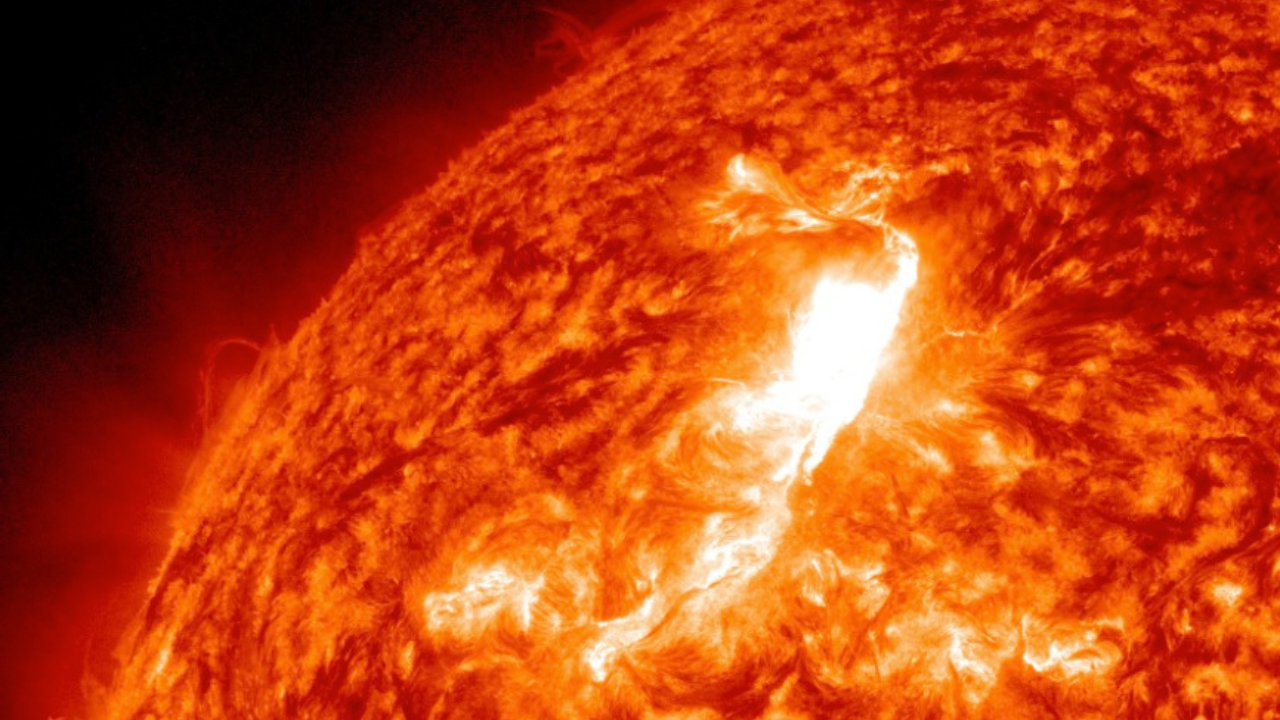

Recently, violent solar flares took place, causing a striking and exceptional spectacle in the northern hemisphere with the appearance of the Northern Lights. However, these phenomena occurring 150 million kilometers from Earth are not only responsible for the appearance of celestial glow. No, they can endanger infrastructure in Earth orbit, but also directly on Earth. It is in this sense that IBM, a pioneer in new technologies and AI, developed Surya in partnership with NASA.
Science & Life was able to discuss with Xavier Vasques, Vice-President and Technical Director R&D of IBM France, about this model which intends to predict solar weather.
Science & Vie: Solar weather, but not only that. Surya is your third AI model for space, what are the others?
Xavier Vasques: We actually have two major partnerships (ESA and NASA) with three major families of geospatial models, all open-source.
First we have Prithvi, a model which uses a type of data, images, coming from NASA satellites thanks to which we can look at soils and their use, vegetation, climate, but also the weather etc. It is therefore a model essentially made to observe the Earth for the scientific community to know and understand the impact of global warming.
We then have TerraMindin partnership with the European Space Agency (ESA). This model is distinguished by the fact that the data are not just images, but so-called multimodal data. We therefore have multispectral images [ndr, des images avec différentes longueurs
d’ondes] which come to us from the mission's satellites
Sentinel 2. Thanks to these we can identify urban areas, drought areas.… The other data on which TerraMind is based are notably radar data, from the mission Sentinel 1which allow the surface to be observed, even when it is camouflaged by clouds.
Finally, we have the Surya model, also in partnership with NASA, which will make it possible to anticipate solar flares whose consequences can be significant on our satellites or our telecommunications on Earth. The model is based on a database which has more than nine years of existence which comes from the Solar Dynamics Observatory (SDO). This satellite therefore captured numerous images, at different wavelengths, of the Sun and recorded numerous measurements of the Sun's magnetic field.
S&V: How does Surya work?
XV:So the goal is to take all the data collected over nine years and integrate it into generative AI to improve the accuracy of solar flare prediction. Something we achieved with 16% greater accuracy than other previous models. But that's not all because Surya can predict solar flares up to two hours in advance.
It doesn't seem like much, but in two hours we can turn off satellites (GPS, communications, etc.) and protect electrical generators that could be threatened following a solar flare. From the moment we have the alert, we can react accordingly and avoid the loss of equipment, but also warn of a potential danger some time before the launch of a rocket, for example.
S&V: Is the model intended only for NASA?
XV: Surya is an open-source model, meaning anyone can benefit from it. Today it has been made available, but has not yet entered operational mode. But we can very well imagine NASA using it to create a warning system based on data analysis to protect its satellites, just like Airbus or Thales. But it can also be weather systems or companies that need to protect certain infrastructures.
S&V: How has AI almost become indispensable in research?
XV: I don't know if we can say, at the moment, that AI has really become essential in research. Faced with certain problems, particularly with regard to solar weather which can have a more or less long-term impact on our planet, it has become an ally to save us worries.
Surya, which makes it possible to alert two hours in advance of the occurrence of a solar flare and therefore the possibility of initiating reactions to this, is a good example. But it is not yet possible to say that it has become essential.
On the other hand, from my point of view, it has become so in the context of climate change because it allows us to better understand the impact but also to better anticipate future changes and the consequences that this could have on the environment and, in fact, on the population.
And if we go further, this kind of analysis model [ndr,
Prithvi ou TerraMind] of the impact of climate change or simply analyzing the Earth, is today mainly intended for research, but nothing prevents in the future from seeing a real estate developer or an insurer take it in hand to find out if land is buildable or if it is worth insuring this or that area.
Finally, we can also say that these AI models could also be used by governments and states to establish policies in the direction of climate change or adapting to the impact of the latter on their country.
S&V: We know that solar flares can have visible consequences on Earth with the Northern Lights. Could Surya therefore predict these celestial phenomena?
XV: In the sense that Surya was developed to predict solar flares, there are chances of the Northern Lights occurring on Earth if such an event occurs. However, I don't think that, right away, this is the application that is preferred.
But that doesn't rule out the fact that one day we might receive a text message or an alert on our phone telling us “There is such a chance that the Northern Lights will appear in a certain area» from a meteorological service which would have taken Surya in hand for this purpose.
Well, don't be disappointed if you end up seeing nothing when you move around the indicated area.
S&V: With these geospatial models, IBM is increasingly in space, is the company tending to perpetuate its position in orbit in other areas or missions?
XV: We have a strong history in the space sector. When our friends went to the Moon in 1969, there were already IBM processors at the time. We also participated in the International Space Station (ISS) mission by sending a small artificial intelligence robot which made it possible to discuss and find documentation.
So it’s already in our DNA to work with space agencies like NASA or ESA or major geospatial clients. This will always be an area in which we will invest. Whether on the software, hardware or AI side, we will inevitably be involved in some way in space.

With an unwavering passion for local news, Christopher leads our editorial team with integrity and dedication. With over 20 years’ experience, he is the backbone of Wouldsayso, ensuring that we stay true to our mission to inform.


