

[Un article de The Conversation écrit par Coline Deveautour – Enseignante-Chercheuse en Ecologie microbienne des sols, UniLaSalle, Anne-Maïmiti Dulaurent – Enseignant-chercheur en écologie animale et agroécologie, UniLaSalle & Marie-Pierre Bruyant – Sciences végétales, UniLaSalle]
The floors make us precious services and still too often invisible: it is thanks to them that many species – including ours – can feed, even dress, thanks to textile cultures. They are the physical basis on which a large part of terrestrial ecosystems – as well as human infrastructure – are built.
They provide incomparable ecosystem services. Not only are the floors to provide plants with the water and nutrients necessary for their growth, but they also make it possible to regulate the water cycle, between the runoff of the rain and its infiltration. Therefore, they play a key role in alleviating the extent of the floods. Their carbon well function also makes them precious allies of decarbonation.
The floors represent an essential habitat for the survival of certain organisms such as microorganisms (bacteria, fungi, algae, protozoa, etc.) but also more or less large animals (Lombricians, arthropods, nematodes, etc.), all linked by a complex food chain.
These organizations are very numerous: a teaspoon of soil contains more living beings than there are humans on earth! There are several hundred millions of bacteria there, several tens of thousands of mushrooms, hundreds of protozoa and dozens of arthropods such as mites or Collemboles.
Under these conditions, a healthy soil is a soil that works well, that is to say which constitutes a suitable habitat for all these living beings. He offers them the cottage and the cover: a safe and constant roof and enough to eat sufficient. The good health of a soil is an undeniable asset for agriculture in terms of fertility, production and the fight against diseases…. But how can you just measure it?
From sausage test to pierced panties
Tests, as a researchers specializing in agricultural environments, we have known: from the sausage of the sausage to that of the glass of water, from the color to the smell of the soil, from the test to the dryer to the earthworms, there is embarrassment of choice.
Let us talk about one of these tests which has the merit of being simple, effective and not devoid of humor: the famous Slip test. To find out the health of a soil, agricultural for example, we can thus bury a pure untreated pure white cotton, then unearthed a few months later in order to note its state.
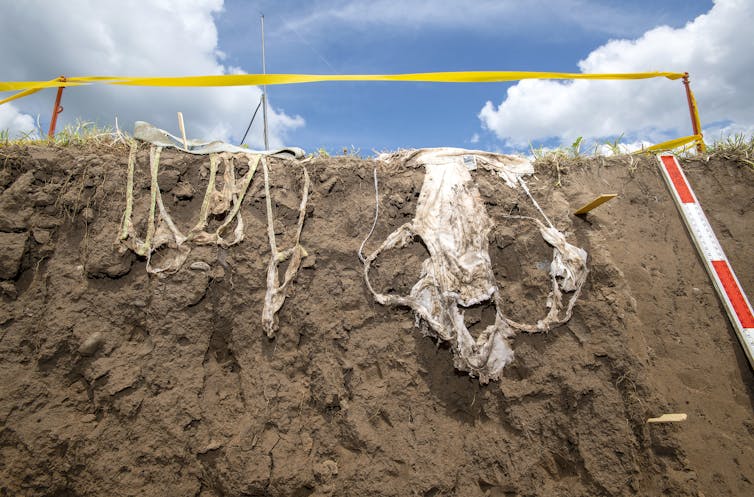
The interpretation is fast and easy: a rather intact underwear will be bad news, while a holey panties will be a sign of a degradation of cotton cellulose. The explanation is a little more complex: healthy soil is inhabited by a wide variety of organisms, which give it optimal functioning, and in particular a good level of decomposition and mineralization of organic matter.
These are the soil functions that allow the recycling of the nutrients necessary for plant growth. However, the cellulose of pants, for example, is an organic matter. Thus, if the Slip is in good condition when it is drunk, this indicates that it has not been degraded, and that the soil does not correctly fulfill its decomposition functions.
Tea sachets, a reference test
To refine the analysis, there is another less publicized test: that of tea sachets.
It is enough to bury tea sachets with different compositions (green tea or rooibos), more or less “digestible” for soil organisms – and therefore more or less difficult to degrade – and to study the weight loss of sachets after a given time. If they have lightened, it is because they have lost matter-and therefore that it was broken down by soil organizations.
After all, a tea sachet simply contains dead plant material inside a nylon canvas. This represents a good bait for decomposing organizations. But all teas are not equal: green tea is easier to degrade, while the king is more woody and takes longer to be broken down. Compare the two therefore makes it possible to assess to what extent the soil can degrade different types of organic matter.
This can lend to smile, but it is a standardized method implemented by researchers. Its protocol is available for anyone wishing to assess the effectiveness of soil degradation.
Not only does this provide valuable information on soil ability to break organic matter, but such a protocol makes the results comparable between different sites around the world, regardless of the soil.
Thanks to this method, unilasalle researchers and farmers from Hauts-de-France were able to highlight a better level of degradation of organic matter in soils in soil conservation agriculture, a less intensive agricultural management mode than conventional mode.
Sain soil is essential for farmers. In the event of a bad decomposition of the material (that is to say, intact briefs and tea sachets which seem ready to be infused despite several weeks spent in the soil), more laboratory analyzes are then useful for understanding where the malfunction comes from.
Soil analyzes, precious for farmers
The soil analyzes make it possible to take stock of soil health, and are therefore precious for farmers. These analyzes can be interested in several parameters and are carried out in the laboratory after having sampled the soil of the plots.
They can thus measure:
- Soil texturewhich informs about the proportion of sand, silt and clay. This is important, because some textures are favorable to a type of culture, but not others. Whatever his practices, the farmer has no effect on this parameter, but must take it into account to adapt his production and his cultures.
- The level of organic matterwhich corresponds to the proportion of substances resulting from the decomposition of plants, animals and microorganisms present in the soil. A high rate improves soil capacity to retain nutrients and strengthens its structure. The farmer can increase it by regularly providing different types of organic matter, such as farming effluents, methanization digestates or by promoting the restitution of plants to the ground.
- The concentration of available nutrients on the ground (phosphorus, potassium, magnesium, etc.) provides information on their presence, sufficient or not, to ensure the needs of cultivated plants. A low concentration of a nutrient can be offset by the contribution of mineral fertilizers or different organic matter which, broken down by the inhabitants of the soil, will release this nutrient.
- Finally, PH, which indicates the acidity of the soilimpacts the development of plants. He can for example influence the availability of nutrients, but also the presence and activity of beneficial organizations for plants. It is possible for the farmer to act on this parameter by different types of contributions, such as lime which makes it possible to avoid too acidic pH.
All this information makes it possible to guide soil management by the farmer. Soil analyzes can be repeated over the years, in particular to monitor the state of a plot according to the agricultural practices implemented.
New bio-indicators under development
As we have understood, soil organizations are largely responsible for its proper functioning and its state of health. But they are sensitive to their environment and soil management. Thus, to take into account their presence, new indicators based on the life of the soil emerging for a few years: we speak of bioindicators to describe these species which, by their presence, provide information on the ecological characteristics of the environments.
Of course, different bioindicators provide different information: the abundance and diversity of the mesofauna (Collembols and mites) provide information on the capacity of the soil to cut the material well, and the mushrooms rather on the effectiveness of the recycling of nutrients. The sensitivity of these organizations to agricultural practices makes good bioindicators.
Other organic indicators are currently being tested, for example to assess the proper functioning of the carbon cycle and that of nitrogen.
These tools are not necessarily accessible for the majority of farmers because they have a financial cost for the moment too high. A research axis would therefore be to develop tests based on bioindicators that are easier to implement and interpret. 

With an unwavering passion for local news, Christopher leads our editorial team with integrity and dedication. With over 20 years’ experience, he is the backbone of Wouldsayso, ensuring that we stay true to our mission to inform.


