
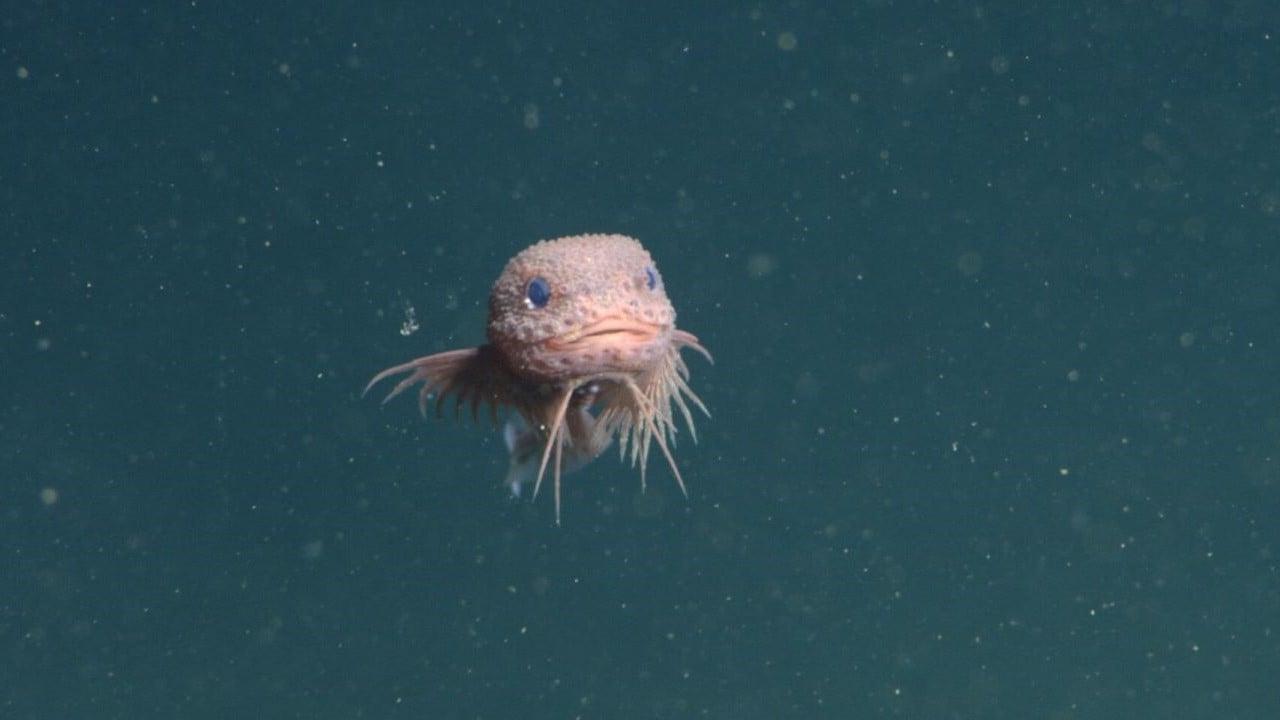

The major seabed, located thousands of meters below the surface, represent one of the least studied circles on the planet. This is where some of the most unknown species in the animal kingdom live, often inaccessible without the help of specialized technologies. In 2025, a team of biologists from Suny Geneseo universities, Montana and Hawaii, in collaboration with the Monterey Bay Aquarium Research Institute (MBARI), described three new species of abyssaux light fish.
Explore abyss to understand extreme life
The ocean abysses remain among the most unknown environments on the planet. Located between 3,000 and 6,000 meters deep, these seabed are subject to overwhelming pressure, temperatures close to the freezing point and permanent darkness. Despite these extreme conditions, they house a diversified fauna, part of which is still unknown to science, explains Connected oceans.
It is in this context that the Monterey Bay Aquarium Research Institute (MBARI) has been leading for several decades for robotic exploration campaigns. In 2019, two separate expeditions enabled the collection of three specimens of light fish until then unidentified. The dives were carried out off California thanks to the Doc Ricketts submarine robot and the Alvin submersible, at respective depths of 3,268 and 4,119 meters. These sites, including station M, are long -term observation places, studied for more than 30 years.
The researchers analyzed these fish using comparative morphology techniques, 3D imaging and DNA sequencing. The objective was clear: to determine if they were species already known or completely new. Gerringer underlines the importance of this work in a press release. “” Discovering three species in a region as well studied shows how our knowledge of the abyss remains partial ».
Three abysmal fish with new characteristics
The three fish identified in 2025 each have the morphological and anatomical characteristics sufficiently distinct to justify their classification as new species. They all belong to the Liparidae family. This family brings together more than 400 species of light fish distributed in the cold and deep oceans.
The first, Careprotus colliculi is nicknamed ” BUMPY SNAILFISH ». His pink skin is indeed dotted with small fleshy protuberances, particularly visible on the head. He has a short body, a rounded head with large eyes, and an abdominal suction cup developed. The female specimen measured 9.2 centimeters. It was filmed at 3,268 meters deep, in the Monterey canyon. A single confirmed observation exists for this species. But archive images suggest that a similar individual had been filmed in 2009 off Oregon.
The second, Careprotus yanceyiOr ” DARK SNAILFISH »»therefore presents an integral black dress. He has a rounded head, a horizontal mouth, and a more modest suction cup. It is larger, with 15.6 centimeters in length. Its bone structure, its simple teeth and its pectoral fins in two lobes indicate an adaptation to the very stable and obscure conditions of the abyss.
Finally, Paraliparis emTHE ” Sleek Snailfish », Presents an elongated and laterally flattened body, without a suction cup, a rare characteristic in this group. His absence of an abdominal disc, combined with an angular jaw and a smooth black body, oriented researchers to the genre Paraliparis. It was taken at 4,115 meters deep, during the same dive as C. Yanceyi. Each of these fish has been designated as a holotype, that is to say the reference copy for its scientific description.
How to identify a new species in the abyss
Identifying a new abysmal species is a complex process, which combines several complementary approaches. The three fish described have been the subject of a advanced morphological analysis, a micro-CT scan, and a genetic sequencing, in order to verify their originality compared to the already known species.
The microscanners used made it possible to reconstruct in three dimensions the internal anatomy of each fish. Including fragile bone structures, impossible to observe without damaging the specimen. These images have revealed key details such as the number of vertebrae, the structure of the fins, or the shape of the teeth. Often decisive elements to differentiate species within Liparidae.
Genetic analysis, based in particular on the Coi genes (Cytochrome Oxidase I) and 16S, has made it possible to locate each species in the phylogenetic tree of the light fish. The authors compared the sequences to those available in the Genbank database. This confirmed that Careprotus colliculi,, C. Yanceyi And Paraliparis em did not correspond to any other species described. Their closest genetic sequences had similarities less than 97 %. A threshold considered to be significant to justify a specific distinction.
The researchers communicated the results with a high level of scientific transparency. Imaging data are accessible on Morphosource, and genetic sequences on NCBI Genbank. This opening allows other researchers to reuse data and compare it to future samples. According to Gerringer, ” Each anatomical characteristic and each DNA sequence strengthen the individuality of these species. The crossing of these methods gives us a robust and precise vision ».
Why these discoveries change our gaze on the great funds
The discovery of three new species in an area already studied for several decades challenges. It shows that abyssal biological diversity remains underestimated, due to logistical and technological difficulties to explore these environments. Unlike coastal waters, large funds are not accessible by conventional means.
The researchers believe that there is a significant sampling bias between 3,000 and 5,000 meters deep. At these levels, the traps and cameras attract large fish more frequently than small light fish, often discreet, even invisible on videos.
In addition, the identification of distinct species, cohabiting in close zones, but with very different morphologies and genetic, questions the mechanisms of adaptation and evolution in the abyss. “” The fact that two very different species were collected in the same place, in a single dive, shows how poorly known this ecosystem is », Note Mackenzie Gerringer.
Beyond the scientific aspect, these discoveries have implications in terms of conservation, underlines Iflscience. Abyssal funds are now targeted by submarine mining or carbon storage projects. Without precise knowledge of the present species, their ecological role or their distribution, all human activity has major risks.
For Steven Haddock, principal researcher at Mbari, ” It becomes crucial to document biodiversity before it is altered. Each new species identified reminds us what remains to protect ».
Source: Mackenzie E. Gerringer et al., “Descriptions of Three Newly Discovered Abyssal Snailfishes (Liparidae) from the Eastern Pacific Ocean”, Ichthyology & Herpetology (2025).

With an unwavering passion for local news, Christopher leads our editorial team with integrity and dedication. With over 20 years’ experience, he is the backbone of Wouldsayso, ensuring that we stay true to our mission to inform.


