
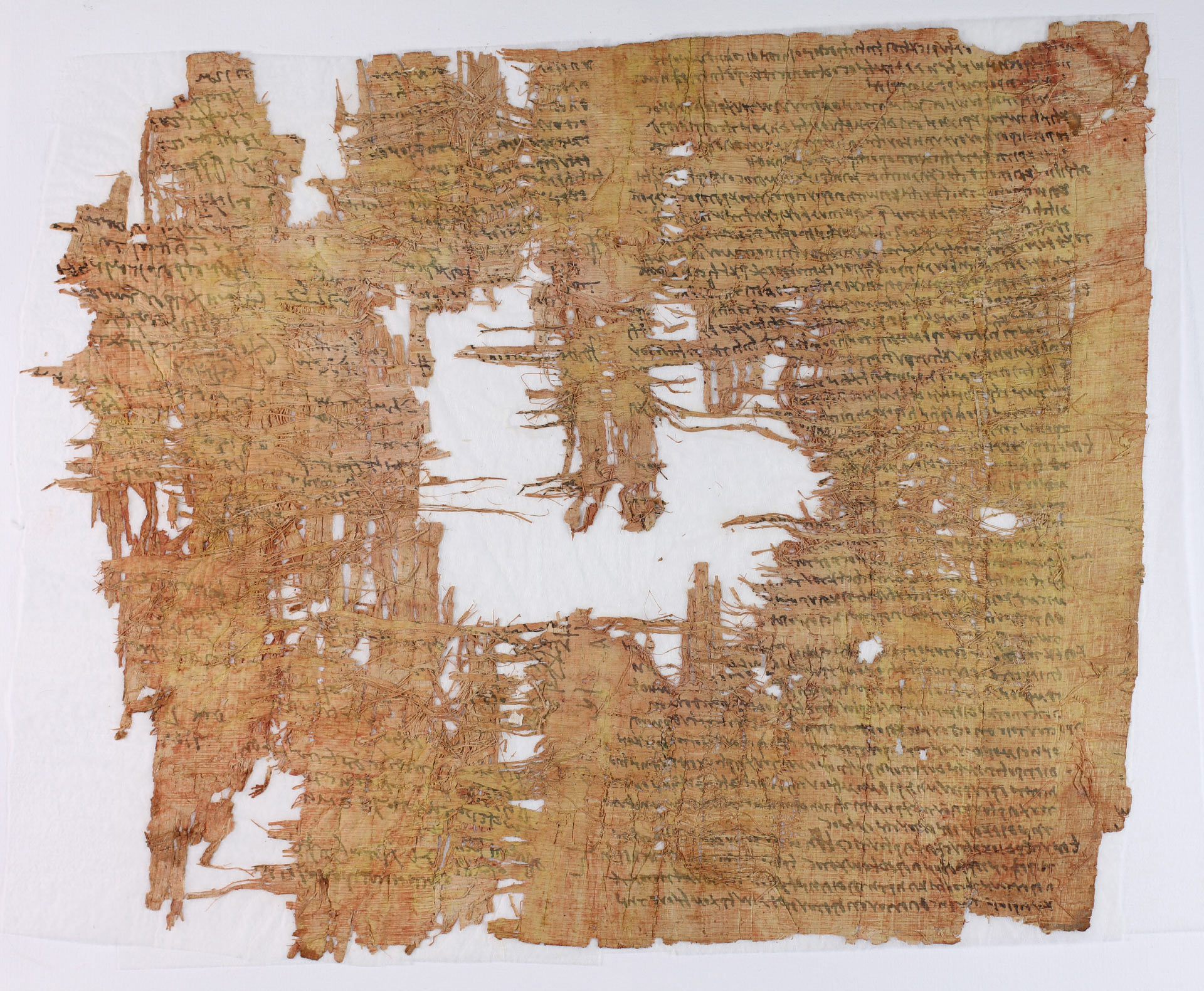

The old archives are often badly classified sometimes even forgotten. However, they can contain unique testimonies on over -gone eras. This is the case of a papyrus rediscovered in the collections of the Israeli Antiquities Authority, after being poorly identified for decades. Dated approximately 1,900 years, this exceptional document sheds unprecedented light on the functioning of Roman justice in Judea, trials and on tax and political tensions which preceded the Kokhba bar revolt (132-136 AP. J.- C.).
A fortuitous rediscovery, a historic treasure
The rediscovery of the “Papyrus Cotton” is based on a competition of circumstances. In 2014, when she was carrying out a classification work in the archives of the Israeli Antiquity Authority, Professor Hannah Cotton-Paltiel, of the Hebrew University of Jerusalem, identified this formerly poorly classified document as a Nabatean text.
By examining more closely writing, she immediately recognized ancient Greek. She understood then that the papyrus, 133 lines long, deserved an in -depth analysis. His intuition led to the training of an international team of specialists, including Fritz Mitthof of the University of Vienna and Anna Dolganov of the Austrian Academy of Sciences. The analysis of the text revealed that it was a detailed report of a Roman trial involving tax fraud and falsification of documents.
A trial for tax fraud and false in writing
The papyrus therefore details how Gadalias and Saulos have set up a sophisticated tax fraud system. They operated slave transactions to bypass the imperial administration. By falsifying acts of sale and emancipation, they sought to avoid payment of the taxes required on these operations. This type of fraud is certainly risky. But it is part of a context where Rome imposed a strict tax control over the provinces, considering any escape as a challenge to its authority. The document also indicates that Gadalias, as the son of a notary, had sufficient legal knowledge to orchestrate these manipulations. This raises the question of potential complicities within the local administration.
The implications of the trial exceeded simple financial fraud. Gadalias was already involved in extortion and counterfeit cases. For its part, Saulos appeared to be the executor of fraudulent operations, organizing false transactions and writing falsified documents. The papyrus highlights the severity of their situation, the Roman sanctions being particularly severe for these crimes. The convicts could be subject to forced work, even to the death penalty. “” The liveliness and direct tone of the papyrus show that these are notes taken by a prosecutor in preparation for the trial “, Underlines the researcher Anna Dolganov.
An explosive political context for a magnitude
The trial described in the papyrus cannot be dissociated from the climate of tension that reigned in Judea on the eve of the Kokhba bar revolt. The Roman administration, under the Emperor Hadrian, reinforced his control over the province. And particularly after the previous Jewish revolts, including that of the diaspora (115-117 AD). She had caused severe repression. In 129-130 apr. AD, Hadrian himself visited the region. He took administrative and military measures intended to stabilize the territory. In this context, any violation of the law, in particular when it involved influential local figures like Gadalias and Saulos, could be perceived as a threat to the imperial order. The Roman authorities tended to associate economic crimes with forms of political resistance. We then interpreted fraud with imperial taxes as a direct questioning of Roman power.
The papyrus also mentions the governor of Judea, Tineius Rufus. We know him in particular for his role in the repression of the Kokhba bar revolt. His presence in the text indicates that the case was not limited to a simple local legal proceedings. But it was important enough to attract the attention of the highest Roman authorities. Some researchers believe that the charges brought against Gadalias and Saulos were going beyond tax fraud. They could hide suspicion of sedition. “” The question remains open, but the simple fact that this suspicion is mentioned shows the atmosphere of distrust and repression that reigned “, Underlines Avner Ecker, epigraphist at the Hebrew University of Jerusalem.
An unprecedented overview of Roman law in the provinces and trials
The “papyrus cotton” therefore constitutes an exceptional source to understand the application of Roman law in the provinces. Particularly in Judea, a region marked by political and social tensions. According to Fritz Mitthof, professor at the University of Vienna, this document confirms that the legal proceedings observed in Egypt, where Roman governors held regular meetings and where local jurors participated in trials, were also in force in Judea. It illustrates the standardization of imperial law through the Eastern provinces. This guaranteed that the same administrative and judicial mechanisms applied themselves homogeneously in the Empire. Anna Dolganov stresses that the structure of the trial transcribed into the papyrus corresponds to known Roman legal practices. A prosecutor writes strategic notes before the hearing, evidence is discussed. Then the case is treated in a well -defined institutional framework.
One of the most striking aspects of the papyrus is the importance given to the tax audit, a pillar of the Roman management of the provinces. Rome closely monitored private transactions, in particular those concerning slaves. Indeed, they represented a significant source of income thanks to the taxes imposed on their sale and their emancipation. “” The Empire did not tolerate any loss of income, especially in a province as unstable as Judea “Explains Avner Ecker. The Gadalias and Saulos affair shows how much Roman authorities considered tax fraud as a serious threat, justifying rapid judicial intervention and exemplary sanctions.
Source: Hebrew University of Jerusalem

With an unwavering passion for local news, Christopher leads our editorial team with integrity and dedication. With over 20 years’ experience, he is the backbone of Wouldsayso, ensuring that we stay true to our mission to inform.


