

The fire has gone out, the smoke has dissipated… but the forest does not grow back. In Portugal as elsewhere, the scenario is repeating itself. Despite human efforts and deployed technologies, the most vulnerable areas remain barren, impassable or forgotten. It was on this observation that two students decided to take action. Their solution? An autonomous reforestation robot, designed to do what drones, tractors and volunteers can no longer do.
Climate, driving force behind a spiral of fires in Portugal
Since 1980, forest fires have consumed nearly 5 million hectares in Portugal, or 54% of the continental territory. Years like 2003, 2005 and 2017 marked historic highs with more than 470,000 hectares going up in smoke. The year 2017 alone represents 60% of the area burned across Europe, and was marked by two heat waves and extreme drought. The study by climatologist Carlos C. DaCamara, published in 2024 in the journal Climate, shows that the intensity of fires is now directly correlated to a drought index called CDSR, the trend of which is sharply increasing.
The climate makes fires longer, more violent and more devastating, especially on steep slopes. However, more than 60% of Portuguese forests are located there, which seriously complicates their reforestation. The slope becomes slippery, the soil compacts, the vegetation disappears. Agricultural machinery cannot climb there without damaging the fertile layers. At the same time, drones drop seeds without precision. Their germination rate rarely exceeds 20%, according to Smithsonian Magazine. For their part, volunteers must deal with fatigue, danger and difficult access to burned areas.
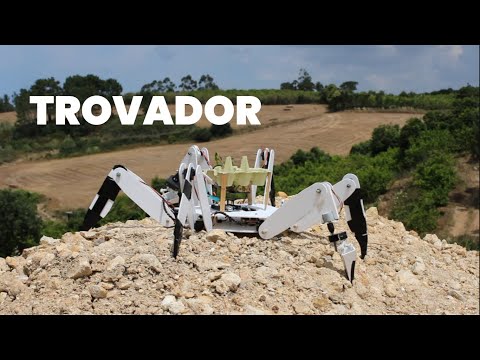
The reforestation robot, a response designed for the field
It was while growing up on the edge of these ravaged forests that Marta Bernardino and Sebastião Mendonça, two young 19-year-old Portuguese people, designed Trovador, a six-legged robot capable of planting trees where no one passes. With an ant-like gait and autonomy powered by artificial intelligence, the machine has been designed to tackle the most demanding terrain. It climbs 45-degree slopes, avoids rock blocks using a depth camera, and adapts its route in real time according to the humidity and pH of the soil.
Unlike conventional agricultural vehicles, Trovador does not compact the soil. Its light weight preserves the porosity of the soil. This porosity remains vital for the respiration of roots and microorganisms. In addition, its mode of movement limits repeated pressure on the ground. This point remains essential, as highlighted in a large review published in Forest Ecology and Management. The authors describe the lasting effects of settlement caused by heavy machinery. They talk about the drop in oxygen in the soil. They also note stronger runoff and more rapid erosion of fertile layers. All of this then slows down the regeneration of forest environments.
The robot follows a three-step protocol: digging, placing the young plant, lightly packing. This method achieves up to 90% survival in real conditions, according to the first tests carried out in Lisbon. Its current capacity exceeds 200 plantations per hour, without requiring human intervention after deposit.
Towards an intelligent and ethical reforestation model
The strength of the project does not lie only in technology. It also offers a new economic and ecological model. Rather than selling the robot, the team plans to offer an on-demand service. Municipalities, NGOs or companies can map an area on an application, select local species, and receive a quote. This solution, promising for Portugal but also for the tropics or California, could cost up to six times less than manual replanting.
Every action of the robot is recorded precisely. It keeps track of GPS coordinates, humidity and available energy. Ultimately, this data could help to better distribute the plants. This would avoid areas that are too dry or too unstable. Trovador constantly observes, adapts and learns.
By integrating the climate dimension from the design stage, the project breaks with traditional approaches. Where reforestation was limited to a symbolic or artisanal act, here it becomes measurable, traceable, scalable. The reforestation robot does not replace humans. It completes its limits, in a context where time is running out, burned areas are increasing, and soils are not waiting.

With an unwavering passion for local news, Christopher leads our editorial team with integrity and dedication. With over 20 years’ experience, he is the backbone of Wouldsayso, ensuring that we stay true to our mission to inform.


