
At the hinge of the Middle Ages and the Renaissance, Europe sees new types of powers rise, built as much on prestige as on military technology. While the southern kingdoms set out to conquer the globe, some sovereigns of the North bet on other forms of supremacy. In this tense and abundant context, the emergence of medieval artillery on board a warship as massive as sophisticated reveals a very different, but just as strategic ambition.
Unlike other monarchs, Hans is regularly on board. It uses the ship for its trips to Sweden, Norway or Gotland. In 1487, he personally led a military operation to regain control of the Visborg castle. The ship thus becomes an instrument of governance, but also of diplomacy and administration, a marine extension of the stone castles. This strategy of territorial occupation by the sea is based on an infrastructure as expensive as it is ambitious. In 1485, the Grshunden would have engulfed on its own 8% of the Danish national budget.
This choice reflects a more than imperial regional territorial ambition. While the Iberian powers invest in shipping fleets, Hans concentrates its resources on the control of Nordic seas. In 1495, when he was preparing a political summit in Kalmar, a mysterious explosion shed the Gribshunden off the coast of Ronneby. It is this shipwreck, which has remained enigmatic for centuries, which will one day rediscover one of the best preserved medieval arsenals in Europe.
Under the boards, an exceptional medieval artillery
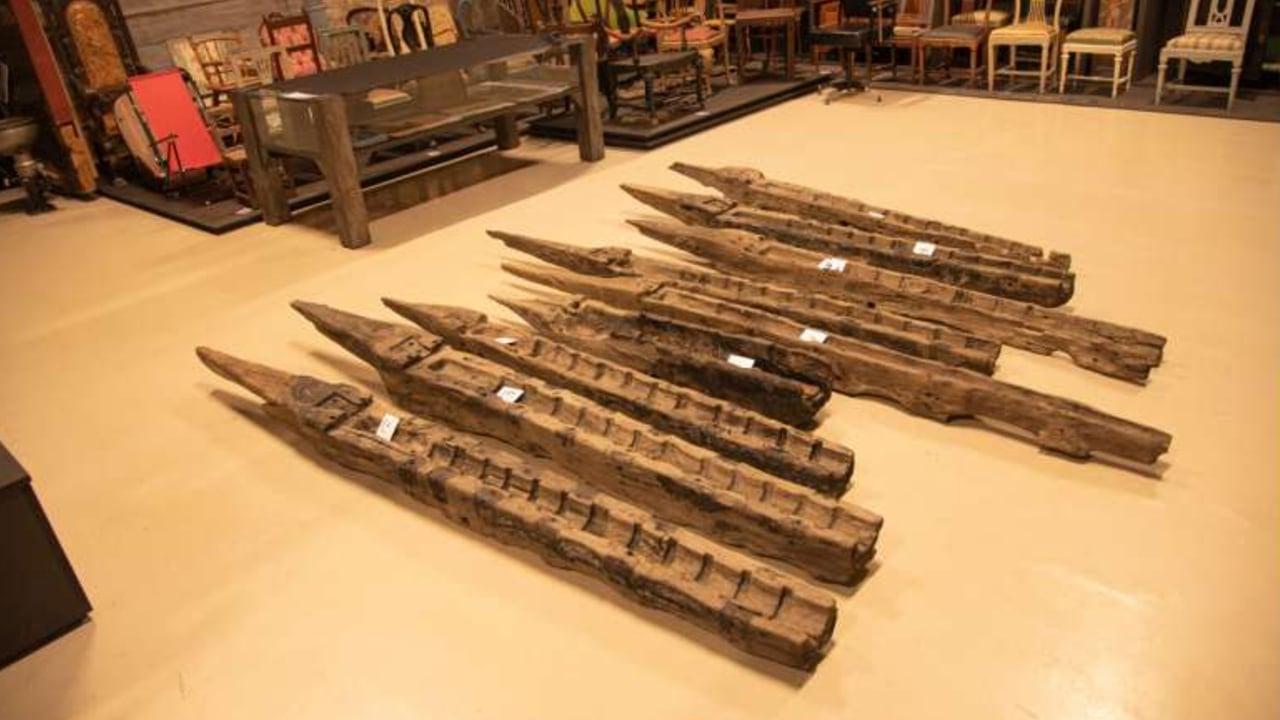
When archaeologists from the University of Lund set out to study the wreck in detail, they quickly achieve its importance. Immersed in the cold and little salty waters of the Baltic Sea, the Gribshunden was remarkably preserved. In particular, its oak cannons beds – the supports of on -board weapons – are intact, a extremely rare fact for a wreckage of this time.
In total, the researchers identified 14 artillery pieces aboard the ship. Most were serpentines, small medieval guns designed for close shooting. According to analyzes published in International Journal of Nautical Archaeology, these weapons were used above all to decimate the crews before discomfort. They were therefore not thought of to sink enemy ships. In addition, a 3D reconstruction led by Professor Nicolo Dell'Unto made it possible to better understand their manufacture. These wrought iron cannons were reinforced by heated straps, then fixed on solid wood.
The most remarkable is the standardization of artillery parts. Some powder rooms seemed interchangeable between several cannons, which was rare at the time. This suggests a clear desire to optimize logistics and improve combat efficiency. In addition, traces of sulfur discovered in a room confirm the use of black powder. Finally, the presence of a wooden Linstock reinforces the idea of continuous operational armament.
Part of the found ammunition is distinguished by its unusual design. Indeed, archaeologists have identified 22 lead projectiles, each with an iron heart. Some even have flattened faces, sometimes on one side, sometimes both. This detail attracts the attention of researchers because it could be linked to an explosion. If the balls were stored near the powder, an internal impact could have caused these deformations.
 © Klas Malmberg
The wreck of the GribShunden delivered an exceptional medieval artillery, revealed here during the underwater excavations led by Swedish archaeologists.
Why Denmark has never conquered the new world
The paradox is there. How did a kingdom with such a naval tool not participate in the race for colonial empires? In 1492, Christopher Columbus paved the way for Spanish conquistadors. Three years later, Hans lost his flagship. Technically, nothing prevented Denmark from entering the running. The kingdom had expert know-how of Flanders, well-paid masters gunner, an exploration history towards Iceland and Greenland. However, the dynamics did not follow.
Several factors explain this disengagement. First, geopolitical priorities. Hans seeks above all to consolidate his power in Scandinavia. Then the fear of the Vatican. In 1493, the Inter Caetera bubble of Pope Alexandre VI granted Catholic kingdoms of Spain and Portugal exclusive rights in the newly discovered territories. At a time when excommunication is still a serious political threat, this papal decision cools many Nordic ambitions.
Finally, the cost of these expeditions remains considerable. Between the construction, the equipment, the pay of sailors and the powder supply, a ship like the Gibshunden represents a financial chasm. The Danish monarchy, whose income depends heavily on herring and toll of the Øresund strait, cannot compete with the centralized resources of the Spanish crown.
The GribShunden, exhibited today at the Blekinge Museum, embodies this historic alternative. That of an empire that could have been born in the north but which stopped at the gates of the Atlantic. The wreck testifies to the precise moment when the naval power did not yet guarantee a colonial destiny, and when medieval artillery remained at the service of local ambitions. A world tilted, but not all of them took part.

With an unwavering passion for local news, Christopher leads our editorial team with integrity and dedication. With over 20 years’ experience, he is the backbone of Wouldsayso, ensuring that we stay true to our mission to inform.


