
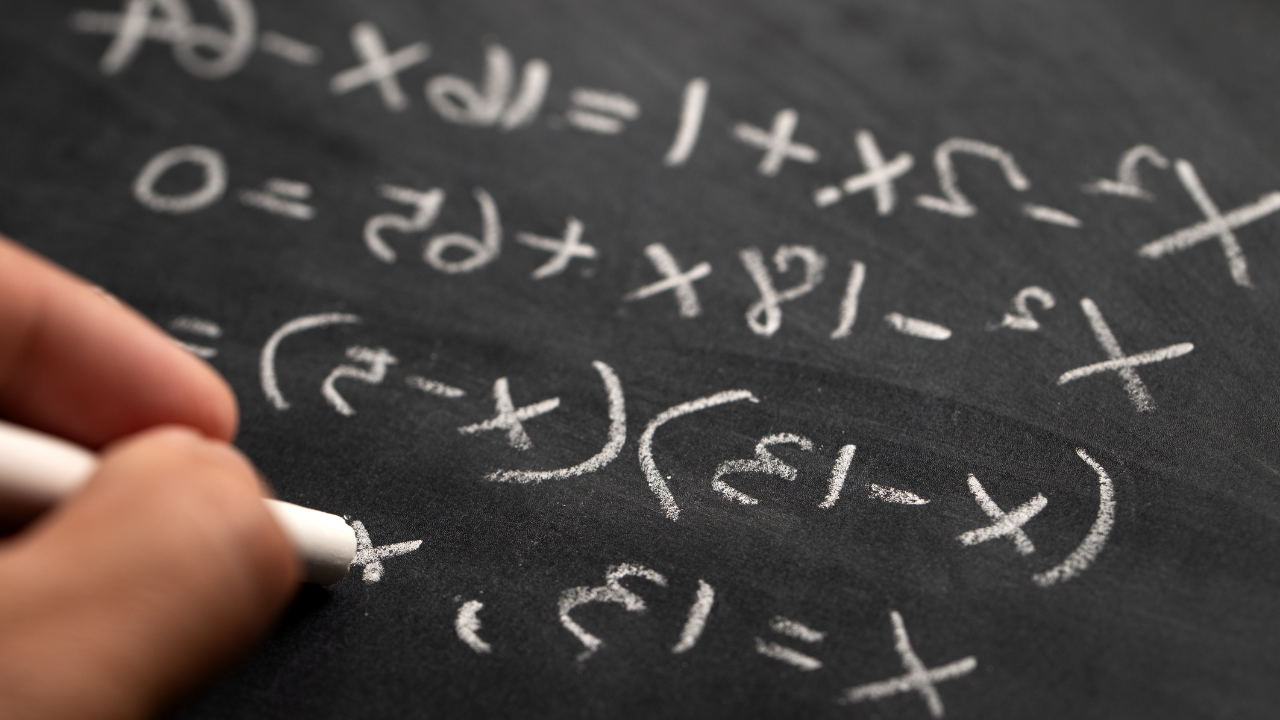

The history of the polynomial problem
Mathematics have been for many college or high school students of Charabia mixing numbers and letters, and algebra is one of them. This branch of mathematical science is characterized by equations called “polynomials”, which have existed for thousands of years. Indeed, solutions to two degree polynomials date from the Babylonian era, almost 4000 years ago.
Called “square completion method”, it later gave birth to the familiar quadratic formula, which allowed scientists of the 16th century to solve the polynomials of degrees three and four. Present in various fields such as computer science or astronomy, in particular to describe the movement of planets. But a problem persisted: why does this technique do not solve polynomials of degrees five?
A mathematician solves the oldest problem in algebra
Demonstrated by the French mathematician Evariste Galois in 1832, the quadratic formula did not allow the equations of degree five and more to be resolved. But recently, Norman Wildberger, a mathematician from Unsw Sydney, Australia, has developed a new method to solve this problem, which had been without solution for thousands of years.
In a study published on April 08 in the journal The American Mathematical Monthly, Written in collaboration with the computer scientist Dr. Dean Rubine, the scientist explained that the solution was to reject the radicals, which are mathematical operations which make it possible to extract the root of a number, and to no longer “believe in irrational numbers”, which, according to him, are based on imprecise concepts and lead to logical mathematics problems.
“Our solution reopens a hitherto closed book in the history of mathematics”
After Phys.org, Its new method is based on specific polynomial variants called “whole series”, which have an infinity of terms in the powers of X. He also uses new numbers of numbers, which represent complex geometric relationships, and which belong to a branch of mathematics called “combinatorial”. The best known example is the numbers of Catalan, discovered in 1838, and which dissected a polygon with any form.
Tests carried out on a famous cubic equation used by Wallis in the 17th century, made it possible to demonstrate that this method worked perfectly. “Our solution reopens a hitherto closed book in the history of mathematics”, he said. A book that has experienced approximate solutions to resolve the degree of degree five, but which do not belong to pure algebra, according to Norman Wildberger.
Source: Phys.org

With an unwavering passion for local news, Christopher leads our editorial team with integrity and dedication. With over 20 years’ experience, he is the backbone of Wouldsayso, ensuring that we stay true to our mission to inform.


