

[Un article de The Conversation écrit par Coralie Thieulin – Enseignant chercheur en physique à l”ECE, docteure en biophysique, ECE Paris]
In the shadows of the rockets that pierced the sky and the astronauts that walked on the Moon hid a woman with a mind faster than a computer. Katherine Johnson, a genius mathematician, calculated the trajectories that allowed America to conquer space. Before writing the history of NASA, she had to face that of her country: a segregationist America where being a black woman meant fighting every day to prove that genius has neither color nor gender.
“Girls are capable of doing exactly the same things as men. Sometimes, they even have more imagination than them. » —Katherine Johnson
A brilliant youth in segregationist America
Katherine Coleman was born on August 26, 1918 in White Sulfur Springs, West Virginia. The daughter of a lumberjack and a teacher, she grew up in an America deeply marked by Jim Crow laws. Very early on, his genius for numbers was evident and caused him to skip several grades at school. Unfortunately, at that time, the county where she lived did not provide education for black children beyond the age of 9 or 10. Her father, determined to give his daughter the education she deserves despite segregation, moved away for part of the year so that she could take quality courses at the West Virginia State College institute.
At age 15, she began her graduate studies there and met mathematician William Schieffelin Claytor, one of the first African Americans to earn a doctorate in mathematics. He takes her under his wing and encourages her to aim higher than society allows. In 1937, at age 18, she graduated with highest honors in mathematics and French.
That same year, she married the physicist and mathematician James Francis Goble, with whom she had three daughters. She began her career as a teacher, one of the few career opportunities for a black woman with a degree in mathematics at the time. His life seems mapped out: teaching, home, and a genius confined to the classroom.
His beginnings as a “human computer”
In 1953, the National Advisory Committee for Aeronautics (Naca), ancestor of NASA, opened a computing department reserved for African-American women: the West Area Computing Unit, headed by a compatriot from West Virginia, Dorothy Vaughan. Johnson applied and was hired as a “human computer” – literally a brain to do, by hand, what electronic computers were just beginning to accomplish. With her husband and daughters, she moved to Newport News, Virginia to join this new position.
In this universe, women calculate, men validate. Even worse: Katherine Johnson and her black colleagues work in a separate wing of the building, eat in a separate canteen and have to walk several hundred meters to find toilets reserved for them.
Meanwhile, her husband James falls seriously ill. However, she continues her work with the same rigor. He died in 1956, leaving her alone with their three daughters.
Calculations that send men into space
In 1958, Naca became NASA and officially abolished segregation in its offices. Katherine is part of the Space Task Group, the unit responsible for the United States' very first manned space program: Mercury. His talent will then prove decisive.
She calculated by hand the trajectory of Alan Shepard's suborbital flight in 1961, the first American sent into space. But it was especially during John Glenn's orbital flight in 1962 that she definitely made history. Glenn knows that new electronic computers are prone to breakdowns and malfunctions: one mistake in a comma and he's an astronaut lost in infinity. Before taking off, he said this famous sentence, speaking of Katherine Johnson: “Have the girl check the calculations. If she says it's good, I'm ready to go. »
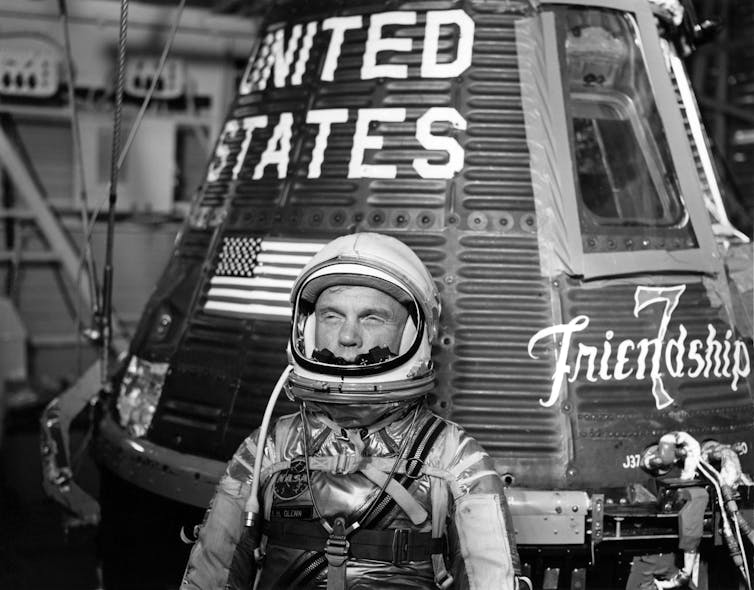
Katherine Johnson checks the equations line by line, by hand. The calculation is correct: Glenn takes off and returns safely. The flight was a success and marked a turning point in the competition between the United States and the Soviet Union in the conquest of space.
Aim for the Moon
During these intense years, Katherine remarried Colonel James Johnson, who supported her career and helped her raise her daughters. The space race intensifies, and Katherine Johnson continues to put her genius at the service of the Gemini and Apollo missions.
For Apollo 11, it calculated the trajectory that allowed the astronauts to leave the Moon, join the command module in orbit and return to Earth by entering the atmosphere with absolute precision – a mathematical feat that leaves no room for approximation. She also published several scientific articles in her name, something very rare for a black woman at the time.
A late recognition
It took several decades for America to measure the extent of its contributions. In 2015, at age 97, Katherine Johnson received the Presidential Medal of Freedom from Barack Obama.
“Katherine G. Johnson refused to be limited by society's expectations of her gender and race, while pushing the boundaries of what humanity can achieve,” the White House said.
The following year, the book then the film Shadow Figures (Hidden Figures) bring the story of Katherine Johnson and her colleagues Mary Jackson and Dorothy Vaughan to the general public. For millions of young girls, especially from minorities, she becomes a role model: that of a woman who proves that genius has no color, no gender, no boundaries.
Katherine Johnson died on February 24, 2020, at the age of 101, leaving behind a colossal scientific and human legacy. In 2016, NASA renamed one of its buildings the Katherine-G.-Johnson Computational Research Facility, as a symbol of moral reparation. His life reminds us that scientific progress is not just about technology, but also about courage, dignity and fairness. 

With an unwavering passion for local news, Christopher leads our editorial team with integrity and dedication. With over 20 years’ experience, he is the backbone of Wouldsayso, ensuring that we stay true to our mission to inform.


