
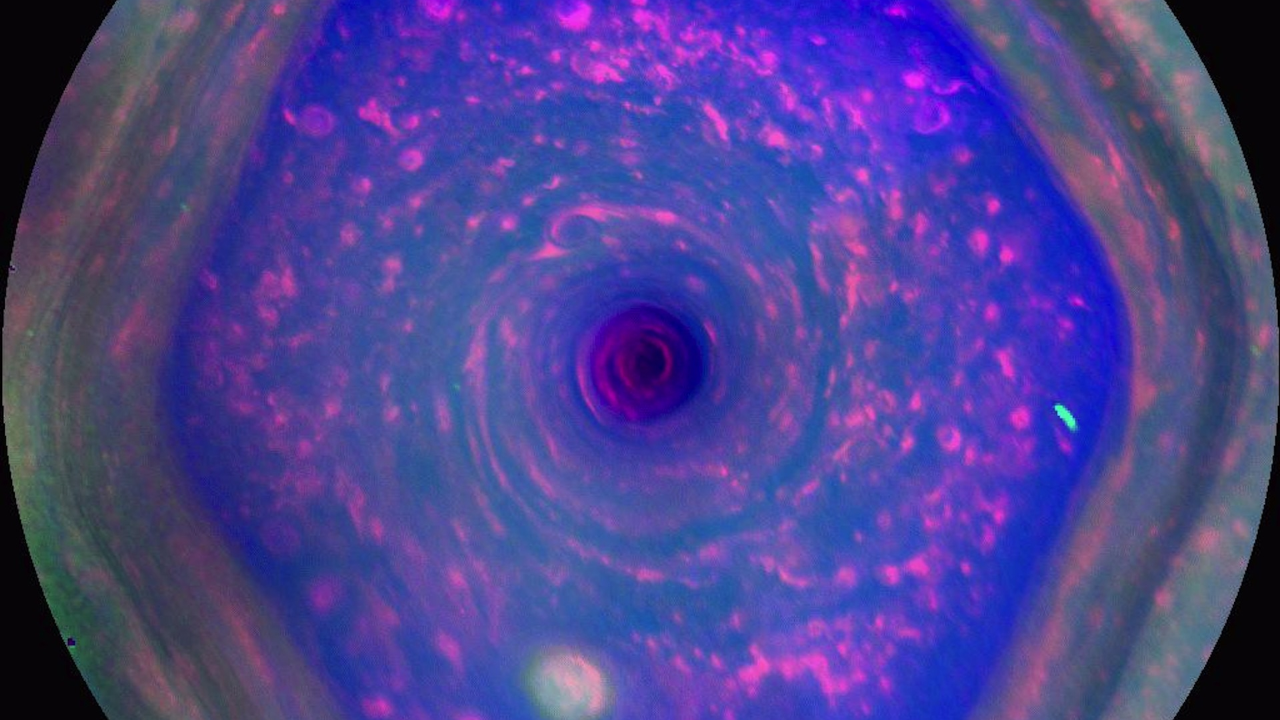
Saturn's study has long rested on the spectacular images of travel and cassini probes, but access to the upper layers of its atmosphere has remained limited. Thanks to the James Webb space telescope, researchers now have an unequaled infrared sensitivity, capable of revealing invisible details from Earth. It is in this context that an international team, led by Professor Tom Stallard of the University of Northumbria with the support of British, American and French colleagues, scrutinized the giant planet in November 2024.
An unexpected discovery above the North Pole
On November 29, 2024, James Webb observed Saturn for ten consecutive hours, targeting his upper atmospheric layers. The instrument mobilized, the Nirspec infrared spectrograph, is capable of measuring very weak emissions, imperceptible from Earth. The researchers expected to detect diffuse signals emitted by hydrogen and methane molecules. However, the images have revealed regular, precise and stable structures over several hours, defying existing models.
In the ionosphere, a region more than 1,100 kilometers above sea level, appeared in small dark areas in contrast to the luminous halos of the polar aurora. These “pearls” are not solid objects, but spectral signatures. They correspond to regions where the infrared radiation is attenuated. The phenomenon is intriguing because it extends over several hundred kilometers while presenting a coherent organization.
In parallel, the stratosphere, about 500 kilometers lower, revealed a four -pointed star -shaped structure. Two expected arms were missing, giving the whole an unbalanced form. This asymmetry, rarely observed on a planetary scale, suggests the existence of atmospheric processes still unknown. According to Stallard, in a press release, ” Saturn has always been difficult to probe these altitudes. The emissions are too weak. Webb opened a unique window to us ». These results surprise all the more since they are not in any preliminary simulation. They offer a first direct and detailed vision of the invisible dynamics of Saturn.
Phenomena aligned on the famous hexagon
One of the most intriguing aspects of observations is the correspondence between these unpublished structures and the famous hexagon of Saturn. This gigantic jet current, discovered in 1980 by traveling, forms a perfect polygon about 29,000 kilometers in width, in rapid rotation at the North Pole. The Cassini probe, in orbit between 2004 and 2017, had made it possible to map the movements. Nevertheless, she had never detected influence in the upper layers.
However, the arms of the star identified by James Webb seem to emerge from the heights of France. The cards established by the team show an astonishing vertical superposition: the patterns of the stratosphere and the dark pearls of the ionosphere appear directly above the key points of the vortex. This suggests that hexagon could influence the atmosphere far beyond the cloud layer where it is visible.
 © NASA/ESA/CSA/Stallard et al., 2025.
The asymmetrical star in the stratosphere (left) and the dark pearls in the ionosphere (right).
Tom Stallard and his colleagues, however, insist on caution. If the alignments seem significant, it remains to be determined whether it is a real correlation or a simple geometric coincidence. The presence of an atmospheric structure in the shape of an asymmetrical star, with only four active branches, further complicates interpretation. This anomaly probably indicates an energy imbalance between different parts of the atmosphere.
The situation is all the more interesting since Saturn is currently in the equinox. In other words, solar light is distributed fairly between its hemispheres. This context could accentuate certain contrasts or, on the contrary, reveal seasonal dynamics which hit the scientists hitherto. If we confirm the link between France and these structures, we will have to review the models describing the atmospheric circulation of Saturn. This would imply that this gigantic vortex acts as a column of energy transmission crossing all the layers of the planet.
Hypotheses around dark pearls and asymmetrical star
Faced with these unpublished observations, researchers try to offer avenues of explanation. The dark pearls, located in the ionosphere, could be the product of complex interactions between the magnetosphere of Saturn and its atmosphere in rotation. This hypothesis is based on the central role of H₃⁺ ions, abundant to these altitudes. These particles, formed by the action of solar radiation or energy particles, participate in many chemical reactions. When conditions change, their infrared emissions can decrease, producing these dark areas.
According to Stallard, ” Pearls could represent regions where energy exchange is altered. They would give a direct overview of the mechanisms that feed the dawn ». The latter are themselves the result of the interaction between the magnetic field and the solar particles trapped? Studying their modulation by such structures would provide valuable information on the VCI-Atmosphere coupling.
The asymmetrical star of the stratosphere, on the other hand, intrigues for other reasons. His four arms seem to extend from the pole to the equator. However, the absence of two branches suggests dynamic instability. Some researchers argue that atmospheric waves, generated below, could spread towards the stratosphere and distort the expected symmetry. Others emphasize the possible role of the rapid rotation of Saturn, which imposes strong Coriolis constraints. They could then cause imbalances.
The vertical association between the pearls and the most marked arm of the star reinforces the idea of a coupled process. However, no measure yet confirms a causal link. Atmospheric models will have to integrate these signals to determine if we are witnessing a simple chance or a manifestation of a global process crossing the atmosphere of Saturn.
A rare and decisive observation window
These observations would not have been possible without an alignment of favorable conditions. The Equinox of Saturn, which occurs about every 15 years, offers a privileged moment when atmospheric contrasts are particularly visible. In November 2024, James Webb took advantage of this configuration to observe the planet from the most stable angle as possible.
The challenge was the very low brightness of the emissions of the ionosphere and the stratosphere. From the earth, these signals are invisible, because it is absorbed by the earth's atmosphere. Even Cassini, however on site for 13 years, did not have sensitive instruments in the nearby infrared. Webb, on the other hand, combines exceptional collection power and spectral precision to identify the signatures of methane and ionized hydrogen.
The results highlight the importance of extending the observation campaign. As Stallard notes, ” Neither the ionosphere nor the stratosphere are accessible from the ground. And the equinox is a brief opportunity ». If new data is obtained, they could show how these structures evolve with the seasons of Saturn. Each for more than seven earthly years.
Beyond Saturn, these works open up a broader perspective: understand how magnetic fields and atmospheric circulation interact on giant planets. This could shed light not only the case of Jupiter, but also the study of massive exoplanets, where such mechanisms could be decisive. The study, funded by the British STFC, NASA and the European ERC, thus illustrates the strategic value of James Webb's planetary observations.
Source: Stallard, TS, et al. (2025). “JWST/NIRSPEC detection of Complex Structures in Saturn's Sub-Auroral Ionosphere and Stratosphere”. Geophysical Research Letters52, E2025GL116491.

With an unwavering passion for local news, Christopher leads our editorial team with integrity and dedication. With over 20 years’ experience, he is the backbone of Wouldsayso, ensuring that we stay true to our mission to inform.


