

[Un article de The Conversation écrit par Sarah Safieddine – Chargée de recherche CNRS (LATMOS/IPSL), Sorbonne Université & Cathy Clerbaux – Directrice de recherche au CNRS (LATMOS/IPSL), professeure invitée Université libre de Bruxelles, Sorbonne Université]
The climate change figures are well known: 1.5 ° C more since the pre -industrial era, and +2 ° C expected by 2050 if nothing is done more than the policies already in place. However, this is an average increase in temperatures over the entire surface of the globe.
Behind these figures hide very different realities, depending on the place where we are on earth, but also depending on the moments of the day. No, it will not be “hot” at noon in midnight: warming trends, too, vary according to local time.
In a recently published study, we have shown that temperature evolution is not uniform throughout the day. The increase can be more marked at night than in the afternoon, or vice versa, depending on the region of the globe.
And yet, climatologists are currently using a unique benchmark to compare climatic data: the UTC time zone (coordinated universal time). Practical to standardize climatic data, but problematic to understand local dynamics. Ignoring local time can distort our understanding of climate change and limit the effectiveness of our adaptation policies, for example when it comes to limiting overheating of cities in heat wave.
First, put the records on time
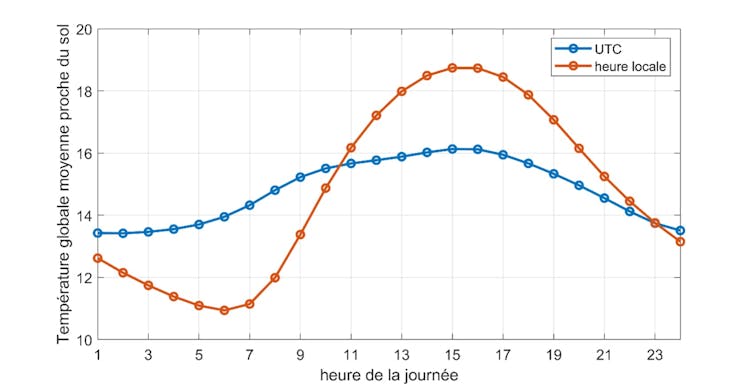
Consider, for example, a statement at 12 o'clock UTC. It will correspond to noon in London, but at 9 p.m. in Tokyo, or at 2 a.m. in Los Angeles. By working only with the UTC, we mix observations made day and night, which masks the daytime variability of temperatures-that is to say, the differences that occur between day and night.
If we only consider the land, excluding seas and oceans, the average of global temperatures close to the ground varies from around 14 ° C to 16 ° C. But if these observations are converted into local hours around the globe, it appears that this global daytime variability has much more amplitude: from 11 ° C to 6 am on average at 19 ° C around 3 pm/16 hours.
For this study, we have analyzed more than forty years of data (1981–2022) from the Earth component (without the seas and oceans) of the ERA5 reanalysis. It is a database that merges models and observations to provide, hour by hour, coherent temperature estimates – and other atmospheric variables – since 1940, on a global scale.
And so, instead of systematically bringing data into UTC, we have transposed them into local hours, applying the principle of time zones. We were able to map, hour by hour, the evolution of land temperatures close to the surface (that of meteorological bulletins) on a global scale. Enough to quantify the impact of climate change more finely on these during the day.
Not uniform, neither in space nor in time
Our results show that the evolution of temperature in the past forty years is not uniform, neither in space nor in time.
In general, since 1981, temperatures have been increasing almost everywhere on earth, with warming particularly marked in the Arctic regions. But, in detail, certain geographic areas, such as India, seem less affected: warming is much slower than elsewhere. If we consider the time slot of 15 hours in India, we even observe a… cooling since 1981.
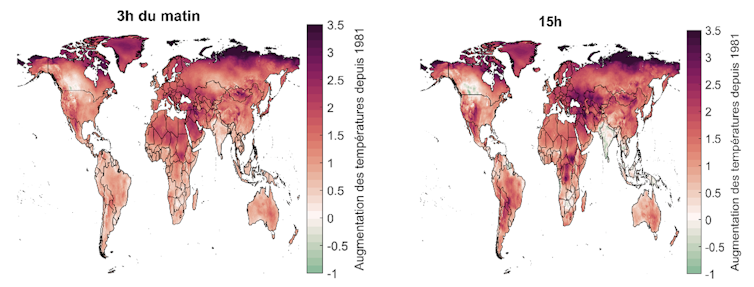
One of the reasons for these heterogeneities is the local increase in certain sources of pollution, in particular fine particles. These can block part of the solar radiation and cool the earth's surface.
To represent the temperature variations during the day in the different regions of the world, we have subtracted the climatic trends observed at 3 hours from those observed at 3 p.m. Enough to highlight the daytime variability of climate change in the world more clearly.
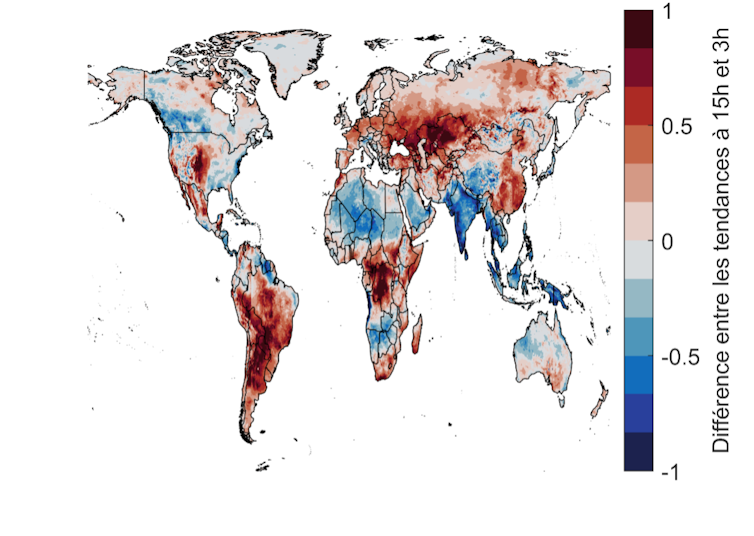
Our results then show that, for a given region, the variation in the amplitude of global warming can reach up to a Celsius degree between morning and afternoon, with sometimes opposite trends (as in India), depending on the time considered.
To adapt better, forecasts at local time
This finer and “hour by hour” vision of warming opens up many concrete perspectives.
First for agriculture, where it is not the annual average of the temperatures that counts, but that which will occur during critical moments, such as germination, flowering, fruit production, etc. Provide more finely the temperature hours peaks would then adapt the irrigation or sowing calendars.
Also in terms of public health: we know that heat waves are all the more dangerous as the night temperature remains high, which limits the good recovery of the body. A finer forecast of these night extremes would make it possible to better identify the nights and the cities at risk for fragile people.
Likewise, this would also help to better schedule sports competitions according to the temperatures scheduled at local time. Indeed, competitions organized at the hottest hours of the day can exhibit athletes and spectators at increased risks.
It is also an important fact to improve the town planning of our cities. These already know, during heat waves, an effect of heat island marked at night.
Fine knowledge of the day -to -day day and nocturnal temperature evolution is therefore essential to design more resilient urban spaces, and in particular “climatic refuges” for residents.
Finally, the improvement of climate forecasting models to really replace them “at local time” would make the alert systems more relevant to citizens and for decision -makers.
Global warming is not just a few more degrees. It is also a question of knowing when, during the day, these additional degrees are added. By emphasizing local time, we reveal a new dimension of climate change which can transform our adaptation strategies.

With an unwavering passion for local news, Christopher leads our editorial team with integrity and dedication. With over 20 years’ experience, he is the backbone of Wouldsayso, ensuring that we stay true to our mission to inform.


