
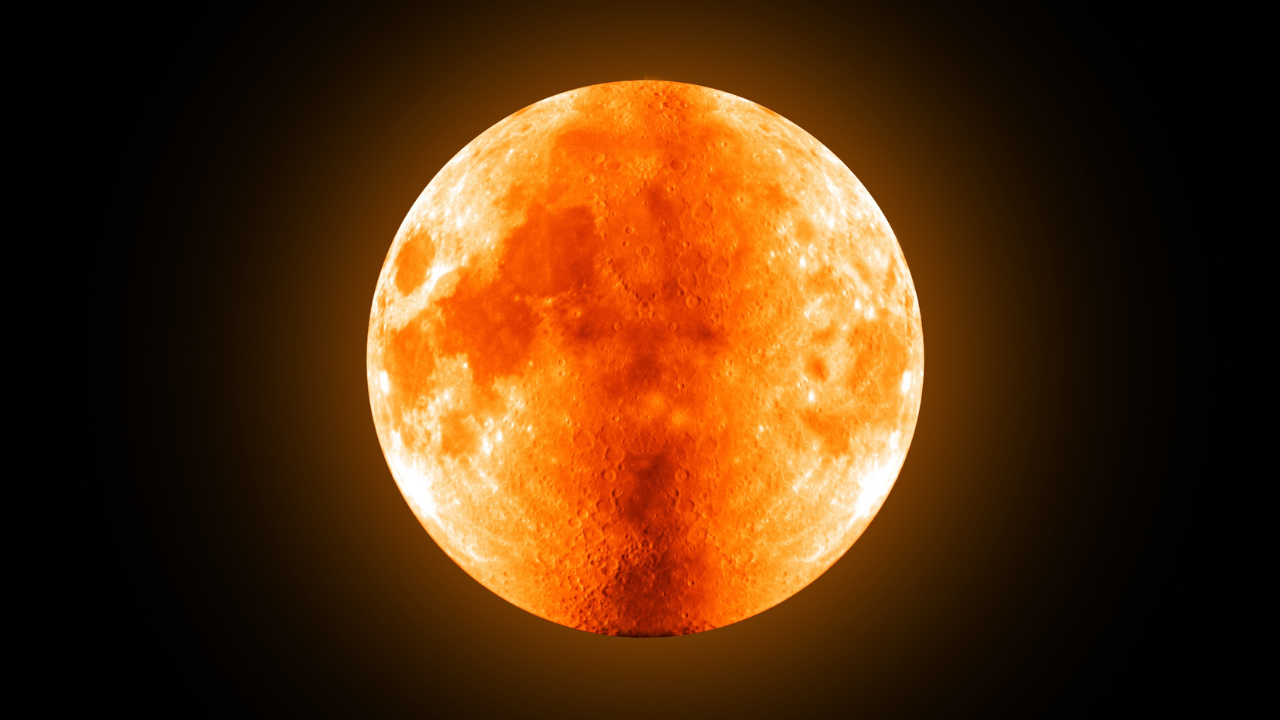
[Un article issu de The Conversation écrit par Guillaume Paris – Géochimiste, chargé de recherche CNRS au Centre de recherches pétrographiques et géochimiques de Nancy, Université de Lorraine]
To answer this, we have to go back far, very far in time, shortly after the formation of the solar system, which started around 4.567 billion years ago. Dust, gases and ice debris revolve around the sun, increase, agglutinate, begin to form small bodies that gradually grow. Between these planetsimals and other planetary embryos, it is war. They revolve around the sun with trajectories that can cross each other. They collide, explode, found in shock, reform.
It is in this somewhat chaotic context that future Venus, Mercury, Mars … close to the sun stabilize. And, of course, the future earth, which scientists imagine moonless at birth. Little by little, the earth approaches its current size.
About 60 million years after the formation of the solar system, another planet, probably the size of Mars, crosses the path of the earth and strikes it suddenly. This celestial body was baptized Théia, named after the Mother Titan of Séléné, goddess of the Moon in Greek mythology. In shock this giant impact, Théia is sprayed, part of the earth too.
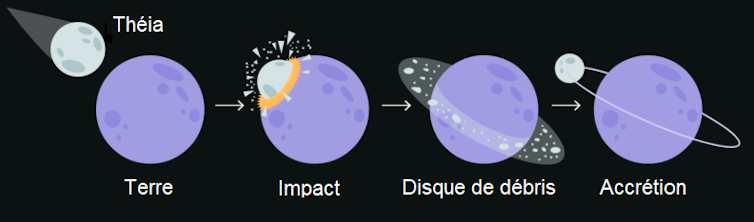
Instantly, the surface of the earth melts, probably over hundreds of kilometers deep, thus generating a new ocean of magma whose cooling and chemical reorganization would gradually give birth to the earthly coat, as well as to the oceans and the atmosphere. Following this cataclysm, the debris of Théia and the pieces of the earth would have cooled by putting themselves in rotation around the earth. Little by little, part of them would have accrected to give birth to the moon.
Of course, you can't be sure, and there are different theories. Scientists have suggested that the Moon could have been formed independently before being “captured” in the orbit of the earth, or entered at the same time as the earth. Others proposed that the moon would have “torn” from a young land that turned too quickly on itself. But these two hypotheses do not manage to explain a certain number of aspects that we know of the compositions of the earth and the moon, as the fact that the latter is poorer in iron, or even the orbit and the parameters of rotation of the earth and its satellite. Conversely, the theory of giant impact makes it possible to explain the poverty in water from the moon compared to the earth, even if it is undoubtedly less dry than what scientists have long thought. Finally, this theory also makes it possible to explain why the moon gradually moves away from the earth of 3.8 centimeters per year.
Thus, initially proposed in 1946, the theory was imposed in the 1970s, in particular following the return of lunar samples of the Apollo mission 11. Since then, the hypothesis of the giant impact is that which makes the most consensus, even if certain observations still resist this theory. What will be the word at the end? For the moment, Moon does not know!


With an unwavering passion for local news, Christopher leads our editorial team with integrity and dedication. With over 20 years’ experience, he is the backbone of Wouldsayso, ensuring that we stay true to our mission to inform.


