
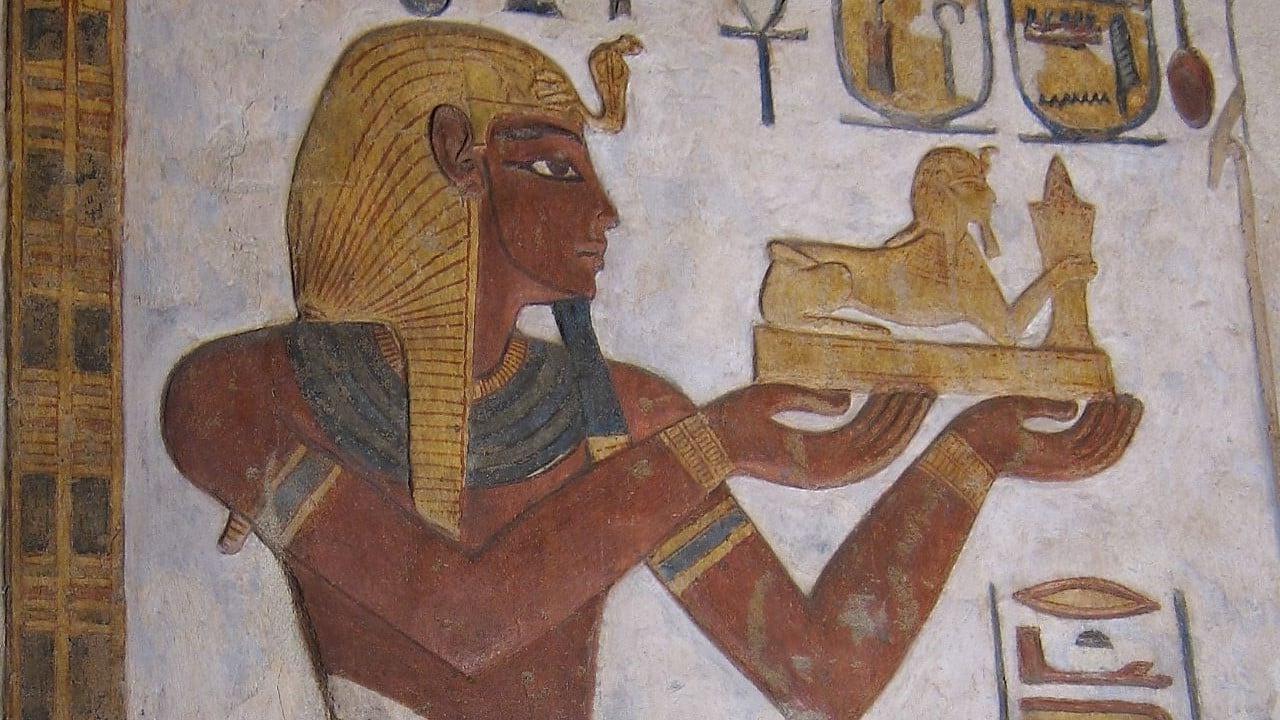
In the south of Jordan, on the edge of the Wadi Rum desert, a team of Jordanian archaeologists, in collaboration with the Saudi Heritage Commission and Egyptian specialists, has uncovered hieroglyphic inscription bearing the names of birth and reign of the Pharaoh Ramses III. This vestige, dated 12th century BC. AD, constitutes the first direct proof of the pharaonic presence on Jordanian territory.
An unprecedented discovery on Ramses III in Wadi Rum
The site, isolated and little explored so far, has revealed two hieroglyphic cartridges clearly identified as those of the Pharaoh Ramses III, sovereign of the 20th dynasty which reigned between 1186 and 1155 BC. One of the cartridges bears his birth name, the other his name of reign. They formally attest to its authority over the upper and bass Egypt.
Minister Lina Annab described the registration of ” precious contribution »In the national archaeological inventory. It strengthens the image of Jordan as a real open -air museum. Hawass, for his part, insisted on the unprecedented character of this find. Never before has an inscription in the name of a pharaoh had been discovered on Jordanian soil.
 © © Minister of Tourism and Antiquities
© Minister of Tourism and Antiquities
This singularity gives the object a major historical value. She could imply that Ramses III or his envoys have crossed or influenced this region. We had never demonstrated it materially before. Hawass also mentioned the need to launch targeted excavations around the site. He believes that other traces of Egyptian presence could be hidden there. This inscription could thus mark a turning point in understanding the interactions between ancient Egypt and the territories of the Arabian peninsula.
Ramses III: a pharaoh beyond the Nile
Ramses III reigned from 1186 to 1155 BCE. There remains a central figure of the 20th Egyptian dynasty. Heir to an Egypt already weakened by internal disorders and external threats, he managed to maintain the integrity of the kingdom in the face of an unstable context. It is notably famous for having rejected the peoples of the sea. It was a conglomerate of invaders from the Mediterranean basin which threatened the Egyptian coast and the Nile Delta. These victories allowed Ramses III to preserve the country's borders and to ensure temporary political stability.
But its power was not limited to the defense of the territory. Ramses III was also distinguished by an intense architectural and cult activity. Like the Temple of Médinet Habou, located in Thebes-Ouest. This complex, one of the best preserved in Egypt, served as a administrative center, a funeral temple and the fortress. It illustrates the centralization of royal power at the end of the new empire.
The appearance of his name in the Wadi Rum desert suggests that his influence went far beyond the traditional limits of the Nile Valley. For Zahi Hawass, this registration could constitute proof of diplomatic or military operations towards the Levant and Arabia. Zones that have so far associated so far with a direct presence of the pharaohs.
Regional scientific collaboration
In addition, this uncovered the registration of Ramses III in the Wadi Rum is part of a joint scientific effort mobilizing several institutions in the region. The field work is carried out within the framework of a structured partnership between the Jordanian department of antiquities, the Saudi heritage committee, as well as experts from Egypt. This cooperation goes beyond the strict framework of excavation. It includes the documentation, the analysis of the materials, the statement of inscriptions and the historical interpretation of the site.
Professor Ahmed Lash and Dr. Ali Manaseer, two recognized figures of Jordanian archeology, play a central role in the epigraphic study of discovery. Their work is based on digital statement and 3D imaging methods to guarantee optimal conservation of inscriptions, exposed to the natural erosion of the desert.
Dr. Aktham Owaidi, head of the Antiquities Department, insisted on the issue of this collaboration. “” It is a question of better understanding regional historical connections through a shared approach to knowledge and resources ». This type of cooperation also makes it possible to pool technical and logistical skills, essential to operate in difficult to access areas such as WADI RUM.
Ultimately, this initiative could be extended to other border areas where the indices of an Egyptian presence still remain to be confirmed. By relying on this collaborative dynamic, the researchers hope to clarify certain unknown sections of the oriental campaigns of Ramses III, still little documented by classical sources.
Wadi Rum, between desert and memory
Located south of Jordan, Wadi Rum is much more than a spectacular desert setting. Listed as a UNESCO World Heritage Site since 2011 for its natural and cultural value, this site is full of old testimonies: rock engravings, Nabatean inscriptions, caravan vestiges. It is considered one of the most strategic historic crossroads in the Arabian peninsula. The hieroglyphic inscription attributed to Ramses III only reinforces this dimension. It introduces an older historical layer, hitherto absent from the local archaeological chronology.
This type of discovery, extremely out of Egypt, modifies the perception of the Wadi Rum, not only as a natural and cultural space, but also as a territory inscribed in the geopolitical dynamics of the end of the Bronze Age. The inscription, placed in a potential place of passage between the commercial roads connecting Egypt, the Levant and the Arabian peninsula, could be the vestige of a point of contact or a relay established for logistical, military or diplomatic purposes.
For Lina Annab, this discovery more values Wadi Rum as a living heritage. She also calls for deepening research to interpret the exact context of registration. Was it a territory marker, a testimony of an alliance or a trace left by an Egyptian expedition?

With an unwavering passion for local news, Christopher leads our editorial team with integrity and dedication. With over 20 years’ experience, he is the backbone of Wouldsayso, ensuring that we stay true to our mission to inform.


