
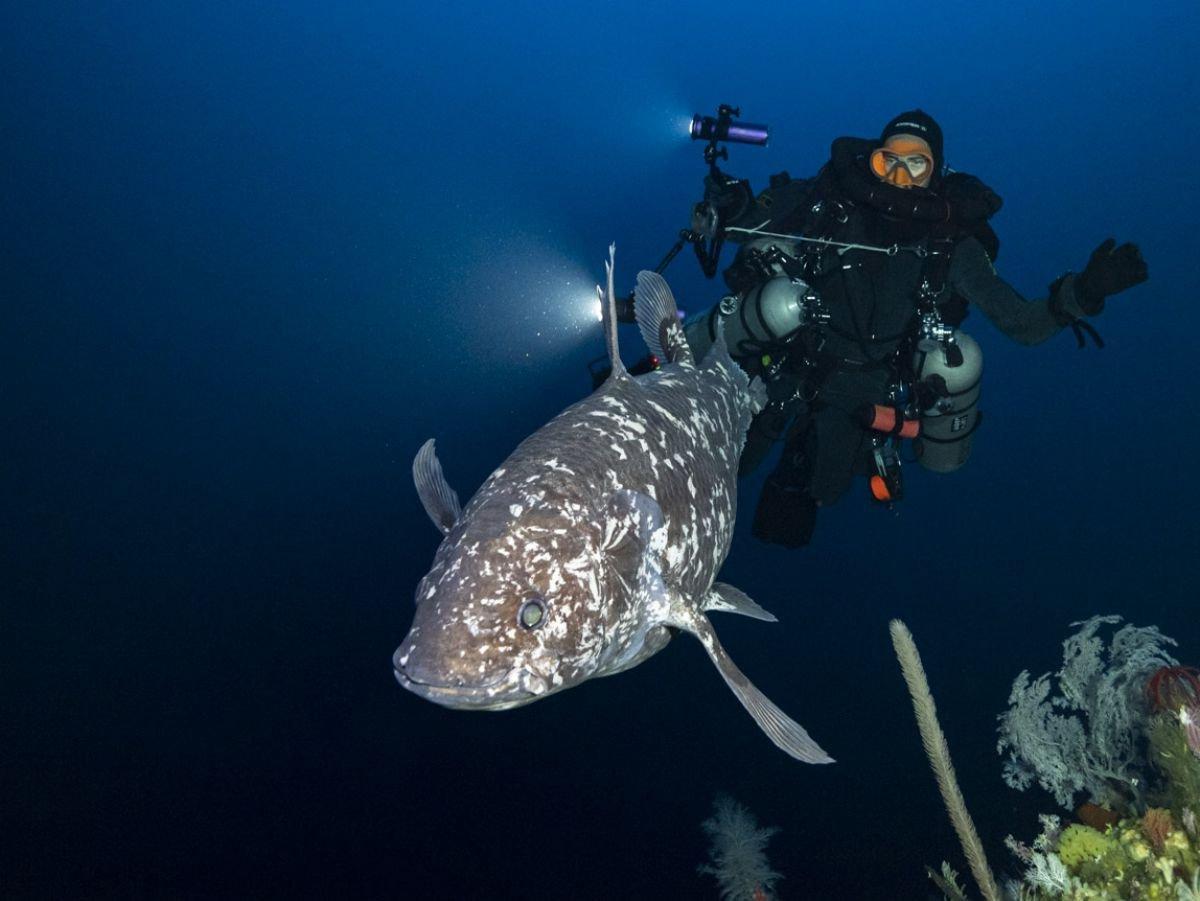
In the dark depths of the Moluccas archipelago, a fish that was forever believed to be relegated to the archives of evolution resurfaced. The coelacanth, long considered disappeared, always evolves discreetly in the underwater faults of Indonesia. Observed alive at more than 140 meters deep, this animal with a prehistoric look embodies a form of silent resistance in front of time, recalling that certain puzzles of earthly life are still waiting for their response where man rarely explores.
This exceptional face-to-face has not argued by magic. For two years, Alexis Chappuis studied the underwater cartography of the archipelago, in search of cold and rugged areas that can host the species. More than fifty dives were necessary to locate this specific site, now kept secret to protect it. This scientific adventure was told in detail in the journal Scientific Reports, which salutes this first in situ observation of a coelacanthe living in the province of Maluku.

What the coelacanth reveals about the origins of earthly life
Long considered disappeared for millions of years, the Coelacanthe reappeared by surprise in 1938 off South Africa. Since then, two species have been identified. Latimeria Chalumnae, present in the Western Indian Ocean, and Latimeria Menadoensis, the Indonesian species filmed here. Although it is sometimes described as “living fossil”, this term does not do justice to its evolution, slow but real.
Coelacanth fascinates scientists for its unique anatomical characteristics. It has articulated fleshy fins that evoke members, a vestige of internal lung and a two -part skull. So many features that make it a precious model to understand the transition between fish and first terrestrial vertebrates.
The observed Indonesian specimen measured approximately 1.10 meters, and contrary to popular belief, it was not hidden in a cave. He evolved uncovered, swimming slowly around a rocky promontory. This posture, fins deployed and without leakage behavior, thus suggests a more flexible behavior than expected in this species long deemed sedentary.
Preserve a discreet but vital habitat for the marine balance
The coelacanthes live in deep areas, between 100 and 400 meters, where extreme conditions dissuade most human explorations. This natural discretion does not, however, protect them from threats. Plastic pollution, rise in temperatures, underwater noise and extreme tourism projects jeopardize their survival. The International Union for the Conservation of Nature classifies the Indonesian species as vulnerable. His very slow pace of life accentuates his vulnerability. He only reaches sexual maturity from 55 years old. Gestation lasts about five years, which therefore strongly slows the renewal. Its longevity, on the other hand, can exceed one hundred years, which makes each individual even more precious.
The discovery of this specimen in Moluccas does not yet prove the existence of an established population, but it strongly suggests the possibility. Between Sulawesi and Western Papua, several deep marine areas are still unexplored. The observation site confirms that suitable habitats exist in this region, and that they could host other individuals. It is therefore essential to preserve these areas from any disturbance.
The research team now hopes to be able to conduct non -invasive studies to collect genetic data directly in a natural environment. This type of approach, without sampling or capture, would make it possible to better understand the distribution, diversity and movements of Indonesian coelacanths. And thus, propose targeted protective measures for one of the most enigmatic fish on our planet.

With an unwavering passion for local news, Christopher leads our editorial team with integrity and dedication. With over 20 years’ experience, he is the backbone of Wouldsayso, ensuring that we stay true to our mission to inform.


