
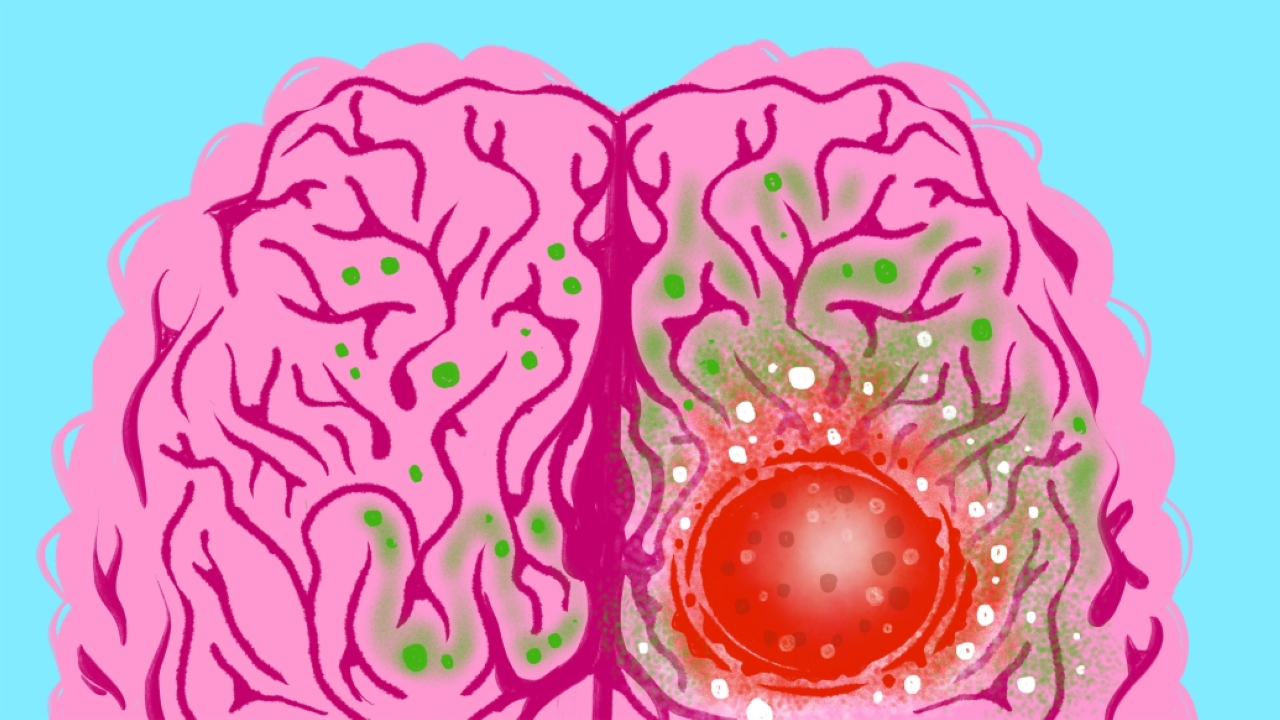

The most frequent and aggressive brain tumor in adults, remains almost systematically deadly despite surgery, radiotherapy and chemotherapy. Its extreme resistance is partly explained by its ability to reshape its metabolism to fuel its rapid growth. A study published in nature and conducted by researchers from the University of Michigan, affiliated in particular to the Rogel Cancer Center and the Department of Neuroscience, reveals how these cancer cells divert glucose for their benefit while exploiting certain metabolic flaws, including their dependence on amino acid with serine.
A metabolism reorganized in the service of the tumor
The glioblastoma is therefore distinguished by its ability to divert brain resources to develop. This brain tumor is not content to proliferate quickly. It fully reconfigures its metabolism to fuel its growth. Tumor cells abandon the classic functions of neurons, such as energy production or neurotransmitters synthesis, to concentrate their resources on cell division.
Researchers' work shows that glioblastoma cells use glucose in a radically different way compared to healthy cells. Indeed, the latter convert glucose into energy via the Krebs cycle. They produce molecules such as glutamate or gaba. However, cancer cells divert this sugar towards the manufacture of nucleotides. These components are essential for the replication of DNA, therefore for the proliferation of tumor cells.
To achieve these conclusions, the researchers carried out glucose infusions marked at carbon 13 with operated patients. They were able to compare the metabolisms of healthy and tumor tissue. This protocol made it possible to identify with precision the activated metabolic routes. They also confirmed these observations in several murine models. Result: in the tumor, the oxidation of glucose in the Krebs cycle is clearly reduced. While its conversion into nucleotides increases sharply.
This metabolic redirection is one of the reasons why glioblastoma is resistant to standard treatments. It constantly has resources necessary to repair damaged DNA by radiotherapy or chemotherapy. He can then continue to grow, despite the most aggressive therapies.
Serine, an essential exogenous fuel for tumor cells
Beyond glucose, researchers discovered another peculiarity of glioblastoma cells. They are drastically dependent on serine. It is a non -essential amino acid, present in food and blood. In fact, normal brain cells produce it from glucose via a well -known biosynthetic route. But many tumor cells prefer to draw the serine directly from their environment.
This preference is far from harmless. By not producing the serine themselves, cancer cells save glucose, which they redirect towards DNA synthetic pathways. To demonstrate this mechanism, the researchers compared isotopic profiles of the serine in tumor and healthy tissues. The healthy cells mainly presented a serine from glucose (form “M+3”), while the tumor showed a preponderance of serine of circulating origin (form “M+1”), marked by food intake.
The experiences of direct serine marked at carbon 13 have confirmed that glioblastomas significantly absorb more exogenous serine than healthy brain tissues. On the one hand, this increased absorption varies from one type of glioblastoma to the other. On the other hand, it depends on the expression of specific transporters to the surface of tumor cells. Costas Lyssiotis, co -author of the study, stresses that this metabolic path acts as a highway very frequented in the tumor, compared to the secondary roads used by healthy cells.
This dependence is not only a metabolic characteristic, but a weakness, specify the authors in a press release. Cancer cells become vulnerable if their supply of serine becomes limited. Indeed, their ability to produce this molecule by themselves often remains insufficient to cover their intense metabolic needs. And especially during stressful periods induced by treatments.
Regimes without serine: a targeted strategy with measurable effects
Based on this vulnerability, researchers have tested a nutritional strategy to weaken glioblastomas. They strongly limited the food intake in serine and glycine. In mice, this involves a specific diet excluding these two amino acids. This approach aims to force cancer cells to produce their own serine. They divert glucose from the synthesis of nucleotides, slowing tumor proliferation.
The team observed that mice with glioblastoma, subject to a regime without serine, responded significantly better to standard treatments. The tumors were smaller, and the survival of the prolonged mice. The most marked effects were observed in the models where the tumor strongly depended on the exogenous serine. However, glioblastomas capable of effectively producing their own serine resisted this food deprivation more.
These observations suggest that the response to this strategy is linked to the metabolic profile of each tumor. The researchers have also developed mathematical models of metabolic flows to predict the sensitivity of tumors to the Restriction in serine, according to their internal synthetic activity and their external capture.
Another crucial point: this nutritional approach does not alter the functioning of the healthy brain. This one, capable of synthesizing the serine from glucose, continues to operate normally even in the absence of external contribution. This discrepancy between the tumor and the healthy fabric creates a real therapeutic differential. The food restriction acts selectively on the tumor without major side effects.
Towards clinical trials and metabolic precision medicine
With these promising results in mice, Dr. Daniel Wahl and his team are now preparing a clinical trial intended to test this approach in patients with glioblastoma. The objective is to combine a diet low in serine with standard treatments, such as radiotherapy and temozolomide chemotherapy, in order to strengthen their effectiveness. The first protocols could be launched by the end of the year.
Several challenges will have to be met. Following a strict diet in full heavy treatment phase represents an additional effort for patients. In addition, all glioblastomas do not react in the same way to the deprivation of Sérine. It will therefore be crucial to identify the patients most likely to benefit from this strategy upstream. For this, researchers are counting on isotopic tracing techniques to assess the dependence on each tumor in the exogenous serine.
This approach opens the way to precision metabolic medicine. It is not based on a new molecule. It is based on fine understanding of biochemical circuits supplying tumor growth. “” What we offer is not to attack the tumor directly, but to starve it intelligently », Summarizes Wahl and mentioned by Live science. By modifying the metabolic environment of the tumor, you disturb its ability to regenerate, without affecting healthy tissues.
The team also points out that other food tracks are possible, the serine being only a first lever. Additional research is underway to explore other metabolic flaws. Ultimately, personalized dietetic support could become a full -fledged therapeutic tool. A tool integrated into oncology care courses, with a real impact on patient survival.
Source: Scott, A. J., Mittal, A., Meghdadi, B. et al. “Rewiring of Cortical Glucose Metabolism Fuels Human Brain Cancer Growth”. Nature (2025)

With an unwavering passion for local news, Christopher leads our editorial team with integrity and dedication. With over 20 years’ experience, he is the backbone of Wouldsayso, ensuring that we stay true to our mission to inform.


