
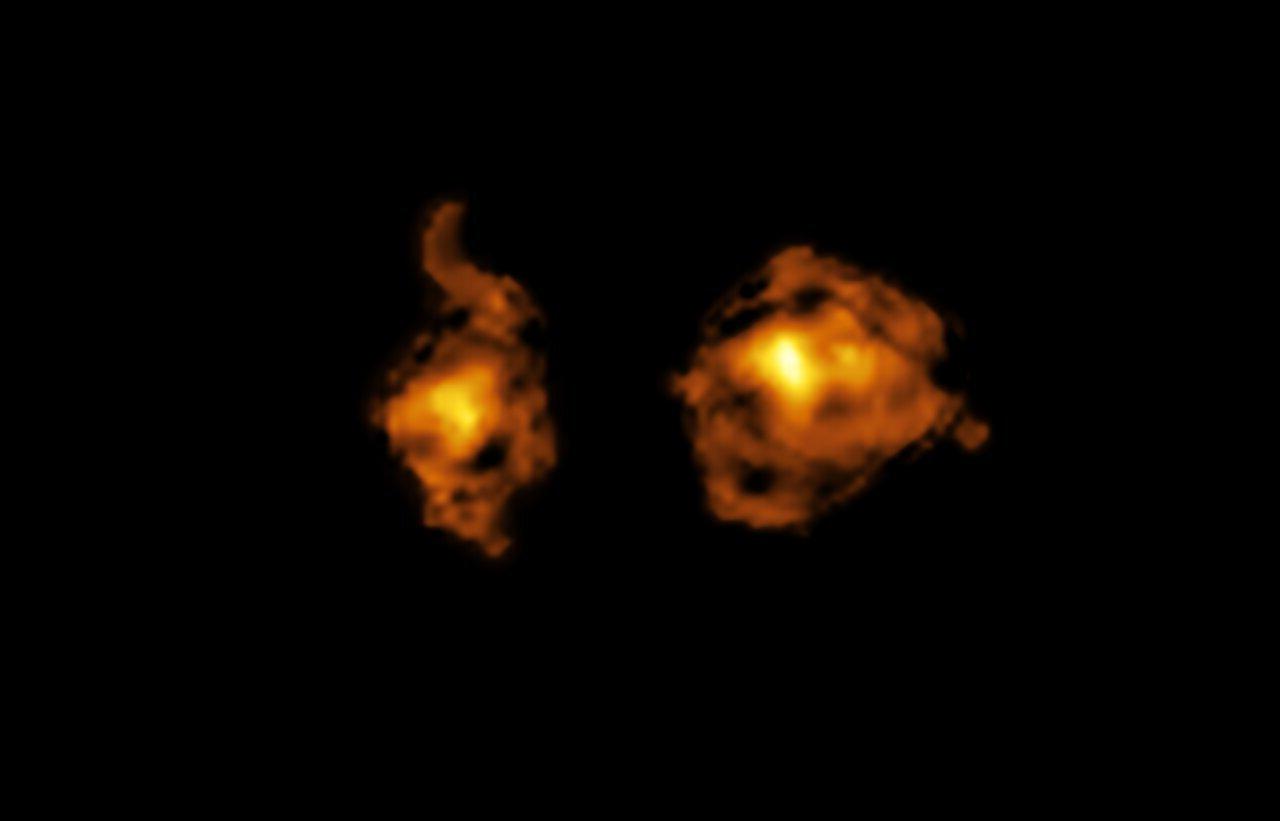
In the depths of the young universe, when the first large cosmic structures were formed, certain meetings left lasting traces. At more than 11 billion light years, two collision galaxies draw a rare intensity spectacle. One of them houses a quasar, this overwhelming galactic heart fed by a giant black hole, whose dazzling radiation pierces its neighbor. This dantesque face-to-face, frozen by light on a journey from dawn of times, reveals a mechanism as violent as it is structuring in galactic history.
Thanks to the Large Millimeter/Submillimeter Array (ALMA) atacama and the very large telescope of the European Austral Observatory, the researchers were able to separate for the first time the two entities previously confused in a single light source. The photo revealed by Phys.org shows two massive galaxies, in full interaction, one of which is the seat of an extremely brilliant quasar. This rare configuration has enabled an unprecedented observation: the radiation of the Quasar passes directly through the other galaxy.

The transformer power of the Quasar
An Quasar is a galaxy nucleus whose central supermassif black hole is in the active accretion phase. He then emits colossal energy, especially in the form of ultraviolet rays. In the case of J0125-0129, this intense flow acts as a scalpel, modifying the structure of interstellar gas in the companion galaxy. This phenomenon was detailed in the study published by nature in May 2025.
Under the effect of radiation, the gas fragments in ultradent clouds, sometimes a thousand times smaller than those observed elsewhere in the universe at that time. Measuring less than 0.02 parsec, these “lumps” survive in light but are too small to initiate the birth of new stars. The galaxy thus irradiated is transformed into a stellar desert, locally sterile, unable to renew its population of stars.
A rare window on the history of galaxies
This particular case highlights a significant phenomenon. During a galactic merger, a Quasar can be activated. This activation then influences the nearby environment, modifying its structure and evolution. Researchers at the Institut d'Astrophysiques de Paris and the Iofe Institute, authors of the prepublication relayed on Arxiv, underline that this observation makes it possible to study processes which were so far largely theoretical.
The exchange of matter, the gravitational tides and the resulting energy flambés play a key role in the evolution of galaxies. The J0125-0129 system works here as a magnifying glass. It reveals an old but essential event in cosmic history. A galaxy transforms another, influenced by an active quasar. The effects extend over several hundred thousand years, even visible today.

With an unwavering passion for local news, Christopher leads our editorial team with integrity and dedication. With over 20 years’ experience, he is the backbone of Wouldsayso, ensuring that we stay true to our mission to inform.


