
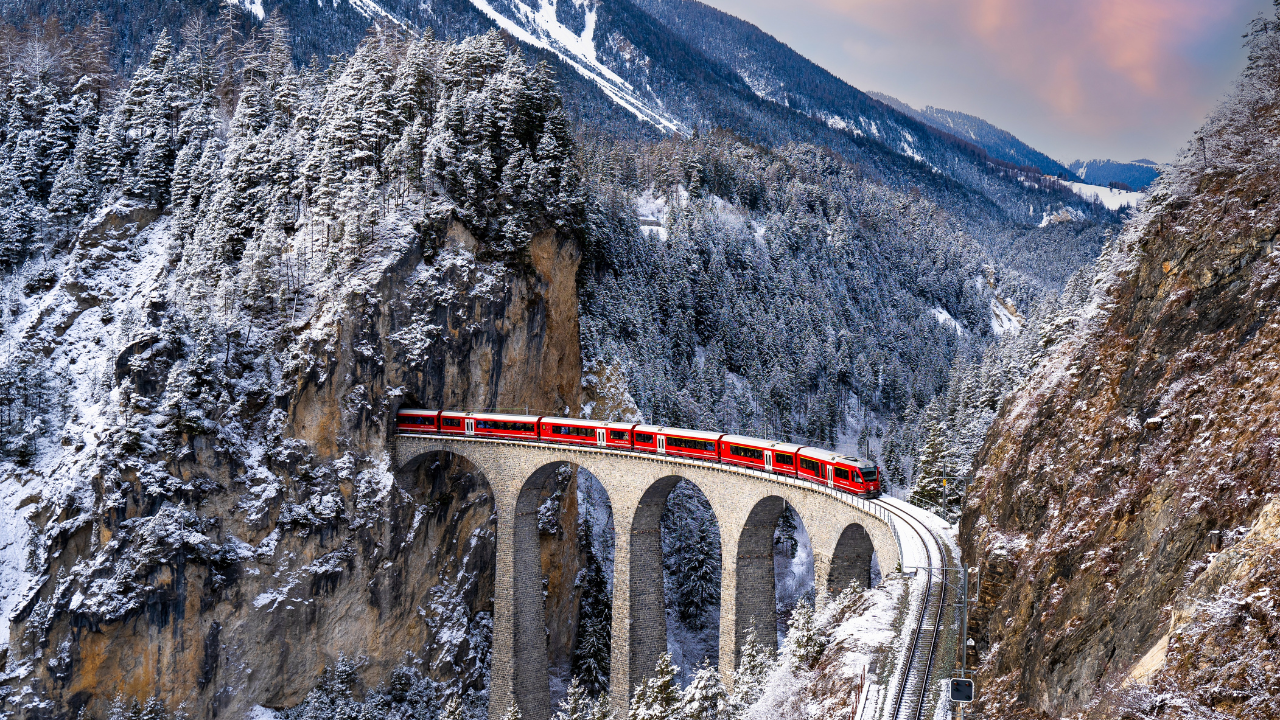
This Monday, March 31, travelers will be able to cross the Franco-Italian border again. For a year and a half, the Paris-Milan line was interrupted due to an impressive landslide on its tracks in August 2023. Far from being an isolated event, this type of incident has multiplied as the effects of global warming are intensifying.
Faced with this situation, it is urgent that all the players in the rail sector (companies, communities, states, etc.) are mobilizing to adapt infrastructure to increasingly unpredictable and violent climatic conditions. And this, at a period when the number of travelers continues to grow.
While some European countries have already embarked on this path, France is slow to take action.
The train, a major ally of decarbonation
The situation is all the more paradoxical since the train constitutes an important lever in the fight against climate change. A train journey emits on average 95 % of Co₂ less than when it is made by car. The railway is therefore a must of the decarbonation of mobility.
A major issue, since the transport sector remains the first contributor to French greenhouse gas emissions, with 30 % of the national total. It is one of the few areas that this figure does not decrease. More worrying, its trend has even been up for three decades.
An increasingly acclaimed means of transport
Travelers are not mistaken. According to a study carried out in 2023 for the SNCF, 63 % of them say they take the train by ecological conviction. Another survey, having surveyed a wider part of the French population, tells us that 83 % of respondents recognize the ecological benefits of this mode of transport.
Each year, travelers' rail traffic breaks records in our country. According to the Transport Regulatory Authority, it increased by 21 % for daily trains and 6 % for high -speed supply between 2019 and 2023.
Conversely, the transport of goods continues its inexorable fall, -17 % in one year.
Infrastructure threatened by climate change
Several reasons explain this strong withdrawal of freight rail services: increase in energy costs, social movements … and landslide on the Paris-Milan line.
Travelers traffic is also increasingly impacted by ever more extreme weather conditions. Total interruption of traffic in January 2025 due to floods in Ille-et-Vilaine, derailment of a TER because of a mud flow in July 2024 in the Pyrénées-Orientales followed by the two similar accidents in October in Lozère then in Aisne … The examples are not lacking in recent news.
If vagaries of this type have always existed, their frequency and intensity increase with the amplification of climate change. Whatever the trajectory of the scenarios of the borrowed IPCC, we know that this trend will continue in the decades to come, more or less marked according to the speed of reducing our greenhouse gas emissions. The bad weather could thus increase rail disturbances by 8 to 11 times by 2100.
The risks on the network are multiple and concern both the ways, the telecommunications, the works and the power supply. Among the main threats are the deformation of the tracks due to high heat, the destabilization of the soil caused by cycles of gel-degel or heavy rains as well as large damage caused by fires and storms.
In France, the shy emergence of an adaptation strategy
The SNCF and its 27,000 kilometers of lines are on the front line in the face of these disasters. Although variable from year to year, their direct cost is estimated annually between 20 million and 30 million euros.
A strategic document of around thirty pages was published by SNCF Réseau last year. It projects an adaptation to an average warming up to +4 ° C by 2100. This roadmap has been developed in collaboration with Météo France, with which the SNCF is systematically linked in the event of weather alerts.
Data exchange is also at the heart of this strategy. For example, an alert tool was designed to monitor the tracks in the event of heavy rain. His predict counterpart anticipates the risk of floods as soon as certain rainfall thresholds are affected.
Chronic under-investment in the network
Not enough to convince the Court of Auditors which, in 2024, alerted the SNCF to the absence of a structured adaptation plan incorporating the future climate. The report also highlights the lack of information on climatic costs.
The jurisdiction joins the Transport Regulatory Authority on Chronic Sub-Investment of which the French network is victim, which mechanically strengthens its vulnerability. A billion euros would still be missing to stabilize the state, while its average age is still 28.4 years.
Already in 2019, a team of researchers had conducted a case study on this subject. Their results highlighted an important gap between SNCF speeches and the low integration of scientific knowledge in its rail management. It would still be in incremental way, without deep transformations, and from past experiences rather than future climatic projections.
Inspiring initiatives in neighboring countries
However, adaptation inspirations from our European neighbors are not lacking. In Belgium and Italy, rails are for example painted white in order to limit the accumulation of heat and, ultimately, their dilation.

Switzerland offers an alternative solution by cooling the rails with a tank vehicle in case of hot weather. The Swiss Confederation as well as Austria (with which it shares an accidental relief) engaged in an attenuation approach aimed at further protecting the lines of avalanches and landslides while improving drainage systems. This involves in particular the strengthening of forests – a real protective shield – and existing works.
So many structuring political choices that have been made in countries where the investment in the railway is 2 to 9 times greater than in France. It is therefore more than ever necessary to engage now in a more systemic adaptation strategy.
Towards a European adaptation strategy?
This is the subject of a European project called Rail4Earth. It bets in innovation and speed of action. But the path to go is still long so that this ambition translates into a real operational roadmap on the scale of our continent.
The application of climatic data – current and future – to the rail sector remains imperfect. The development of governance integrating experts in climatology is desired by the SNCF, which is one of the partners of this project.
There is an urgent need to act. As demonstrated by a British study, the adaptation of railway infrastructure to the different scenarios of the IPCC is often overestimated. They are therefore more vulnerable than projections suggest.
One more reason, if it took one, to engage now in a European -scale action plan in order to continue to make the train a major lever of decarbonation of our trips in a world that continues to warm up.


