

[Un article de The Conversation écrit par Maia David – Professeure et chercheuse en économie de l’environnement, AgroParisTech – Université Paris-Saclay – Basak Bayramoglu – Directrice de recherche INRAE, Directrice adjointe de l”unité PSAE – Carmen Cantuarias-Villessuzanne – Chercheuse associée, Université Paris-Saclay; École Supérieure des Professions Immobilières & Laetitia Tuffery – Maîtresse de conférences en économie, Université de Nîmes]
During the summer of 2025, France once again suffered one of the most intense heatwaves ever recorded. The month of June 2025 was thus the hottest ever measured in Western Europe. On this occasion, several cities crossed the 40°C mark, such as Bordeaux (41.6°C), Toulouse (41.5°C), Angoulême (42.3°C) or Nîmes (41.8°C).
The intensification of heat waves, both in terms of frequency and duration, contributes to making urban spaces increasingly difficult to live in. The cause is the urban heat island (UHI) effect: asphalt and concrete, for example, store heat, and the lack of vegetation limits nighttime cooling by evapotranspitation.
Faced with these extremes that have become the norm, cities must reinvent themselves and create “urban islands of coolness”, refuge areas where temperatures are milder.
Several approaches can be considered.
- They can be based on changes in the behavior of city dwellers, such as night-time ventilation of homes, adaptation of working hours or even the reduction of outdoor activities during periods of high heat.
- They can also be based on technical and architectural developments, such as the construction of bioclimatic buildings, the use of high albedo coatings or occasional irrigation of outdoor spaces.
- A third way, finally, lies in the increase in urban vegetation, widely documented in the scientific literature as a cooling factor.
However, there is a structural limit. Large cities rarely have sufficient space to plant trees, de-waterproof the soil and green the streets without having to transform the uses of public space and reduce the space allocated to other uses.
Vegetation is notably shaking up the place of the car, as we were able to demonstrate in research published in the journal Land Economics.
Urban green, between benefits and areas of friction
The benefits of nature in the city are numerous and documented: islands of freshness, improvement of air quality, infiltration of rainwater, welcome of biodiversity, noise reduction, without forgetting the positive impacts on mental health and social bonds.
A single tree can lower the ambient temperature by several degrees, and attract species that are sometimes rare in urban areas. For example, a simulation carried out by Météo France estimates that adding 300 hectares of vegetation to Paris would lower the temperature by 0.5 to 1°C during a heatwave.
More concretely, in Aubervilliers (Seine-Saint-Denis), a town located north of Paris, the transformation of a parking lot into an island of coolness thanks to the planting of 72 trees reduced the temperature felt by 3.1°C on average.
But this revegetation requires space, even though urban space is precisely limited and is subject to multiple competing uses. In Paris, the pedestrianization of the banks of the Seine or the transformation of Rue de Rivoli have, for example, sparked lively debates.
In Bordeaux (Gironde), Lyon (Rhône) or Grenoble (Isère), the creation of green networks also leads to contrasting reactions depending on the neighborhoods and user profiles. Conflicts of use between motorists, cyclists, pedestrians and local residents are at the heart of the tensions linked to these projects.
In Lyon, as elsewhere, new urban developments (public squares, roundabouts, riverside roads, transport networks, etc.) are incorporating more and more vegetation. The surroundings of the new tram lines have been redesigned to accommodate trees, lawns or flower strips.
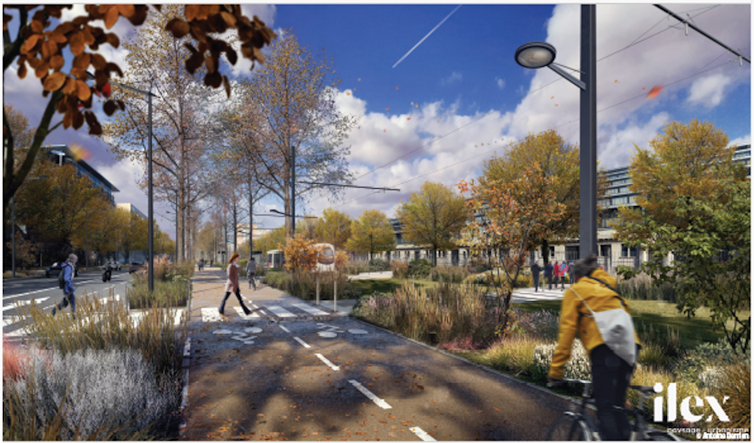
These transformative projects are part of ambitious environmental policies, such as the Canopée de la métropole plan, and respond to growing citizen demand for a healthier living environment.
But they are often to the detriment of other uses: narrowed traffic lanes, elimination of parking spaces, logistical slowdowns, implementation and maintenance costs.
These decisions raise the question of the use of public space and the social acceptability of urban greening projects.
Citizens ready to make compromises… under certain conditions
To better understand how residents make these trade-offs, we, as part of our study, assessed the social demand for urban greening from residents of the Greater Lyon metropolis.
In a survey based on what is called the choice experiment method, 500 respondents representative of the population of the metropolis were confronted with several greening scenarios around the tramway in their territory.
Each scenario included, at varying levels, four key parameters:
- reduction in temperatures during heatwaves,
- increased biodiversity (measured by the abundance of birds),
- reduction of space for traffic and parking,
- finally, an increase in local taxation.
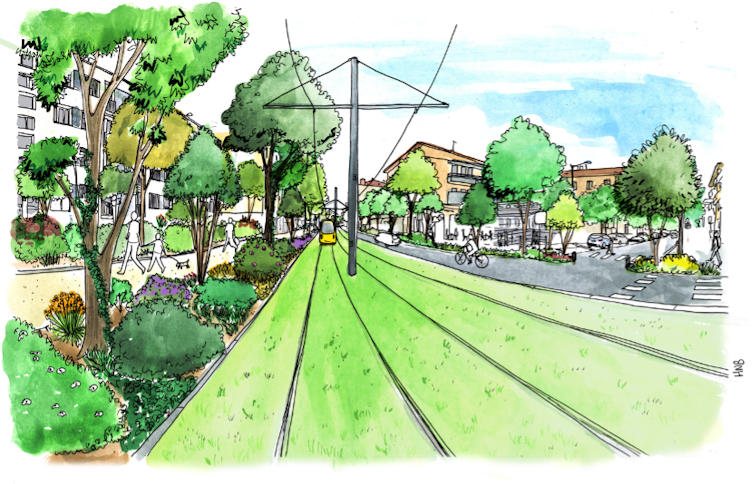
This study made it possible to estimate an average “willingness to pay” of respondents for different characteristics of greening in the city. This type of tool is valuable for guiding public policies, because it reveals citizen preferences for goods and services such as ecological services which do not have a market price.
Results: citizens ready to make compromises… under certain conditions.
On average, the residents surveyed are in favor of greening. They are prepared to pay €2.66 per month (in terms of local tax increases) for each degree of drop in temperatures and €0.49 for each biodiversity point gained (1% more birds). They favor scenarios that improve biodiversity and air freshening while minimally reducing space for cars.
However, they are clearly opposed to scenarios which more significantly reduce road space without sufficient environmental benefit.
Our analyzes also show a strong heterogeneity between respondents: city center residents, probably already faced with several traffic restrictions, are more critical as are the most advantaged households and daily car users.
Conversely, people with children or consuming products from organic farming – the latter being an indicator of environmental sensitivity – express increased support for urban greening projects.
Planting with citizens, not against them
Faced with the climate emergency, cities must adopt ambitious greening policies. But these solutions must also be socially acceptable.
Our study shows that the majority of Lyon residents would be ready to contribute to the financing of an urban greening project as long as it only moderately reduces the space available for cars. A solution that would not take up too much space, such as vertical planting, would therefore be relevant.
For local decision-makers, it is therefore appropriate to implement revegetation projects primarily in municipalities with a tree deficit. As highlighted by the results of our study, the acceptability of these projects requires involving citizens from their design and regularly measuring their impact. It is at this price that the cities of the future can be greener, more livable, and fairer.

With an unwavering passion for local news, Christopher leads our editorial team with integrity and dedication. With over 20 years’ experience, he is the backbone of Wouldsayso, ensuring that we stay true to our mission to inform.


