
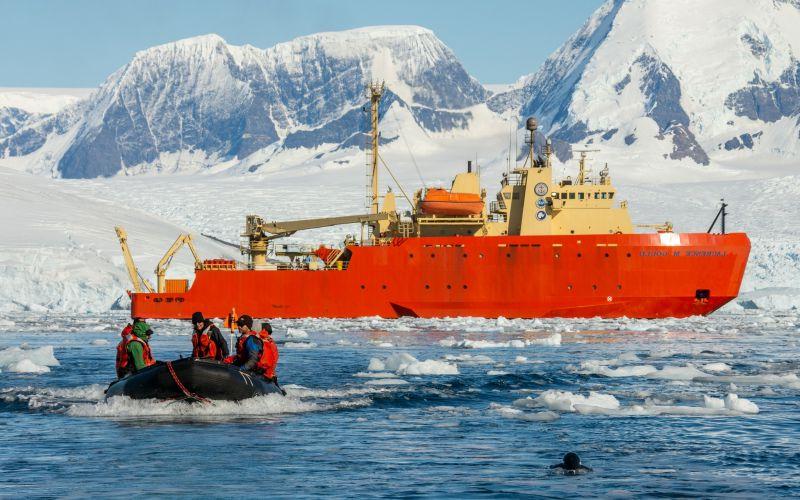
Antarctica is not a continent that one approaches lightly. Its hostility imposes extreme logistics, where each scientific advance depends on extraordinary material resources. In this frozen theater, the American presence has been based for three decades on a fleet designed to cut through the ice floes and transport research to places where no station can be set up. However, this fragile balance has just shifted. As research vessels disappear in Antarctica, an entire generation of studies, data and expertise risks being left behind.
A frozen continent where research is won by the strength of hulls
In the Southern Ocean, research is never done behind a screen. You have to face the terrain, which is often hostile. To collect data, explore glacial margins or probe currents, the ice must first be broken. This is what the ship Nathaniel B. Palmer has allowed since 1992. This 94 meter icebreaker led the way in the densest frozen areas. It made previously inaccessible regions accessible.
For geologist Julia Wellner, it changed everything during a mission to the Thwaites Glacier. This glacier is melting at such a rate that it could cause the oceans to rise by 60 centimeters. Thanks to the Palmer, his team was able to reach areas free of water, facing the glacial front, in order to discover unexpected sediment flows. This progress then made it possible to launch new study campaigns.
But this type of research cannot be done without a ship with extreme capabilities. Taking core samples from deep sediments, deploying autonomous underwater systems or aerial weather sensors requires a dedicated logistics platform, designed to withstand weeks of navigation in the ice. However, this capacity has just disappeared.

The gradual disappearance of research vessels in Antarctica sounds the alarm
In 2024, scientists had already suffered a first loss. The ship Laurence M. Gould, used since 1997 to connect Palmer Station to the South American continent, has been withdrawn from service. Then, at the end of the 2025 season, it was the Palmer itself which was decommissioned without a designated replacement. According to the Washington Post, this decision came without the National Science Foundation (NSF) proposing an immediate alternative. As a result, access to large research areas is suspended, and some vital projects risk being postponed indefinitely.
The 2026 NSF budget confirms the trend. Although support for the three scientific stations on the continent is maintained, funding allocated to maritime logistics is frozen, and no new generation ships are being built. The agency admits that development of a replacement has been “paused”, with a possible re-evaluation pushed back indefinitely.
Faced with this vacancy, temporary solutions have been found. Two ships from the American university fleet, the Sikuliaq and the Roger Revelle, will be redirected to carry out some missions in the Antarctic Peninsula. These vessels typically operate in other regions of the globe and are not designed for prolonged forays into thick ice. Their missions, planned to last only a few weeks, offer neither the robustness nor the versatility of old dedicated ships. “ It's not a replacement, just a bandage “, laments researcher Amy Leventer.
Scientific America weakened in the face of the growing ambitions of other powers
While the United States is reducing its maritime presence, other nations are advancing their pawns. China, South Korea, Japan, Australia and the United Kingdom have all invested in new ships capable of operating in the most extreme environments. These modern icebreakers not only carry out research missions, but also strengthen the strategic presence of their countries in a region about to become a new geopolitical chessboard.
Science is not the only one concerned. The absence of U.S. ships also means fewer opportunities for field training. Young polar researchers, who learn to handle instruments, manage environmental constraints and collaborate in extreme contexts, are thus seeing an irreplaceable educational tool disappear. An entire generation risks being deprived of this founding experience.
The issue goes beyond the sole domain of knowledge. It is the scientific influence of the United States which seems to be declining little by little. More than 170 experts from the polar regions have signed an open letter to warn of this lasting loss of capabilities. According to them, without a dedicated fleet, the United States is now struggling to keep up with the terrain. Collecting climate data, monitoring species or monitoring ecosystems are becoming more difficult. This fragility could therefore increase in the years to come.
Deprived of its research ships in Antarctica, America is allowing a gap to widen. Not in the ice, but in its ability to understand, monitor and influence one of the last wild territories on the planet.

With an unwavering passion for local news, Christopher leads our editorial team with integrity and dedication. With over 20 years’ experience, he is the backbone of Wouldsayso, ensuring that we stay true to our mission to inform.


