
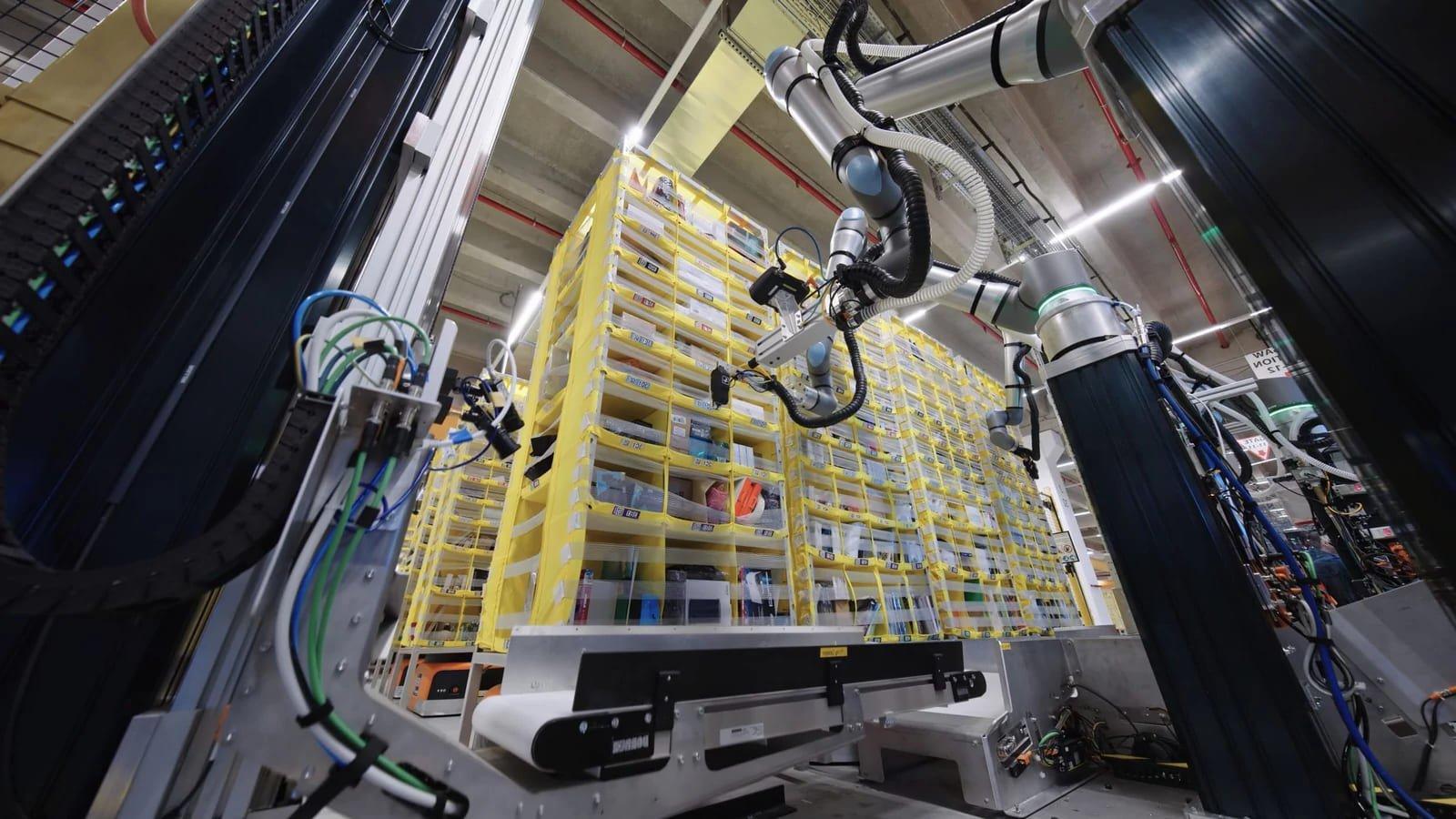
In the vast warehouses where millions of articles pass every day, precision and speed have become absolute priorities. It is at the heart of this logistical challenge that Vulcan, the latestbot of Amazon robots, appeared. Designed to adapt to the most expensive spaces and manipulate objects with unprecedented dexterity, Vulcan combines artificial intelligence, pressure sensors and stereoscopic vision to transform the current standards of automated handling.
Vulcan is not the first robot in Amazon distribution centers, but it marks a turning point. The robot enters approximately 75% of the articles stored, even in the most expensive spaces. It detects objects and adjusts the strength of its socket thanks to its sophisticated pressure sensors. This technical feat makes it possible to eliminate the most painful tasks, such as the recovery of parcels located in height, traditionally carried out using stepladder, a tedious and risky operation for employees.
Engineer Aaron Parness, director of sciences applied to Amazon and former NASA laboratory jet, explained to the rostrum that this robot embodies a real “robotic revolution”, capable of managing unique situations thanks to artificial intelligence and complex algorithms. Vulcan is thus the fruit of a decade of research in perception, computer vision and physical interactions in congested environments.

Between robotization and valuation of human skills
For over ten years, Amazon has been deploying robots in its warehouses massively. 750,000 units already manage 75% of orders, recalls Clubic. Unlike fears often expressed on the disappearance of jobs, the introduction of Vulcan is part of an assumed complementarity strategy.
According to Aaron Parness, automation does not target the total replacement of employees. On the contrary, robots such as Vulcan should allow operators to focus on higher added value missions, including supervision, maintenance and technical development of robotic systems.
New professions appear: maintenance technicians, robot operators, reliability engineers. These roles require specific skills that current employees can acquire thanks to Amazon internal training programs.
What future for Vulcan and tactile robotics in the industry?
Vulcan's design required new innovations. It has an articulated arm, a suction cup and an on -board camera to analyze and grasp objects with remarkable precision, according to the details reported by Le Figaro. The combination of a stereoscopic vision and strength sensors allows Vulcan to gently move fragile articles without damaging them.
This advance opens the way to new applications. The robot's ability to handle objects in complex environments could ultimately extend to other industrial sectors, or even to the delivery of the last kilometer. For the moment, Vulcan remains confined to controlled spaces, but Amazon plans a progressive deployment in the United States and Europe in the next two years.
Finally, continuous research to further improve vulcan: reduction of errors, detection of anomalies, standardization of manufacturing. An ambitious roadmap which confirms, according to the words of Aaron Parness, that the development of the sense of touch among robots is only in its infancy, with at least twenty years of upcoming innovation.


