
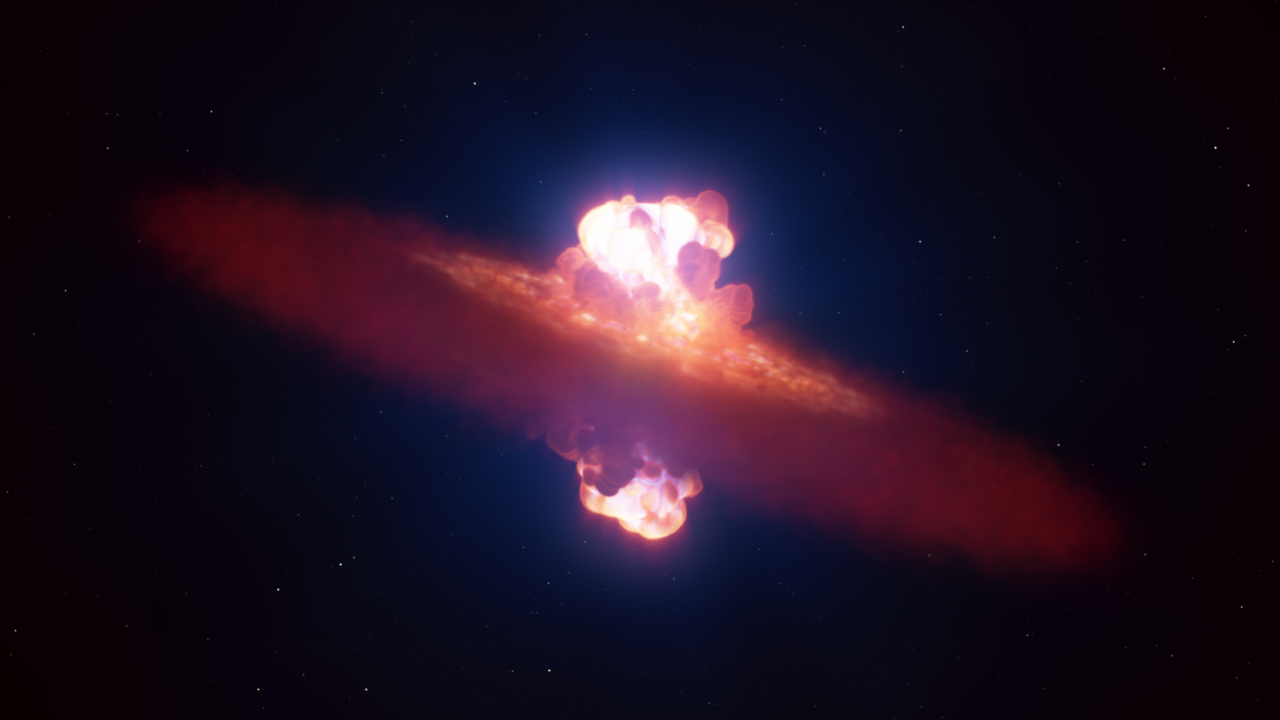

Understanding how massive stars die remains one of the concrete challenges of contemporary astrophysics. Although supernovae have been observed for decades, their exact dynamics, particularly during the first hours of the explosion, have until now eluded instruments. In April 2024, a rare event made it possible to fill this gap: the ultra-early detection of the supernova SN 2024ggi, just 22 million light years away, offered an unprecedented observation window on its initial geometry.
Thanks to the responsiveness of an international team led by Yi Yang (Tsinghua University, Beijing) and Dietrich Baade (European Southern Observatory), the Very Large Telescope was able to capture, for the first time, the real shape of a stellar explosion. Published in Science Advances, their analysis challenges standard models of supernova symmetry, revealing an unexpected elongated structure from the first hours of the event.
Flash detection for an ephemeral phenomenon
Supernovae remain among the most energetic events in the universe, but their observation in real time remains extremely rare. On April 10, 2024, the ATLAS system (Asteroid Terrestrial-impact Last Alert System), intended to monitor the sky to spot potentially dangerous objects, detected a new bright point in the spiral galaxy NGC 3621. It is SN 2024ggi, a type II supernova that appeared 22 million light years away, in the constellation Hydra. The observation window was particularly short. Just a few hours after the explosion, the shape of the expelled material already begins to interact with the surrounding environment. Which confuses the information on its initial configuration.
Astrophysicist Yi Yang, from Tsinghua University in Beijing, while traveling in the United States, immediately understood the opportunity. Less than 12 hours after the ATLAS alert, he submitted an urgent observation request to the ESO Very Large Telescope (VLT), located in Chile. Thanks to exceptional validation, the telescope is directing its FORS2 instrument towards SN 2024ggi from April 11, i.e. 26 hours after the initial detection. This speed was decisive. “ Without this coordinated chain reaction, we would have lost the only chance to capture the explosion in its breakthrough phase », Specifies Dietrich Baade, co-author, in an ESO press release. This lightning detection ushers in a new era of dynamic observation. The reaction speed becomes a key element for exploring transient phenomena in astrophysics.
An optical technique that reveals the invisible
The analysis of the supernova SN 2024ggi would not have been possible without a specific method: spectropolarimetry. This technique combines spectroscopy (study of the distribution of wavelengths of light) and polarimetry (measurement of the orientation of light vibrations). It makes it possible to obtain crucial information on the geometry of celestial objects. Even when they appear as a simple point of light, as with supernovae observed from Earth.
Normally, the light emitted by a star appears weakly polarized. In a perfectly spherical shape, the polarities cancel each other out. In contrast, sharp polarization indicates an asymmetry in the structure of the observed object or event. This is precisely what the researchers measured using the FORS2 instrument, the only one capable of carrying out such observations in the southern hemisphere.
The results were unequivocal. The light from SN 2024ggi showed non-zero polarization from the first hours. This means that the explosion was not spherical, but elongated along a well-defined axis. Astronomer Lifan Wang (Texas A&M University), co-author of the study, explains it. “ Even though the supernova cannot be resolved spatially, the light it emits tells us about the shape of the explosion. It is a unique window into the internal dynamics of a star at the end of its life “.
This result marks a world first. It proves that spectropolarimetry can not only confirm the asymmetry of a stellar explosion, but also measure it with great temporal and geometric precision. The ability to capture this polarization in such a short time made it possible to fix the initial morphology of the supernova, before any interaction with the stellar environment.
A structured explosion with massive origins
Unlike type Ia supernovae, which come from white dwarfs, type II supernovae come from the collapse of massive stars. In the case of SN 2024ggi, researchers identified a progenitor star 12 to 15 times the mass of the Sun, with an estimated radius of 500 solar radii. It was a red supergiant at the end of its life, a classic profile, but rarely captured so early in its terminal collapse.
When the core of such a star stops producing energy, the radiation pressure drops suddenly. Gravity then takes over, causing the core to collapse. In a few seconds, a shock wave forms by rebound effect, propelling the upper layers outwards. It is this wave that astronomers observed in real time. It crossed the stellar surface releasing colossal energy, visible through the polarization of light.
The initial shape of the explosion, described as an elongated ellipse, was confirmed by observations made up to the tenth day after the explosion. The outer layers, notably rich in hydrogen, continued to align along the same axis as the initial wave. This suggests that the asymmetric structure is not a secondary effect, but rather a fundamental feature of the explosion mechanism.
For Yi Yang, this spatial coherence indicates “ that an underlying physical process imposes large-scale directional symmetry “. This challenges classical models of isotropic collapse. Several hypotheses emerge: rapid rotation of the heart, intense magnetic fields or hydrodynamic instabilities. However, none of these mechanisms has been resolved. But this observation drastically reduces the possible scenarios, excluding those which predict perfect symmetry.
Towards a rewriting of stellar models
This discovery forces astrophysicists to review current theories on the dynamics of supernovae. Until now, many models assumed that the explosion remained globally isotropic, that is to say the same in all directions. The observation of SN 2024ggi, with its stable axis of symmetry and its marked asymmetry from the first hours, invalidates this hypothesis in the case of massive stars.
The implications are multiple. First, the directional shape of the explosion could have an impact on the distribution of chemical elements produced by the supernova. An asymmetry favors the concentration of certain heavy elements in specific directions. Which potentially modifies the enrichment of the interstellar medium. Then, this geometry would influence the birth of neutron stars or black holes, depending on the intensity and orientation of the central rebound.
Furthermore, the consistency of the phenomenon observed several days apart confirms that the asymmetry is not intended to be transitory. For researchers, this indicates the existence of an explosion mechanism common to massive stars, characterized by robust axial symmetry. “ It is a strong physical signature », underlines Dietrich Baade. “ We can look for it in other supernovae provided we observe them as early
“.
Finally, this observation demonstrates the effectiveness of responsive scientific collaboration on an international scale. The study brought together more than fifteen institutions, including ESO, Tsinghua University, Texas A&M, UC Berkeley, Weizmann Institute and several European universities. According to Ferdinando Patat of ESO, “ it is proof that science can cross borders in a few hours, to capture the secrets of rare but fundamental cosmic phenomena “.
Source: Yi Yang et al., “An axisymmetric shock breakout indicated by prompt polarized emission from the type II supernova 2024ggi”. Sci. Adv.11,eadx2925(2025).

With an unwavering passion for local news, Christopher leads our editorial team with integrity and dedication. With over 20 years’ experience, he is the backbone of Wouldsayso, ensuring that we stay true to our mission to inform.


