

It was 2011 when Armelle Jung, a trained biologist, created, with several legal and scientific colleagues and friends, Des Requins et des Hommes, an association which would act on an international scale for the research and conservation of so-called cartilaginous fish, 'that is, sharks and rays. Back in Brittany after more than a year of sailing expedition with her partner and two daughters, aboard Parsifal, a red Rêve d'Antilles model sailboat, which has proven itself through various navigations in the four corners of the world.
[Un article de The Conversation écrit par Gaël Le Croizier – Chargé de recherche en écologie trophique et écotoxicologie, Institut de recherche pour le développement (IRD)]
Initial research projects to assess the state of sawfish populations in West Africa and Indonesia have been initiated. After several months on site, Armelle realized that containers filled with rostra were being shipped to European or American territories. It turns out that in France and elsewhere, second-hand dealers collect these rostra and resell them. A first project to combat trafficking in protected species has been implemented. Within the limits of French jurisdiction, the association has since been fighting against the trafficking of these rostra, which has since been extended to other parts such as shark jaws and turtle shells, by working with the French Biodiversity Office. (OFB) and in collaboration with the legal network of France Nature Environnement (FNE), to file complaints against second-hand dealers, especially repeat offenders who have already been reminded of the law.

In 2013, Armelle collaborated with Colombian researchers on the project ColShark. For this project, thresher sharks (Alopias vulpinus) are marked with satellite tags, to better understand their use of space and thus adapt fishing methods in Colombian waters in order to limit accidental captures.
A complex environmental context
Technical advances in recent decades have also allowed an increase in fishing capacities, both in terms of distances traveled and times spent at sea as well as in catching capacities. This increase in fishing pressure has led to a significant decline in many marine species, including sharks and rays, as their overall abundance is estimated to have fallen by almost 70% in less than a year. century. It is now well known that these top predators, some of them, have a so-called “keystone” role in their respective ecosystems. This means that no other species can carry out their function in their place in the event of local or general extinction.
In this context, it is essential for the scientific community to continue to study ecosystems, both on a local and global scale, in order to be able to understand the resilience capacities of species and their environments. This will help adapt fisheries management according to environments and meet the future challenges of feeding human populations sustainably in the coming decades. Knowledge is the key to the management and rational exploitation of natural resources.
If certain knowledge can only be acquired through the use of methods heavy on fossil resources, others can be obtained by more sober means such as sailing. And that's where Parsifal comes in!
In search of the porbeagle shark!
The Parsifal is an amateur construction, a sailboat 11.8 m long. Purchased in Thailand more than 20 years ago, it has proven its robustness over the many trips it has already made. However, ten years on land took its toll: the hull was eaten away by rust, and the rudder, the submerged part of the rudder, was completely seized. It was necessary to renovate an engine and have a suitable propeller made. It took 3 years to restore this boat with the help of many volunteers.
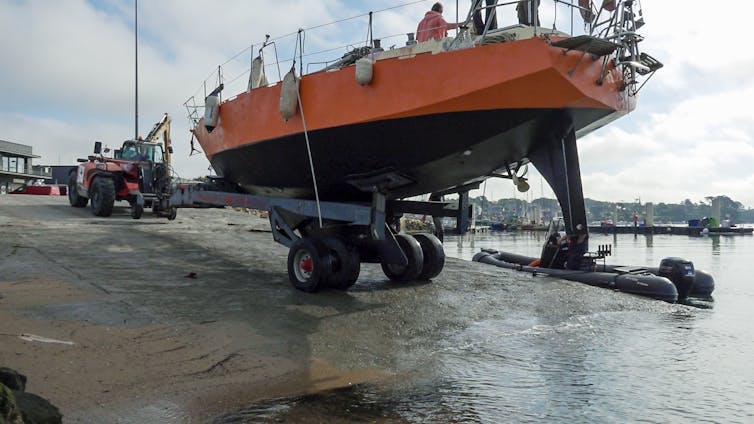
But since June 24, 2024, the Parsifal is afloat again, and has already been equipped with acoustic receivers, in partnership with InnovaSea, an Australian company, in order to detect organisms marked with acoustic transmitters by other research teams , and thus be able to transmit detection data to them. This is the first time that such a device has been attached to a sailboat hull!
The Parsifal will become a new study platform as part of Porbeagle, a project to study the porbeagle shark created in 2021 by Armelle as well as Arthur, Lucas and Paul, then students in marine biology. The objective is to understand the place of the Trégor area, in Côtes-d'Armor, in the ecology of the species, using non-invasive approaches. The protocol is relatively simple: get into the water with the animals, following a strict guide to reduce the impact on their behavior, and simply use cameras to collect as many images as possible of all the sharks' faces. . Using their individual marks, we can then identify individuals and have an estimate of the number of sharks present at the site each year and which ones return to the site from one year to the next.
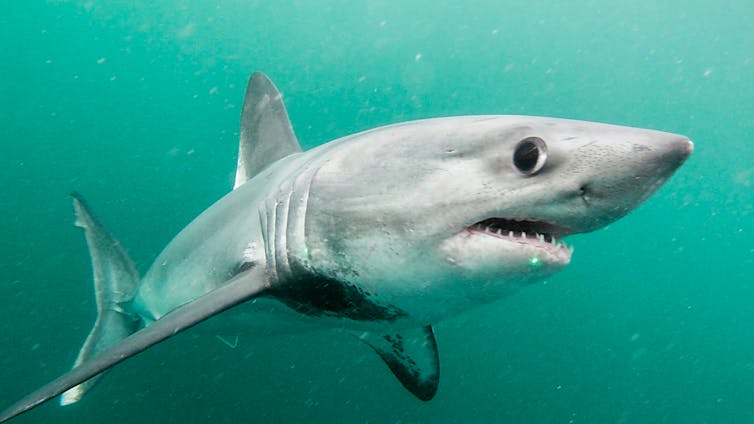
This project also allows the first behavioral study on this species, which was previously impossible: the porbeagle shark being particularly discreet, most observations were made in a targeted fishing context and it had almost never been approached in diving.
A first documentary is produced, Breizh Lamna, in search of the porbeagle shark. And three years after the start of the project, the first results are finally published. More than 130 sharks have been identified in the area in three years, only females, and it seems that the most mature of them return every year, the latest observations showing that some of them have been observed for five successive years .
A promise of scientific adventures low carbon
The Parsifal will allow us to explore other sites in order to extend the study area and continue to better understand this species. A sailboat allows you to stay at sea for a long time with an autonomy of several weeks or even months, and has a minimal impact on the environment, continuing the non-invasive aspect of the Porbeagle project.
At a time when sailing science is developing, the Parsifal is part of a new vision of oceanography, more eco-responsible, in a context of current climate change and global extinction of biodiversity.
Now that the Parsifal is in the water, the ambition is also to collaborate with other research teams. The association's philosophy is to work with researchers and local stakeholders on research and conservation projects all over the world. Recent collaborations with the Trinity College (Ireland) and InnovaSea are promising. This ship therefore promises to be the scene of scientific and human adventures, which we will share with the general public through web series and documentaries produced by the team's “mediaman”, Timon. Raising awareness among the general public is indeed a vital aspect of improving everyone's behavior and adopting a sustainable way of acting as much as possible, from daily life to scientific research.


With an unwavering passion for local news, Christopher leads our editorial team with integrity and dedication. With over 20 years’ experience, he is the backbone of Wouldsayso, ensuring that we stay true to our mission to inform.


