
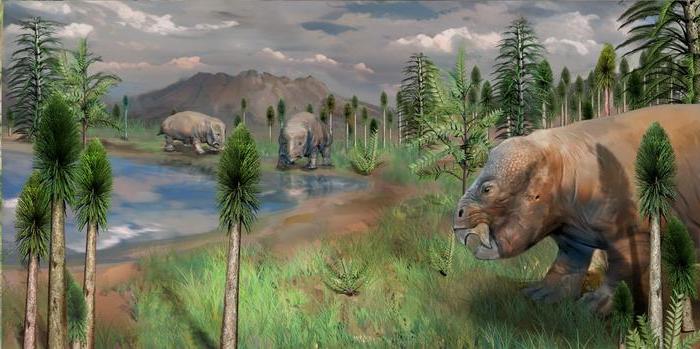

252 million years ago, the earth crossed the greatest mass extinction in its history, destroying more than 80% of marine species and radically transforming terrestrial ecosystems. For decades, scientists have considered this crisis as a total biodiversity collapse event. However, an unexpected discovery upsets this vision: in the Turpan-Hami basin, in China, an ecosystem resisted where everything seemed condemned. Protected by particular climatic conditions, dense vegetation has been maintained there, offering refuge to surviving species. This ecological resilience questions the natural mechanisms that allow life to last in the face of planetary disasters.
Unlike dominant theories, this area has not experienced a total collapse of earthly ecosystems. The researchers discovered that it served as a refugee, a sanctuary where the vegetation has continued. Fossils of pollens and spores, as well as trunks and rods of intact ferns, prove it. The vegetation has not been swept as elsewhere. This discovery changes understanding of extinctions. It shows that part of the terrestrial flora has survived and continued to evolve. Without major interruption, it offered a solid base to the reconstruction of biodiversity.
The research team, led by paleobotanists from the Nanjing Institute of Geology and Palaeontology, highlighted that this vegetation was very local and not from the sedimentary deposits transported from other regions. The study of these microfossils confirms that the flora of the Turpan-Hami basin remained in place throughout the duration of the extinction event and allowed a rapid return of terrestrial ecosystems.
Key factors of this ecological resilience
Far from being a simple coincidence, the survival of this ecosystem is based on several factors. Analysis of sediment and fossil pollen revealed key clues. A dating model, designed by researchers from the Missouri University of Science and Technology, made it possible to refine the results. It shows that this region has benefited from a stable climate throughout the extinction period.
The key factor in this resilience is the stability of the semi-humid climate. With around 1000 mm of rain per year, the Turpan-Hami basin has maintained dense vegetation. Other regions have undergone extreme droughts or acid rain, consequences of massive volcanic eruptions in Siberia. This constant humidity therefore protected plants and offered a refuge to survivor animal species.
Stable vegetation directly influenced local fauna. Less than 75,000 years after extinction, the region already had a wide variety of tetrapods. Among them, Lystrosaurus, a robust herbivore, prospered after the crisis. Alongside him, carnivores and chroniosuchians have found refuge in this ecosystem. Together, they formed a structured trophic network. This discovery contradicts the idea that the reconstruction of a complex ecosystem takes millions of years after mass extinction.
Paleontologists have also studied the influence of the Turpan-Hami basin, close to the Siberian volcanic areas. Unlike expectations, this proximity was not destructive. The geological characteristics have attenuated the impact of toxic ashes and acid rain. Thus, the region remained a protected enclave where biodiversity was able to survive.
A lesson for the preservation of current ecosystems
The discoveries made in the Turpan-Hami basin provide crucial lessons on the ability of ecosystems to resist extreme climatic and environmental disasters. The study, relayed by Eurekalert, highlights a key phenomenon: ecological resilience, that is to say the capacity of an environment to regenerate after a major crisis.
Today, many scientists alert to the risk of a sixth mass extinction, this time caused by human activity. The destruction of natural habitats, pollution and climate change threaten many species. Understanding how certain ecosystems of the past have survived major extinctions makes it possible to identify areas of resistance that could play a key role in the conservation of modern species.
The researchers say that geography and climate strongly influence the preservation of biodiversity. These local elements play a key role in the face of the global ecological crisis. Certain regions could thus become natural shelters against climate upheavals. Identifying and protecting them then becomes a priority. Preserving these sanctuaries could limit the effects of the current crisis. This approach would offer an additional chance to many endangered species.
By analyzing the conditions which allowed the survival of this ecosystem to permien, paleontologists thus offer a unique perspective on the strategies that nature can deploy to preserve life in the face of planetary disasters.

With an unwavering passion for local news, Christopher leads our editorial team with integrity and dedication. With over 20 years’ experience, he is the backbone of Wouldsayso, ensuring that we stay true to our mission to inform.


