
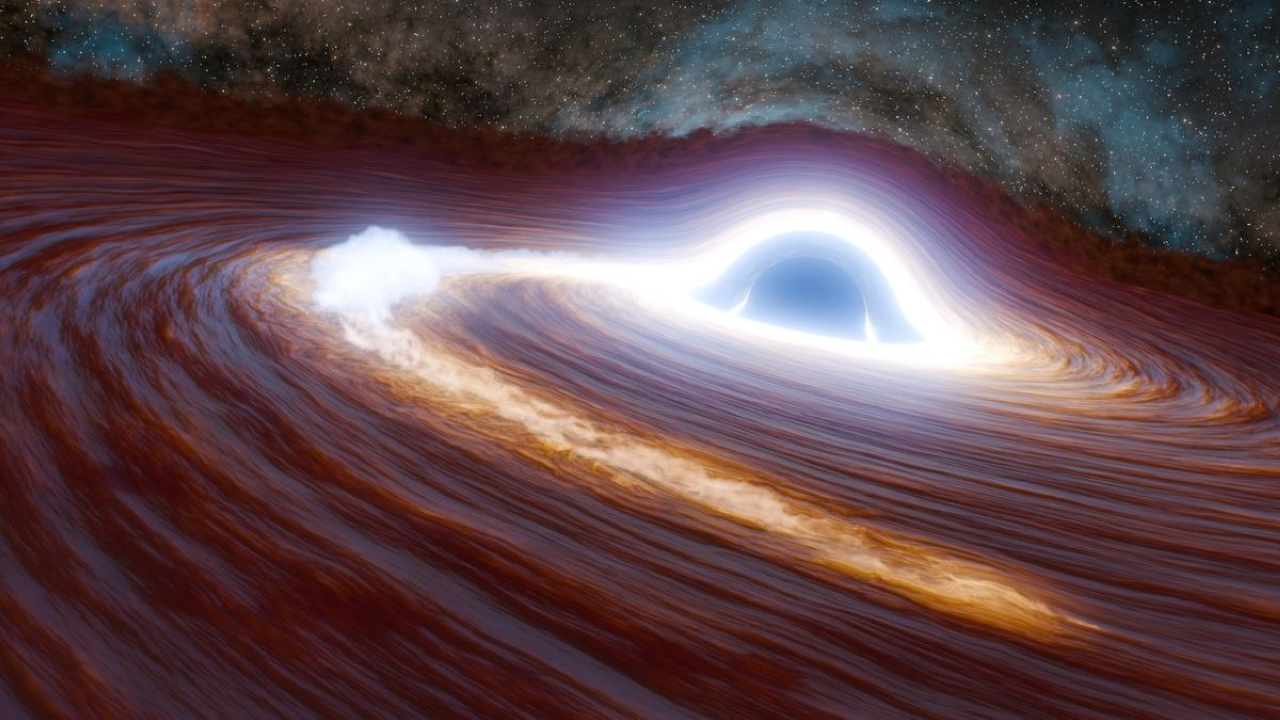

A black hole can spend centuries silently engulfing the matter around it, until an event of extreme violence changes its course. In 2018, a luminous phenomenon of unprecedented intensity was detected by the Zwicky Transient Facility, an astronomical observation program led by the California Institute of Technology (Caltech). After years of cross-analysis with other data from ground and space observatories, an international team of Researchers have confirmed the nature of this cosmic burst.
This is the most powerful burst ever recorded around a black hole, produced by the destruction of a giant star. The study, published in the journal Nature Astronomy, describes an energetic event equivalent to 10 trillion suns, observed in a galaxy 10 billion light years away. A rare discovery that redefines what we know about active galactic nuclei.
A burst of light of unprecedented proportions
The event observed in 2018 by the Zwicky Transient Facility (ZTF) was, at the time, nothing spectacular at first glance. It was an abnormally bright point of light, designated J2245+3743, located in a very distant galaxy. It was only in 2023, during a re-evaluation of old data, that astrophysicists realized the extent of the phenomenon. The source is about 10 billion light years away. Its glow was 30 times brighter than any other known black hole burst, including the event dubbed Scary Barbieyet considered until now as a reference.
At its maximum, this eruption emitted an energy estimated at 10⁵⁴ ergs, the equivalent of converting the entire mass of the Sun into energy, according to the formula E=mc². This was emphasized by KE Saavik Ford, an astrophysicist at the City University of New York, in a press release. She recalled that “
this quantity of energy corresponds to the complete transformation of our Sun into light “.
This type of burst is linked to a supermassive black hole, here estimated at 500 million solar masses, located in the active core of a galaxy. The observation was confirmed by several instruments, including the Keck telescope in Hawaii and infrared data from NASA's WISE mission. These tools made it possible to rule out other possible explanations, notably a supernova or a jet oriented towards Earth. The magnitude of the burst could only have come from an event of extreme gravitational violence.
A giant star broken up by a supermassive black hole
Scientists have identified the most likely cause of the phenomenon: a “tidal disruption event» (TDE), or gravitational disruption event. This process occurs when a star gets too close to a black hole and is torn apart by its tidal forces. It's not an instant process. The star gradually disintegrates, its fragments falling into the black hole. They then produce an immense quantity of energy in the form of light radiation.
In the case of J2245+3743, the victim was no ordinary star. It would have had a mass at least 30 times greater than that of the Sun. Which makes it one of the most massive ever involved in a TDE. For comparison, the star involved in the event Scary Barbie was estimated between 3 and 10 solar masses. The giant star of J2245+3743 is thought to have evolved inside the black hole's accretion disk — a matter-rich region that surrounds certain active galactic nuclei (AGN).
According to KE Saavik Fordthis could explain its unusual size. “ Stars within an AGN's disk can accumulate mass by absorbing surrounding matter. As if they were feeding on gas from the disc “. This type of stellar growth remains rare, but not impossible, especially in extreme environments like AGN. Continued observation of the burst shows that the breakup of the star is not yet complete. The black hole still engulfs him.
An event stretched in time by cosmic expansion
One of the most fascinating features of the J2245+3743 event is its apparent duration. Observed for more than seven years from Earth, the burst still does not show a return to its initial level. This slowdown is explained by a physical effect well known in cosmology: time dilation. In an expanding Universe, light from very distant objects undergoes a lengthening of its wavelength, but also a temporal stretching.
In other words, a phenomenon that occurs in a very remote region of space will appear to unfold more slowly to an observer on Earth. “ Seven years here is two years there “, explains Matthew Graham, researcher at Caltech. “
We watch the event unfold at reduced speed, like cosmic slow motion “. This phenomenon has concrete implications for the interpretation of observational data.
In this case, it allowed researchers to track the burst over an extended period, providing a detailed view of its progression. An observation impossible without the continuous monitoring campaigns of the ZTF, which has been examining the night sky for more than seven years. The data collected not only makes it possible to identify light variations, but also to model the physics of the TDE. Thanks to time dilation, scientists can deconstruct the successive phases of the interaction between the star and the black hole.
A window into the hidden activity of active galactic nuclei
Active galactic nuclei (AGN) constitute central regions of galaxies hosting supermassive black holes in the accretion phase. They emit a large quantity of energy, particularly in the visible, X-rays and ultraviolet. This intense activity can, however, mask other phenomena, such as TDEs, by drowning them in their permanent luminosity. This is what makes the J2245+3743 event so unique. It produced in an active AGN, but its intensity made it detectable despite this bright background.
According to Matthew Graham, this event suggests that “ similar phenomena probably take place in other AGNs. But they go unnoticed because of the shine of the accretion disk “. This opens a new perspective in the study of active black holes. Some exceptional bursts could be buried in the data, misclassified or ignored.
This discovery results from the joint efforts of several instruments. In addition to the ZTF, the researchers used the 200-inch Hale telescope for the first spectral observations, then the WM Keck Observatory for more detailed analyzes in 2023. The data from the WISE mission made it possible to rule out a beaming effect (light beam directed towards the Earth) which could have distorted the interpretation.
The researchers now want to re-examine old records in light of this discovery. The upcoming Vera C. Rubin Observatory could detect other TDEs of this magnitude. The objective is clear: to understand how often these extreme phenomena occur and to refine the modeling of AGN, which play a central role in the evolution of galaxies.
Source: Graham, MJ, McKernan, B., Ford, KES et al. “An extremely luminous flare recorded from a supermassive black hole”. Nat Astron (2025).

With an unwavering passion for local news, Christopher leads our editorial team with integrity and dedication. With over 20 years’ experience, he is the backbone of Wouldsayso, ensuring that we stay true to our mission to inform.


