
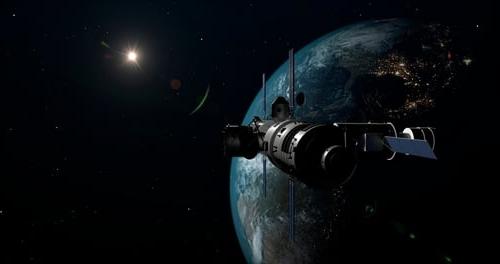
The spatial mission Pharao, which must take off on April 21, 2025, is one of these efforts. Its atomic clock will measure time very precisely, to compare how it flows on the surface of the earth and at the altitude of the international space station.
[Article issu de The Conversation, écrit par, Didier Massonnet Chef de projet Pharao, Centre national d’études spatiales (CNES) et Martin Boutelier, Centre national d’études spatiales (CNES)]
Seventy years after the disappearance of Albert Einstein, his theory of general relativity is one of the two fundamental pillars on which science is based to explain the universe. The successes of this theory are numerous and it has been largely verified, in particular applied to the infinitely large.
His big defect? It is not compatible with the other fundamental pillar on which physics is based, quantum theory of fields, otherwise called quantum mechanics. So how do you reconcile these two theories? What changes should be made to make them compatible? Is there a new unknown physique that could arise from this incompatibility?
To progress on these questions, it is essential to verify the two current theories at ever more precise levels, in order to identify possible deviations which could lead to retouching them at the margin, with the hope that these retouching open the way to compatibility between them, even towards a theory encompassing the two.
An atomic clock in space to verify general relativity
Such verification experience will be launched to the International Space Station (ISS) on April 21. This experience, called Aces (Atomic Clock Ensemble In Space), is led under the aegis of ESA, the European space agency. The main element is an atomic clock of exceptional precision, called Pharao and developed by the French space agency, the CNES.
The objective is to measure with unequaled precision a strange prediction of general relativity: the mass of an object modifies the flow of time around him. The closer you are to this mass or the greater the mass, the more slowly the time flows. This prediction reaches its climax at the limit of black holes, where time … stops!
For our little land, this effect is less spectacular: 400 kilometers above sea level, the altitude of the ISS, an astronaut ages faster than its twin that has remained on the ground of a second every 300 years. At the altitude of satellite positioning systems (Galileo, GPS, Beidou and Glonass fly more than 20,000 kilometers above altitude), this effect is more important. If it was not corrected, the positioning accuracy of these systems would be degraded.
Pharao's objective is to measure this very low slowdown with unequaled precision. To do this, our clock must not be mistaken by more than a second in 300 million years, a drift of 2 tenths of a second since the disappearance of dinosaurs; Or in an equivalent way, less than a minute from the Big Bang, the beginning of time! Translated in terms of distances, this would amount to measuring a light year to the nearest meter …

To be able to verify that Pharao beats the time slower in space than on earth, you have to be able to compare it very precisely to clocks that have remained on the ground. For this, it is accompanied by two systems responsible for this comparison: a microwave which makes it possible to communicate time to the ground when the ISS flies over a metrological laboratory housing an atomic clock, as well as a laser link allowing to define “tops” of synchronization between the soil and the space.
The Pharao clock is a very exact but also very complex clock that needs time to get its ultimate precision. To fulfill this mission, it is supported by two other clocks, less accurate but allowing to initiate and keep time. On the one hand, an ultra stable quartz oscillator is integrated into Pharao and allows you to roughly initialize your time, allowing it to question atoms with a frequency already close to their reference frequency.
On the other hand, a Masser using the hydrogen atom (an atomic clock of another type), maintains the time reference during the adjustment phases. The effect of these settings can then be measured in relation to this reference.
An atomic clock on the international space station
Pharao will fly hanging outside the ISS, on a balcony of the European Colombus module. Even if the years of the ISS are now counted with an out of service followed by an evidence envisaged for 2030, Pharao will have time to fulfill its objectives.
Installing this clock aboard the ISS has advantages and disadvantages: among the advantages, there are frequent transport opportunities, moderate radiation levels, proven control and communication services as well as positioning, attitude, heating/cooling and power supply.
Among the drawbacks, we find the fact that the ISS flies in the end quite low … If Aces had been placed on a geostationary orbit (36,000 kilometers from the Earth surface), the general relativity effect would be twelve times more marked, improving the precision obtained with the same clock. In addition, the proximity of astronauts can disrupt the experience, especially because of the vibrations of their muscle training machines.
Ever more precise atomic clocks
Since their invention in the 1950s, atomic clocks have experienced a rate of improvement comparable to that of electronic systems (the famous “Moore law”).
Their principle is to settle on one of the many frequencies specific to an atom and which reflect its state of excitement, a universal signal. Depending on the energy of the chosen vibration, the clock can be in the radio (10 giga hertz), optics (visible and infrared), even “nuclear” (distant ultraviolet).
The lower frequencies of radio clocks are the easiest to master and the official definition of the second (1967) is based on a vibration of the electrons of the cesium atom in the radio field. In recent years, clocks in the optical field, more efficient, have appeared and have been available on the ground. Their complexity still makes them difficult to send in space. Finally, promising results were obtained by questioning vibrations of the nucleus of an atom, perhaps prefiguring even more efficient “nuclear clocks”.
The Pharao clock is based on a decisive improvement in radio clocks, obtained by the use of atoms cooled by laser. This laser cooling technique notably earned the Nobel Prize to the French physicist Claude Cohen-Tannoudji in 1997. The atoms thus cooled to a millionth of absolute degree have very low residual speeds. Coupled with a microgravity environment, significant auscultation times are obtained, a key parameter of clock performance. The ground clocks that implement this principle are called “atomic fountains”.
In order to preserve the cold atoms of any interaction with other atoms, a very advanced vacuum, known as “ultravide” must reign in the center of the Pharao clock. This vacuum is 1000 times better than the space environment around the ISS. Only metals or glasses can be used for the elements of the cavity and the joints which bind them between them, any other material such as rubber or plastics evaporates in the void (degassing phenomenon) making it impossible to obtain an ultravid. The design of the ultravid cavity was therefore particularly complex, in particular because of the joints between silicious portholes and titanium parts (two materials whose waterproof contact is difficult) or even waterproofing of steel joints.
By measuring the effect of gravitation on the flow of time, Pharao is capable of detecting tiny variations in the gravitational potential equivalent to a change in altitude of 1 meter. The latest optical clocks on the ground, even more precise, can detect a change in the gravitational potential equivalent to a variation of one centimeter.
At this level of precision, such changes can be linked not only to variations in the altitude of the clock, but also to variations in the distribution of the masses on the surface and inside the earth: movement of the water tables, internal movements of the earth, movement of the air masses … It is the domain of “chronometric geodesia”.
We bet that, in the not so distant future, clocks even more efficient than Pharao, connected and compared to a reference clock placed in space, could well measure almost everything … except time!


With an unwavering passion for local news, Christopher leads our editorial team with integrity and dedication. With over 20 years’ experience, he is the backbone of Wouldsayso, ensuring that we stay true to our mission to inform.


