
Beneath layers of forgotten sediments, the Cueva de Mono cave, in the Dominican Republic, has provided rare testimony to the interactions between extinct species. By analyzing fossilized remains of Caribbean rodents, an international team has uncovered a unique behavior in prehistoric bees: the use of bone cavities as nesting sites. This phenomenon, never documented before, reveals how certain insects were able to adapt their reproductive strategy in the face of a particularly restrictive environment.
The study, carried out by researchers from the Field Museum of Natural History in Chicago and the University of Florida, was published in early December in the journal Proceedings of the Royal Society B. Through the analysis of fossil traces preserved in bones, it sheds new light on the effects of ecological pressure on the evolution of animal behavior, well beyond what modern biology had envisaged.
An accumulation of animal remains at the origin of a unique fossil site
The Cueva de Mono Cave, located in the south of the Dominican Republic, has an exceptional concentration of skeletal remains of small vertebrates. These accumulations, analyzed by the team led by paleobiologist Lazaro Viñola Lopez (Field Museum, Chicago), mainly result from the predatory activity of Tyto ostologaa now extinct giant barn owl. This species, endemic to the island of Hispaniola, used the cave as a nesting and feeding site.
Researchers have identified thousands of bones, mainly from hutias, large island rodents related to beavers. The remains accumulated over several generations, in the form of partially consumed carcasses or balls of rejects rich in fragmented bones. The cave thus functioned as a natural “taphonomic trap”. A site where predation behaviors, biological cycles and geological deposits combine.
This particular configuration favored the three-dimensional preservation of numerous bones, with little subsequent disturbance. The researchers emphasize the absence of major water transport or significant erosion. Conditions often responsible for the dispersion or degradation of fossils. Here, the bones remained relatively intact, sometimes still articulated, which constitutes a rare context in paleontology.
Bone cavities transformed into nesting chambers by bees
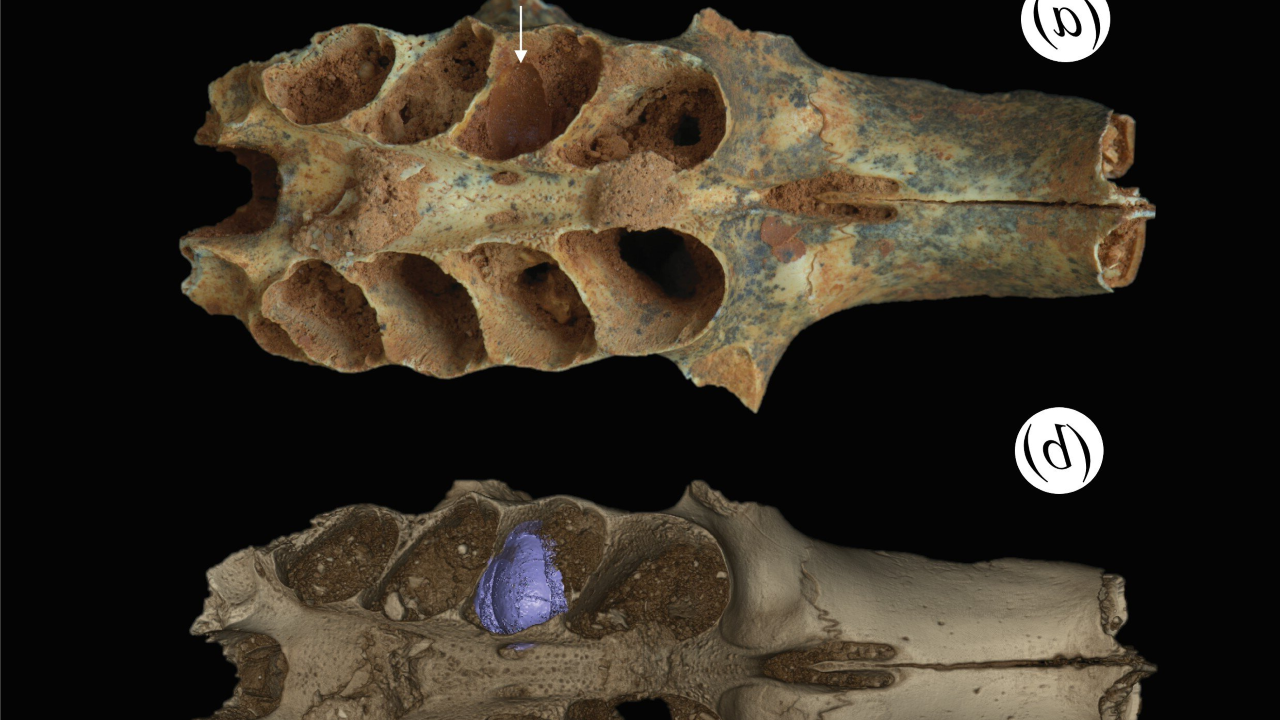
Among the fossil remains exhumed, researchers have therefore identified a phenomenon never observed before. Smooth, well-defined cavities inside animal bones, including tooth sockets, vertebrae, and sloth tooth cavities. These structures were not natural, nor the result of classical taphonomic processes. They showed clear signs of secondary biological modification.
These cavities are actually nesting cells left behind by extinct burrowing bees. The authors named them Osnidum almontei. The majority of bees dig tunnels in soft soil. However, this species exploited the cavities already present in fossilized bones, a completely new strategy in the fossil record.
The researchers confirmed this interpretation thanks to several converging elements. The internal surfaces of the cavities showed a smooth, uniform texture, typical of honeycombs covered with protective secretions. This waxy layer allows the chamber to resist humidity and microorganisms. Additionally, it leaves a distinctive imprint in the host material. No evidence of active drilling was observed. The bees did not dig into the bone, they only used the spaces already available.
Computed tomography (CT) scans revealed superimposed structures. Some cavities contained up to six stacked nest cells. This stratification proves that multiple generations of bees used the same cavities over time, a phenomenon rarely documented even in current species. This chronological series organization reinforces the idea of stable and structured reproductive behavior, motivated by specific environmental constraints.
Extreme ecological conditions as a driver of behavioral innovation
The unexpected behavior of Osnidum almontei
can be explained by very specific local ecological conditions. In the Cueva de Mono region, the soil remains mainly composed of karst limestone, formed by the erosion of soluble rock. This type of land is poor in fine soil, unstable, and unsuitable for tunneling by burrowing insects. It offers few opportunities for bees to establish their classic nests in the ground.
In this context, the protected cavities inside the bones represented a valuable alternative. By using them as nesting chambers, these bees have circumvented the geological limitations of their habitat. This behavior, dictated by constraint more than by preference, illustrates a case of opportunistic behavioral adaptation in the face of environmental stress.
“ The surrounding karst is extremely poor in usable soil. And fossil cavities were probably one of the only viable options for reproduction », Explains Mitchell Riegler, co-author, in a press release. He points out that this behavior could be more widespread than we think. But it is rarely detected due to the lack of adequate conservation in other regions.
This case study highlights the direct influence of the geological context on the evolution of animal behavior. It also questions the resilience capacities of species in the face of major environmental changes.
Rare but valuable fossil traces for paleobiology
The structures left by Osnidum almontei
constitute ichnofossils. That is to say traces of behavior frozen in time. These indirect fossils allow paleontologists to infer biological interactions that the bones themselves do not reveal.
In this case, the ichnofossils show the interaction between at least three trophic levels: predatory owls, accumulated prey, and insects reusing the remains. This superposition of biological activities is valuable for reconstructing a vanished ecosystem in its complexity. It goes beyond the simple observation of the species present at a given time. It reveals how they lived, reproduced, and interacted with their environment.
 © Jorge Mario Macho, Machuky Paleoart.
An illustration showing the bones and bees' nests in the cave.
The absence of degradation of the internal structures and the precision of the deposits have allowed exceptional conservation of these ichnofossils. Each filled cavity corresponds to a developing bee cell, and some even preserve the internal layers of the waxy walls, visible in section thanks to medical imaging analyses.
For science, these discoveries provide unique documentation of insect behaviors that are now extinct. They open the way to a new approach to paleoecology. No longer focused solely on extinct species, but also on their actions, their strategies, and their ability to adapt.
Source: Lázaro W. Viñola-López et al., “Trace fossils within mammal remains reveal novel bee nesting behavior”. Royal Society Open Science (2025).

With an unwavering passion for local news, Christopher leads our editorial team with integrity and dedication. With over 20 years’ experience, he is the backbone of Wouldsayso, ensuring that we stay true to our mission to inform.


