
Ancient history often has its eyes fixed on the men of power, leaving in the shadows those who nevertheless shaped their era. In the jungles of Yucatán, among the remains eroded by time, certain feminine names still escape official accounts. It took fourteen centuries for a forgotten Mayan queen to resurface, engraved in the stone of a monument that no one had thought to look at so closely.
An unexpected discovery under the steps of Nohoch Mul
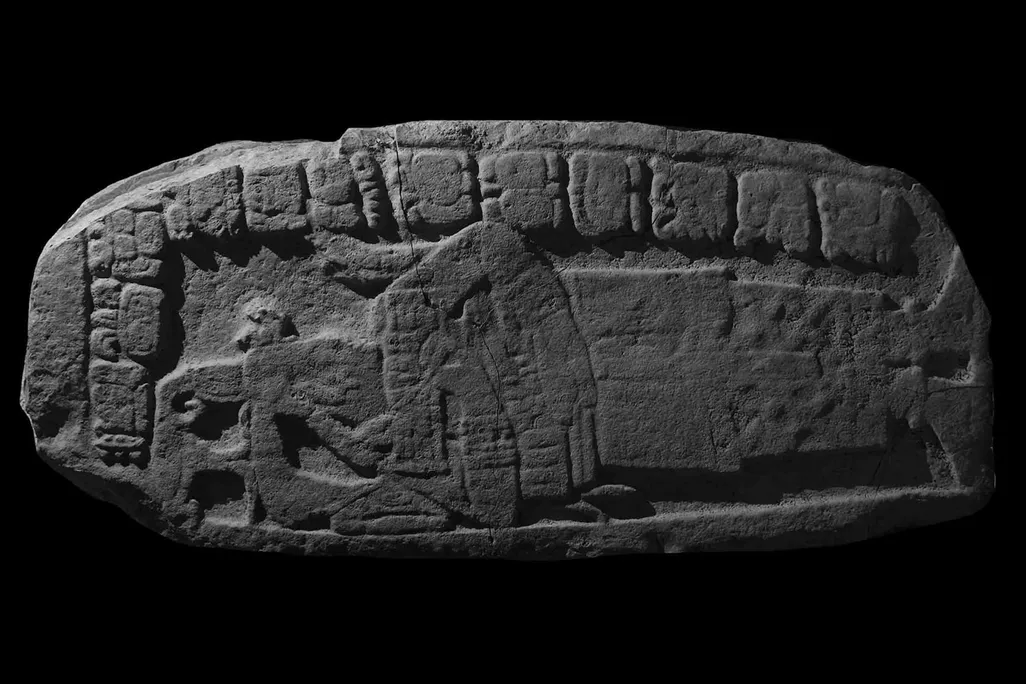
In the heart of the Yucatán Peninsula, the ruins of Cobá were until recently renowned for their network of paved roads and their monumental pyramids. In 2024, a simple, partially buried walk revealed the existence of one of the most complex hieroglyphic texts ever discovered in the region. Named “Roca de la Fundación”, this limestone slab measuring 4 by 3 meters presented 123 glyphs engraved on 12 columns and 13 rows, barely visible under the salt concretions and the ravages of time.
Protected by INAH teams, the monument required exceptional conservation treatment, including injections of lime mortar to fill the cells formed by the roots and the acidity of the soil. This initiative, carried out as part of the Promeza program linked to the construction of the Maya Train, made it possible to stabilize the stone, extract a precise 3D model and begin a partial reading of the text.
The analysis of the Roca de la Fundación was accompanied by a comparative study of steles found in the surroundings of Cobá. Among them, steles 26 and 30 as well as panel no. 7 mention a previously unknown name. According to Smithsonian Magazine, it is that of a woman who ruled the city in the 6th century.
 © INAH / Octavio Esparza
Mayan inscriptions engraved on the “Roca de la Fundación” in Cobá.
Ix Ch'ak Ch'een, a forgotten Mayan queen who asserted her sovereignty
The name of Ix Ch'ak Ch'een appears in several inscriptions engraved between 569 and 573. One of them mentions that the leaders of Cobá established the title of kaloomte' (lord of lords) on May 12, 569. This rank, which the kings of Teotihuacan and the lords of Kaanuʼl already employed, directly associated military power and supreme political authority. The Roca de la Fundación suggests that Ix Ch'ak Ch'een received this investiture shortly after, at a time when the city was redeploying its dynastic power.
Another inscription, dated December 8, 573, mentions his role in the construction of a ball court, a symbol of political renewal and cosmic legitimacy in Mayan tradition. Although the spellings of her name vary from one medium to another, the concordant dates and events have allowed epigraphists David Stuart and Octavio Esparza Olguín to confirm that it is the same and unique sovereign.
The influence of Ix Ch'ak Ch'een undoubtedly went beyond the limits of Cobá. Indeed, the Roca de la Fundación mentions other protective figures, such as Bolon Tz'akab Ajaw. This god seems linked to the symbolic birth of the city. Thus, the link between political power and divine forces seems obvious. It reinforces the idea that the queen had a strong and thoughtful dynastic project.
The Kaanuʻl empire and the queens on the fringes of hegemony
If Ix Ch'ak Ch'een was not the initiator of the Cobá dynasty, she seems to have consolidated her influence at a crucial moment. INAH specialists even assume a link with Testigo Cielo, ruler of the powerful Kaanuʻl entity. This link remains hypothetical, due to a lack of explicit cross-references, but the dynamics of the time reinforce this possibility.
Throughout the Mayan world, the kingdom of Kaanuʻl (whose origins date back at least to the beginning of the 5th century according to the study published in Ancient Mesoamerica) extended its authority over a large part of the Lowlands for two centuries. Cobá, then in full rise in power, seems to have participated in this game of alliances and vassalizations, in particular via interdynastic marriages involving noble women.
The recognition of Ix Ch'ak Ch'een as a sovereign in her own right puts into perspective the historical invisibilization of female figures in archaeological memory. As Artnet points out, several queens exercised an active political role in the 6th and 7th centuries, but many remain anonymous or confused with ritual decorum.
Thanks to this discovery and the cross-analysis of other inscriptions at Cobá, a forgotten figure emerges from the shadow of the eroded stones. And with it, the testimony of a feminine power that was just waiting to be rewritten.

With an unwavering passion for local news, Christopher leads our editorial team with integrity and dedication. With over 20 years’ experience, he is the backbone of Wouldsayso, ensuring that we stay true to our mission to inform.


