
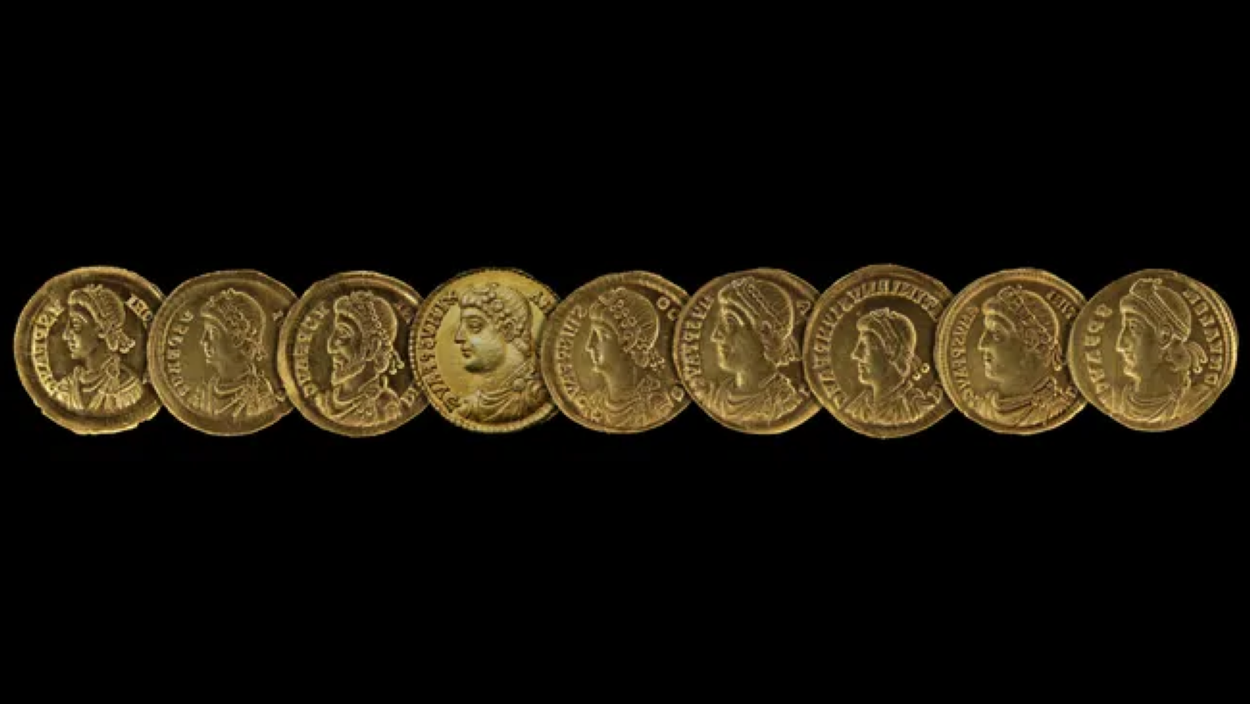
European archeology regularly offers crucial discoveries for understanding the transformations of Late Antiquity. Among them, the recent unearthing of 141 Roman gold coins in Luxembourg sheds light on the political, economic and religious dynamics of the end of the Western Roman Empire. Supervised by the National Institute of Archaeological Research (INRA) of Luxembourg, this excavation reveals not only monetary practices, but also clues about the tensions between pagan traditions and emerging Christianity.
Why such discreet searches?
Between 2020 and 2024, an archaeological mission of exceptional scale took place in the north of Luxembourg. The “secret” nature of the excavations carried out at Holzthum is explained by security and conservation requirements. Located in an area still marked by the dangers linked to the presence of munitions and explosives dating from the Second World War, the site required prior mine clearance operations supervised by the Luxembourg Army Mine Clearance Service (SEDAL).
Furthermore, the exceptional potential of this archaeological discovery required total discretion in order to protect the site against the risks of looting or unauthorized interventions, which could have compromised the integrity of the artifacts. Finally, the objective of guaranteeing a rigorous and exhaustive scientific study before any public disclosure led the researchers to maintain strict confidentiality throughout the four years of excavation.
A unique ancient site, a treasure trove of coins
The team of archaeologists was therefore able to explore the foundations of a burgus in detail. It is a watchtower dating from the Late Roman Empire. This type of structure, located on the northern limits of the Empire, was used to monitor border movements. It unequivocally testifies to Roman efforts to secure strategic areas against barbarian incursions.

One of three gold coins depicting Emperor Eugene. © C. Nosbusch/INRA
Among the discoveries, the monetary hoard is particularly notable. The 141 gold coins, called solidi, are minted with the effigy of nine Roman emperors who reigned between 364 and 408 AD. For archaeologists, they embody the prosperity and monetary organization of the Late Empire. These coins weigh approximately 4.5 grams each. They were used throughout the Mediterranean basin as a reliable means of exchange thanks to their homogeneous gold content. Their excellent state of conservation, coupled with the rarity of certain examples, offers researchers a unique opportunity to analyze the economic flows, financial practices and political strategies of the period, thus revealing still poorly understood dynamics of the late the Roman Empire.
Eugenius, a little-known and controversial emperor
Among this treasure, three gold coins struck with the effigy of Eugenius particularly attract the attention of specialists. This ephemeral emperor is often described as “illegitimate”. He embodies the political and religious upheavals which shook the Western Roman Empire at the end of the 4th century. Proclaimed emperor in 392 AD by the Frankish general Arbogast, Eugenius came to power in a troubled context marked by the mysterious death of Valentinian II, his predecessor. His reign, although short, was part of a period of growing tensions between supporters of ancient pagan traditions and an elite increasingly converted to Christianity.
Eugenius, an atypical figure, sought to restore pagan rites by promoting in particular the rehabilitation of temples and traditional cults. These initiatives violently clashed with the ambitions of Theodosius I. He was the Eastern Emperor and fervent defender of Christianity. The rivalry between the two men culminated in the decisive Battle of Frigidus in 394. Eugenius was defeated and executed. The extreme rarity of coins struck with his image certainly reflects the brevity of his reign. But it also proves the voluntary erasure of his memory by the Christian victors. These pieces offer today a precious testimony to a time when imperial legitimacy was contested as much on the battlefields as in the religious domain.
A wealth of heritage and science thanks to the 141 pieces
In accordance with legislation relating to cultural heritage, the State has compensated the rights holders of this deposit. The 141 gold coins discovered therefore have an estimated value of 308,600 euros. A sum which testifies to the wealth and economic organization of the last decades of the Western Roman Empire. As for their burial, researchers put forward several hypotheses. These pieces may have been hidden for protection during political or military unrest, a common scenario in border regions exposed to barbarian incursions. This thesis, reinforced by the presence of a burgus on the site, underlines the instability which reigned during this period of decline.

The place of discovery of the treasure in Luxembourg. © INRA
This discovery has an importance that goes beyond the simple numismatic aspect. It is part of a scientific approach aimed at better understanding the social, military and economic dynamics which marked the fall of the Roman Empire. Currencies reflect not only political structures, but also tensions between imperial centralization and external pressures. “ It will still take some time to process the excavations and discoveries “, declared the Luxembourg Minister of Culture, Eric Thill, in a parliamentary declaration. He adds: “ But it will undoubtedly increase our knowledge and understanding of the last century of the Roman Empire in the West », where the Empire tried to maintain its authority in the face of profound changes. These pieces, true witnesses of history, provide keys to decipher the mechanisms which led to the transformation of the ancient world into medieval Europe.
Source: INRA

With an unwavering passion for local news, Christopher leads our editorial team with integrity and dedication. With over 20 years’ experience, he is the backbone of Wouldsayso, ensuring that we stay true to our mission to inform.


